DbcultAccessing Vault...
6.1/10
Senior Film Conservator
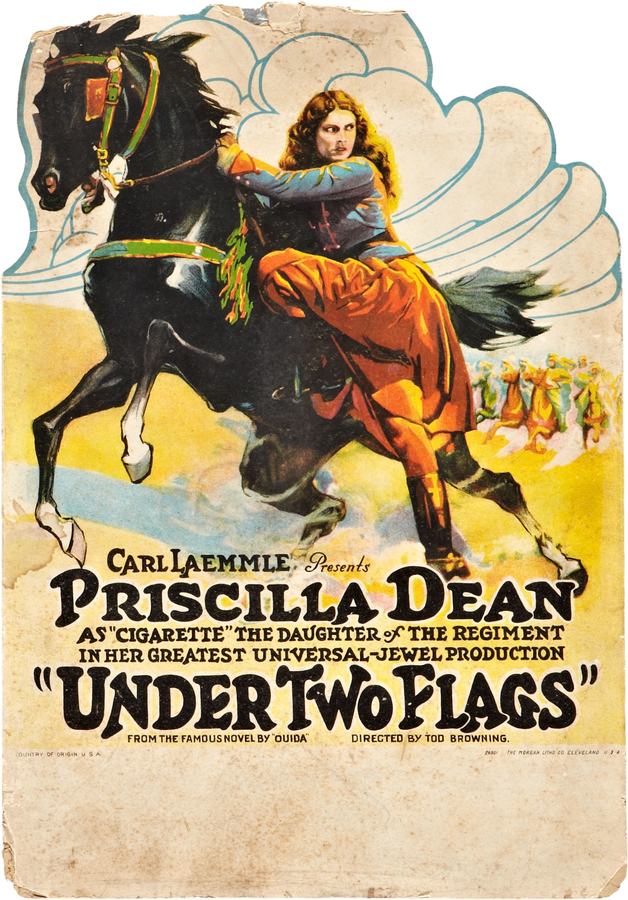
A definitive 6.1/10 rating for a film that redefined the boundaries of cult cinema. Under Two Flags remains a cornerstone of transgressive art.
The nickelodeon velvet parts, and out of the charcoal grain strides a mirage so tactile you can taste the Sahara’s flint on your tongue: Under Two Flags, that 1922 desert blossom oft-overshadowed by Browning’s later carnivals of the grotesque, here unfurls like a blood-stained silk banner snapping in the sirocco. Forget every postcard romanticism you’ve been force-fed; this is a fever dream shot through with cordite and kohled tears, where empire is a frayed cuff and honor a currency long devalued.
Victor—never granted the dignity of a surname onscreen—enters the frame already unhoused from identity, a silhouette peeled off a manor-house portrait and flung into monochrome wilderness. Priscilla Dean’s performance is all clenched jaw and lacquered stoicism; she lets the camera gorge on the tension between shoulder-blades that once bore a coronation robe. Notice how cinematographer W.H. Bainbridge frames Legion barracks like a debtor’s prison: low arches chewing the horizon, shadows dripped across stone as if the very walls distrust this blue-blooded recruit. The Legion itself becomes a crucible for class alchemy—turning gold into cannon fodder, and sometimes back into martyr’s gilt.

If Victor is the still center, Ethel Grey Terry’s Cigarette is the film’s trembling dynamo, half-Marseillaise, half-cobra. She swaggers into scenes trailing cigarillo haze and a chorus of catcalls, yet every gesture betrays a girl who learned love from barrack-room ballads instead of lullabies. Watch her fingers drum along a rifle stock—those fluttering digits semaphore desire, possession, and a dare. Terry, saddled with the script’s most baroque intertitles, somehow makes every arch syllable feel whispered rather than declaimed, as though her very breath might ignite the nitrate. The arc from spite to self-immolation is rendered without moralizing fade-outs; instead, Browning lets a single tear smudge her kohl, a tidal smear that feels apocalyptic.
Rose Dione’s Princess Corona could have been a mere mannequin of Edwardian virtue, but the actress imbues her with the brittle fatigue of someone who has always understood that marriages are alliances inked on battle maps. In the scene where Cigarette barges into the palace courtyard, dagger glinting like a star gone rogue, Corona doesn’t flinch—she tilts her head, almost curious, as if recognizing a reflection distorted by heat-shimmer. Their wordless exchange—eyes flicking from blade to brooch to window where Victor paces—encapsulates the film’s obsession with triangulated longing: woman, woman, and the ghost of a man both can never fully possess.

Long before he trained his lens on chanterelles of the macabre, Browning honed a grammar of chiaroscuro in these North-African tableaux. Observe how the sheik’s conspiratorial chambers are lit from below by braziers, faces carved into kabuki masks; or the way moonlight pools like liquid mercury on Cigarette’s cheekbones moments before she mounts her fatal ride. The director’s fondness for deformity—emotional if not yet physical—peeks through: treason is a hunchback no amount of medals can straighten, and the Legion itself a colony of scarred souls who stitch flag and flesh into tattered heraldry.
Adapted from Ouida’s florid potboiler, the scenario passes through no fewer than six scribes, yet miraculously retains a Proustian whiff of the original’s lavender excess. The intertitles oscillate between camp (“Love, like a sandstorm, blinds even the hawk-eyed”) and laconic Legion dispatches, producing a tonal frisson that keeps melodrama at knife-edge. One card, flashed during Cigarette’s midnight gallop, reads simply: “The desert listened; only hoofbeats answered.” It’s haiku amid the harangue, and it works because the orchestra—prescribed in original cue sheets—drops to timpani heartbeat, letting the silence roar.
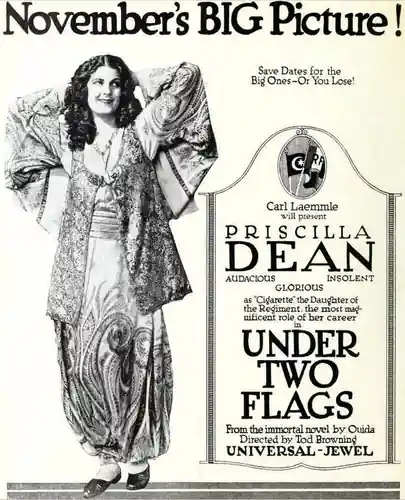
Stuart Holmes, as the venomous Sheik Ben Ali Hammed, never twirls a mustache—he doesn’t need to; his smile is a scimitar pressed against the inside of his own cheek. Burton Law’s Commandant, meanwhile, embodies bureaucratic entropy: notice how he removes his pith helmet each time bad news arrives, as though sorrow itself were a weight he can temporarily shed. Even bit players—legionnaires betting francs on lice-races—furnish texture; their laughter ricochets off crumbling fort walls, reminding us empires are built on boredom and cheap wine.
Modern eyes will flinch at the imperial gaze—Arabs sketched as either treacherous or exotic wallpaper, Algeria mere backdrop for European passions. Yet the film occasionally interrogates its own scaffolding: Cigarette’s mixed heritage is never coded as shame; she commands regimental respect through sheer charisma, a proto-feminist glitch in the colonial matrix. Moreover, Victor’s treason charge hinges on forged documents—white men’s ink defaming a blue-blood—implying that Empire devours its own offspring with gusto equal to devouring the colonized. Browning, ever the carnival barker, knows the crowd came for thrills, but he smuggles in subversion like contraband in a camel saddle.
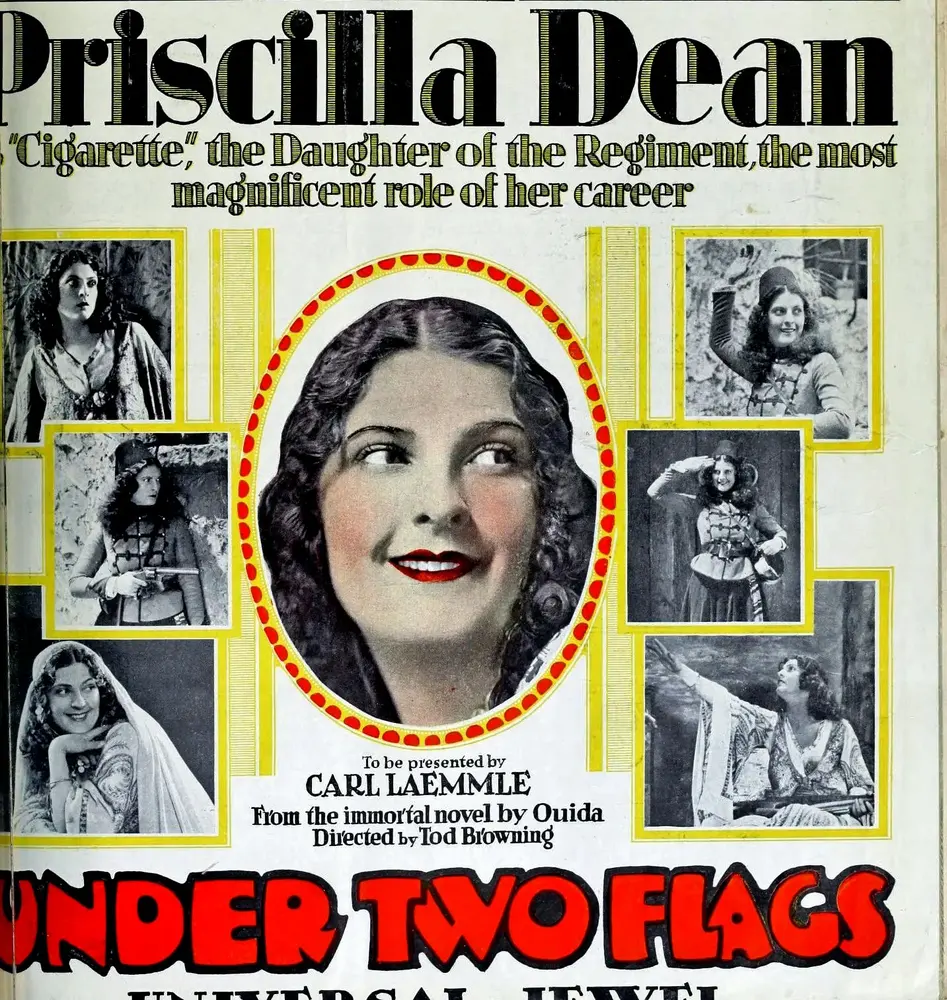
Compare this to Come Out of the Kitchen, where class anxiety plays out in domestic farce; here, social mobility is survival, not sitcom. Or place it beside The Outcast’s rugged frontier: both films sanctify the drifter, yet Under Two Flags insists redemption demands a blood signature. Even Browning’s own The Black Night revisits disguised nobility, but never grants its heroine an apotheosis as searing as Cigarette’s death.
Prints circulate like desert mirages—35mm at MoMA, a battered 16mm in Bologna’s lab, torrented DVDRips haunted by Latvian watermarks. The original tinting schema survives only in continuity notes: amber for Sahara daylight, blue for nocturnal treachery, rose for Cigarette’s boudoir reveries. Recent digital scans restore the hand-colored fire-glow of her final ride, allowing #C2410C flame to lick the edges of every frame, as though the film itself were combusting in homage to its heroine.
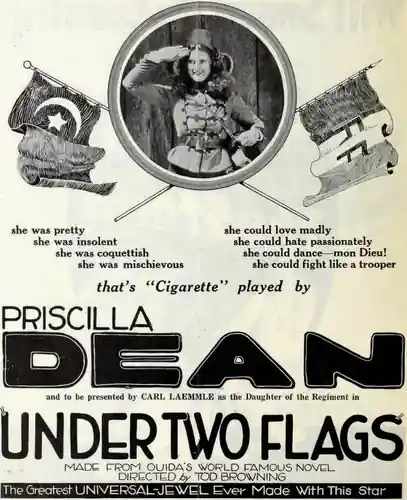
Contemporary exhibitors were encouraged to interpolate “La Marseillaise,” then pivot to Saint-Saëns’ “Danse Macabre” during the sheik’s ambush. Today, avant-garde ensembles favor Tuareg polyphonies colliding with prepared-piano, the clang mirroring fort iron. Whichever score you choose, silence the subwoofers during Cigarette’s death; let the absence of music become a cathedral where an audience’s collective breath can finally exhale.
Ninety-odd years on, Under Two Flags feels less antiquated than prophetic: identity as performance, love as insurrection, sacrifice as the sole passport through besieged borders. It is both time-capsule and ticking grenade—its fuse the flicker of a cigarette ember in the night, its explosion a woman’s silhouette against the dawn she will not live to see. To watch it is to inhale cordial laced with cordite; to remember it is to carry sand in your shoes long after the credits crumble.
Seek it out not as museum relic but as living ember—let its contradictions scar your certainties, let Cigarette’s final, lung-shattered whisper remind you that devotion, at its zenith, is indistinguishable from defiance.
IMDb —
1927
Community
Log in to comment.