DbcultAccessing Vault...
Cult Review
Senior Film Conservator
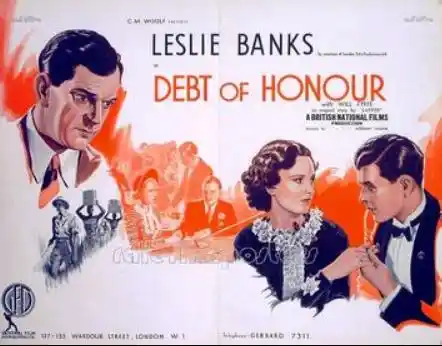
If you like old British films that smell like mothballs and have absolutely no patience for modern pacing, you'll probably get a kick out of Debt of Honour. If you need your movies to have, you know, actual energy or characters who don't talk like they're reading from a pamphlet, stay away. This is for the folks who want to see how people in 1936 thought they looked while they were being noble.
The whole thing feels like a very polite argument happening in a drawing room that never ends. Leslie Banks is doing a lot of heavy lifting here, looking concerned in almost every frame. I don't blame him. There’s a lot to be concerned about when you’re stuck in a script this rigid.
It reminds me a bit of the tone in Voice in the Night, where everything feels just a little bit too contained, like the walls are slowly closing in on the actors. There isn't much room for anyone to breathe or just be a human being.
Every time the plot starts to move, someone walks into a room and says something incredibly formal to stop it dead in its tracks. It’s almost a talent. I found myself checking my watch, not because I was bored, but because I wanted to see if the movie was aware of its own sluggishness. It clearly wasn't.
Phyllis Dare is fine, I guess. She does the 'distressed lady' thing perfectly well, but it’s a role that doesn't really let her do anything else. It's a bit like watching a well-oiled machine work through a script that was clearly written for a different era of theater. You can see the gears turning.
Anyway, it’s not a masterpiece. It’s just a movie that exists. Sometimes that’s enough, right? Maybe not today. ☕️
1936
IMDb Rating
—

Editorial
Deciphering the legacy of transgressive cult cinema.
Community
Log in to comment.