DbcultAccessing Vault...
Cult Review
Senior Film Conservator
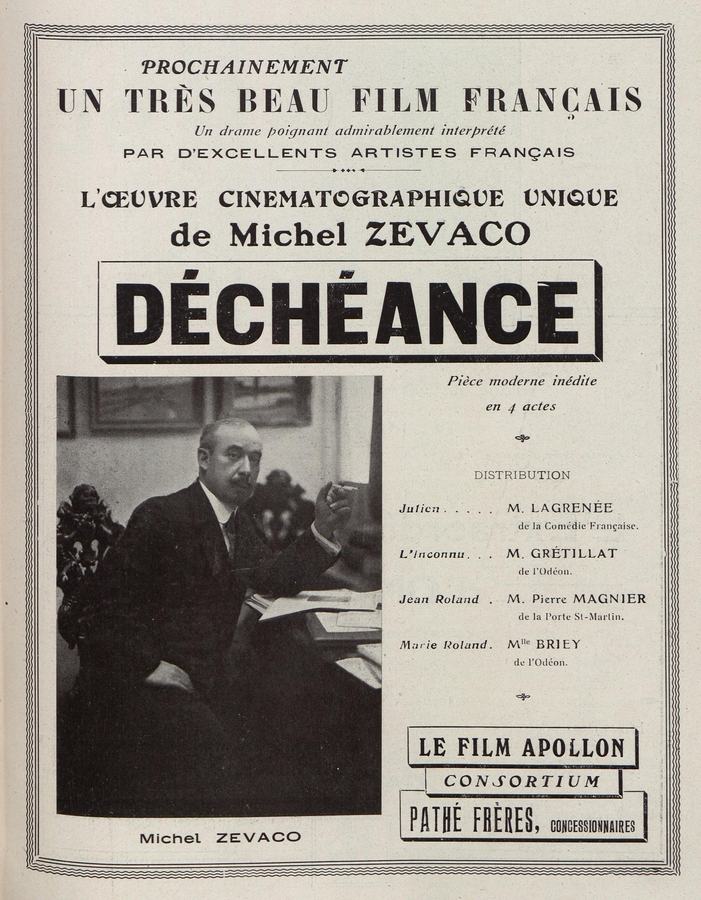
There's a particular melancholy in analyzing lost cinema – like reconstructing a ghost from whispers and moth-eaten lace. Déchéance (1917), Michel Zévaco's corrosive dissection of pre-war French aristocracy, exists now through fragmented reels and contemporary accounts, yet its spectral power lingers. Jeanne Briey's Adèle remains one of silent cinema's most fascinating antiheroines: a spider spinning golden webs in drawing rooms thick with moral decay.
What startles modern viewers fortunate enough to see reconstruction prints is how aggressively Zévaco rejects sentimentality. Unlike the tragic femininity of The Selfish Woman (1916), Briey's portrayal operates with chilling surgical precision. Watch how she handles a champagne coupe in the ballroom scene – fingers caressing the stem like a scalpel, eyes calculating the room's vulnerabilities over the rim. Her performance builds not through grand gestures but through terrifying stillness, anticipating Dietrich's later work in The Velvet Hand.
Cinematographer Louis Forestier paints with shadows in ways that still feel revolutionary. The infamous 'mirror sequence' where Adèle practices facial expressions reveals his mastery: triple exposures show Briey simultaneously as society ingénue, ruthless predator, and hollow mask – a visual trinity that predates similar experiments in Ipnosi by nearly a decade. Forestier's lighting doesn't illuminate; it accuses. When Dubois (Magnier, radiating tragic decency) first visits Adèle's salon, vertical shadows from window grilles transform the luxurious space into a literal prison cell.
Zévaco's architectural symbolism warrants frame-by-frame analysis. The Comte's decaying mansion features prominently in the second act, its crumbling cornices and water-stained silk wallpaper mirroring the aristocracy's internal rot. Unlike the documentary realism of My Four Years in Germany released that same year, Déchéance's sets function as psychological landscapes. Staircases loom oppressively; doorways contract to trap characters; even floral arrangements seem to wilt on camera beneath the weight of deception.
Jacques Grétillat delivers career-defining work as the ruined Comte. His disintegration follows Shakespearean rhythms – watch how his posture collapses incrementally across three key scenes: initially towering in military regalia during the opening hunt sequence; later diminished in a dressing gown while signing away estates; finally curled fetal on a divan, clutching Adèle's discarded glove. Modern audiences might compare it to the self-destructive pathos of The Failure, but Grétillat's genius lies in never begging for sympathy. His Valois understands his own complicity, making the character's downfall exponentially more devastating.
Contrast this with Maurice Lagrenée's explosive performance as nephew Henri. Where Briey operates through icy control, Lagrenée embodies incandescent rage. His introduction – bursting through double doors during Adèle's salon gathering, mud-spattered from riding – functions as the film's detonator. Lagrenée's physicality suggests a caged beast, movements jerkier and more unpredictable as his vengeance plot crystallizes. That Zévaco restrains him from melodrama through precise blocking (often framing him in doorways or behind barriers) demonstrates remarkable directorial control.
The film's much-imitated temporal structure warrants particular attention. Rather than linear progression, Zévaco employs flashbacks triggered by sensory associations – a technique virtually unprecedented in 1917. When Dubois smells Adèle's signature jasmine perfume, we abruptly cut to Valois experiencing the same scent during their initial seduction. This creates disorienting emotional echoes, suggesting history's inescapable recurrence. It's a bravura narrative device that wouldn't be explored again until Forget-Me-Not nearly a decade later.
Zévaco further fractures chronology through parallel editing of strikingly dissimilar scenes. The film's most discussed sequence intercuts Adèle coolly selecting jewels with Henri exhuming financial documents from his uncle's archives. Neither character is aware of the other's actions, yet the juxtaposition creates unbearable dramatic irony. Editor Simone Laurent (one of few female editors in silent French cinema) maintains tension through increasingly clipped rhythms – diamond clasps snapping shut synchronize with ledger pages turning, building to a visceral climax.
Contemporary accounts describe Léon Moreau's original score as 'Ravel interpreting Satie in minor key.' Unfortunately, only fragments survive, but reconstruction attempts reveal startling modernity. Moreau scored pivotal scenes against expectations – Adèle's emotional climax features unsettling pizzicato strings rather than sweeping melodies, while the bridge confrontation uses near-silence punctuated by discordant piano strikes. This audacious sound design created such discomfort during previews that theater musicians reportedly struggled to perform it. Imagine the revolutionary impact compared to the sentimental orchestrations of Volunteer Organist playing nearby.
Moreau's most brilliant innovation was his treatment of Briey's close-ups. During extended moments of silent calculation, he scored only the faintest ambient sounds – a distant carriage wheel, a ticking clock – forcing audiences to project their interpretations onto her famously inscrutable face. This created a participatory tension where viewers became complicit in imagining her schemes. Such sophisticated manipulation of audience psychology wouldn't be seen again until the dream sequences in Das Abenteuer eines Journalisten.
The Pont Alexandre III climax remains one of silent film's most visually sophisticated sequences. Shot over seventeen nights to capture specific moonlight conditions, Forestier used experimental magnesium flares to create unnatural silver highlights on the Seine's ink-black water. Briey and Magnier move through this expressionist nightmare like figures in a Munch painting – her white fur coat becoming a spectral shroud, his silhouette fragmenting against ironwork.
Zévaco stages their confrontation with brutal minimalism: no explanatory title cards, just bodies speaking through posture and proximity. As Dubois realizes Adèle's true nature, Magnier performs his disillusionment through incremental collapse – shoulders folding inward, head bowing as if physically struck. Briey counters with terrifying stillness, her face gradually emptying of all affect until she resembles a porcelain death mask. Their final separation plays out in agonizingly slow tracking shots along the bridge's span, the physical distance between them growing into an existential chasm.
The film's controversial reception reveals much about pre-war French society. Critics condemned its 'immoral cynicism,' particularly Briey's unpunished survival. Yet workers' collectives championed its class critique, projecting it in union halls with radicalized intertitles. This schizophrenic response anticipated debates around later works like Out of the Darkness, proving Déchéance struck exposed societal nerves.
Visually, its influence permeates French poetic realism – watch how Carné borrows Forestier's rain-slicked cobblestone textures in Le Jour Se Lève. More profoundly, Briey's amoral heroine became archetypal. Dietrich studied her performance for The Blue Angel; Stanwyck channeled her pragmatic ruthlessness in Double Indemnity. Even the film's narrative structure echoes in Resnais' temporal experiments. Yet for all its descendants, Déchéance retains singular power in its unwavering gaze at humanity's capacity for self-destruction – a gaze as uncomfortably relevant now as in 1917.
Perhaps this explains why the fragments feel so haunting. In a single surviving close-up, Briey stares directly into the lens while adjusting a diamond bracelet. Her expression contains multitudes: triumph, contempt, exhaustion, and terrifying emptiness. It's the look of someone who's sold their soul and found the transaction underwhelming. Over a century later, that gaze still challenges us to see the moral compromises lurking beneath our own polished surfaces.
IMDb 5.8
1923
Community
Log in to comment.