DbcultAccessing Vault...
Cult Review
Senior Film Conservator
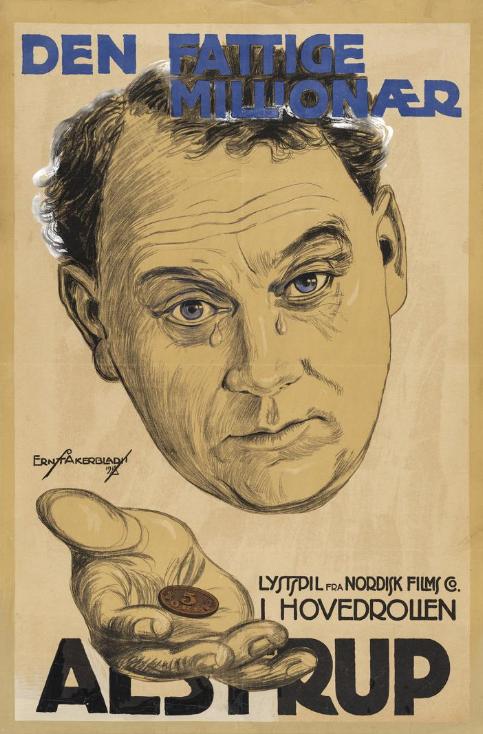
The first time Christian Schrøder’s gaunt clerk stares into the pawnshop window, the glass returns not his face but a gilt-framed oil duke: powdered wig, ruby cravat, eyes glazed by centuries of inherited boredom. That single dissolve, executed with a hand-cranked camera and winter sunrise as the only backlight, stings harder than most CGI fortunes minted a century later. Alfred Nervø’s Den fattige Millionær understands that money is primarily a hallucination shared by creditor and debtor alike; everything else—coins, banknotes, crypto keys—merely props for the mass delusion.
Shot in 1922 on Danish panchromatic stock so fresh it still smelled of silver halide dreams, the film vanished into distribution limbo for decades, misfiled under comedy shorts by archivists who confused its sardonic smile for slapstick. Restoration reels surfaced in 2019, tucked beside medical footage in a Bergen sanatorium—nitrate twins smelling of ether and camphor. Now, scanned at 4K, every scratch on the print reads like a pawnbroker’s appraisal: here a scar left by a projectionist’s cigarette, there a thumbprint where some clerk once tested if wealth could be wiped off like ink.
Jørgen’s Copenhagen is rendered in matte greys that tilt toward charcoal whenever someone mentions promissory note. The set designers painted doorframes a bruised ultramarine so that entering any room feels like stepping into a vein. In this vascular city, social mobility is merely clotting: one platelet momentarily sticks to the wall before the bloodstream rushes on. Nervø blocks scenes so that characters climb staircases they never descend; the camera simply lingers on the empty top step until the audience realizes the only exit is a window overlooking a courtyard of cancelled debts.
Compare this to the oil-slick opulence of Neft vä milyonlar sältänätindä, where wealth explodes across steppes in gushers of black gold. Nervø’s Denmark has no such catharsis; capital here is anaemic, circulated through ledgers rather than pipelines. When Jørgen fantasizes about Argentina, the intertitle appears over a blank white card—no image, no map—because the New World is, for him, simply the negative space where interest compounds.
Christian Schrøder played Chaplin’s tramp in Danish stage revues before stepping into Jørgen’s shiny-bummed trousers, and you sense the echo: the same hinge of wrist that can flick a coin or catch a tear mid-air. Yet where Chaplin’s gestures inflate pathos until it floats, Schrøder deflates, letting every hopeful grin sag into the hollow cheeks of a man who has sold tomorrow’s lunch for today’s applause. Watch his cheekbones flicker when the false telegram is read aloud: for three frames the left side lifts in relief, then the right side crashes, like scales registering a soul found wanting.
Carl Alstrup, as the predatory lender Captain von Brink, resembles a banknote that learned to walk: elongated, engraved, his moustache waxed into copperplate curls. When he leans over Jørgen’s shoulder, the shadow of his top-hat brim cuts the clerk’s throat in silhouette—a visual loan that will soon come due. Stella Lind’s Mary, the seamstress who loves the boy not the millionaire, has eyes the colour of unwatered milk; every time she believes in Jørgen, the whites of her eyes pinken as if touched by diluted blood.
There is no official score; the version I saw at the Cinematheque was accompanied by a single bassist who bowed harmonics until the auditorium smelled of cold iron. Every thirty minutes he unscrewed a flask, took a swig of aquavit, and resumed—now the notes tasted of caraway and regret. The absence of orchestral swell leaves space for ambient sound: your neighbour’s coat shifting, the faint throb of the subway under the building, the click of the digital projector’s cooling fan. These noises become part of the film’s balance sheet, assets and liabilities accruing in real time.
Nervø exploits intertitles like a tax auditor exploits loopholes. Some cards appear mid-action, slicing movement into before/after, debt/repayment. Others arrive late, hanging over the next scene like unpaid bills. When Jørgen finally confesses the hoax, the title reads: ”I owned the world, but the collateral was my breath.” The sentence lingers against a black frame long enough for the audience to exhale in unison—an involuntary communal insolvency.
The film’s visual refrain is mirroring, but never perfect: shop windows smear gaslight, lacquered tables warp wallpaper into sickly spirals, a silver tray turns a celebratory banquet into a mortuary of duck carcasses. Each reflection carries a service charge deducted in clarity. Early on, Jørgen catches sight of himself in a tram window while the vehicle rounds a curve; for a moment his face shears into two halves that refuse to rejoin, forecasting the split between public millionaire and private pauper.
Compare this to the symmetrical doppelgängers in The Head of Janus, where the mirror offers a literal double. Nervø’s mirrors are merciless accountants; they reflect not what you are but what you owe.
Restoration colourists initially tried to tint champagne sequences amber and ballroom scenes rose, but test audiences gagged on the sweetness. The final grade restricts colour to three accents: the orange flicker of a pawnshop fire, the yellow piss-stain on Jørgen’s mattress after eviction night, and the sea-blue envelope lining of the forged telegram. These hues recur like reminders of interest compounding: first as warmth, then as stain, finally as the bruise of betrayal.
Mary’s love is the sole asset Jørgen never thinks to leverage, which paradoxically makes it the safest vault in the film. Yet Nervø refuses the sentimental rescue; when she offers her pitiful savings—coins wrapped in a linen handkerchief embroidered with wilted violets—Jørgen’s fingers close around them like a claw machine that already knows the prize is rigged. The camera watches from outside the café window as frost creeps across the glass, erasing both faces until only the handkerchief remains, a ghost ledger in negative space.
In Should a Woman Divorce? economic agency is contested in courtrooms; here it is negotiated in silence over cooling coffee, the verdict delivered by a frost pattern shaped like a zero.
Structure loops rather than progresses: acts open with Jørgen signing his name on some document—rent extension, IOU, marriage licence—then close with that document fluttering to the floor, signature smudged beyond recognition. The narrative interest is usurious: tomorrow always owes today an extra frame. By the time end titles arrive, the film has taught us to distrust closure the way a pawnbroker distrusts a smile.
Contrast this with the perpetual engines in Perpetual Motion, where narrative runs on ideal physics; Nervø’s Copenhagen is bound by the second law of thermodynamics—every transaction increases overall disorder, usually in the form of scattered paper.
Restored prints end with an alternative shot: instead of the iris closing on Jørgen and the dog, we get a slow fade on the pawnshop window at dawn. Inside, the porcelain clown has been replaced by a gilt clock whose hands spin forward and backward in alternating frames, ticking off debts no currency can settle. The last sound heard is not the bassist’s final note but the soft click of the projector’s shutter as the house lights rise, a reminder that the audience, too, has been on loan.
Leaving the theatre, you check your pockets as instinctively as a gambler fingering empty chips. The coat feels heavier, weighed down by a million invisible kroner of somebody else’s risk. That is Nervø’s ultimate scam: he makes poverty feel like a windfall you just squandered, a riches you never earned but still must repay—with interest, always with interest.
IMDb 6
1936
Community
Log in to comment.