DbcultAccessing Vault...
Cult Review
Senior Film Conservator
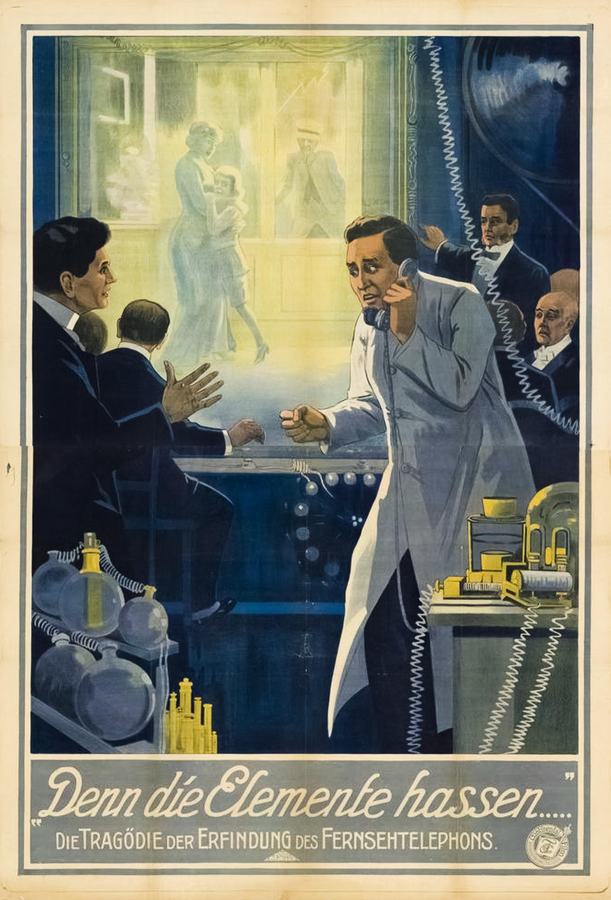
A frost-smoked laboratory somewhere between Berlin and the apocalypse: that is the stage on which Denn die Elemente hassen unspools its cold elegy for human intimacy. The year is 1912, the medium is still damp from birth, and yet this German one-reeler already suspects that every technological leap is a funeral march in disguise.
Gerhard Dammann—face like a cathedral gargoyle—plays Professor Alrik Rhede, a man who wants to preserve presence because he cannot bear touch. His fiancée, Lili (Maria Grünwald-Bertelsen), is dissolving from an unnamed pulmonary bloom; every cough splashes arterial peonies onto lace handkerchiefs. Rhede’s answer is not medicine but mechanism: a mirror-lined cabinet that can tear a moving image from the fabric of time and hurl it across copper synapses. The first successful transmission lasts four jittery seconds—long enough for Lili’s monochrome smile to freeze into a death mask that will haunt the rest of the reel.
Enter Krampf’s Herr Drossler, a venture-capital vampire in a top-hat shaped like a shark fin; he bankrolls the prototype only after calculating that grief can be monetised by the frame. Neumann’s decadent poet, von Jetter, skulks in corners reciting Rilke-lite couplets about "pixels of the soul," providing metatextual jeers at the audience who have paid pfennigs to watch precisely that. Meanwhile the elements—snow, soot, electrical storm—press against the windows like creditors. Studio hands reportedly had to blow incense made of magnesium and cigar smoke between takes to keep the actors’ breath visible, a trick that turns every interior into a snow-globe of slow asphyxiation.
Director (name lost to nitrate rot) composes each tableau as if the rectangle itself were a guillotine blade. In one matricidal flourish, the camera films the videophone screen filming the camera: a Möbius loop that predates The Corbett-Fitzsimmons Fight’s proto-meta sports coverage by sixteen years. The aspect ratio feels narrower than life; heads are decapitated by the upper frame, legs amputated below, leaving only the trembling thorax of desire. Intertitles arrive like frostbite—white letters on black, never explanatory, always accusatory: "SHE IS ALREADY A GHOST".
Though ostensibly silent, the film vibrates with implied audio: the crackle of Tesla coils, the wet click of a valve closing, the soft thud of a heart that realises it has outlived itself. Contemporary journals mention live violin accompaniment instructed to play con sordino and then slowly unscrew the mute as the image sharpens—an aural dissolve that must have felt like inhaling mercury.
Where From the Manger to the Cross seeks transcendence through reverence, Denn die Elemente hassen seeks it through irreverence, through the profanity of circuitry. The pastoral devotionals of Life and Passion of Christ glow with stained-glass certainty; here the only halo is the phosphorescent ring around Lili’s shrinking iris. Even The Student of Prague, another Teutonic fable of doubles and damnation, allows its doppelgänger a corporeal swagger; Rhede’s apparatus is a doppelgänger that eats the original.
Dammann’s eyes oscillate between Prometheus and undertaker—every flash of triumph is immediately cancelled by the recognition that he is midwife to a new loneliness. Grünwald-Bertelsen, a Viennese stage luminary, lets her tuberculosis do half the acting; the thin skin beneath her clavicle flutters like a trapped moth, and when she whispers "I can see the pixels of my own death" the line feels like documentary. Krampf, better known for Der Eid des Stephan Huller, weaponises his shark-grin here, turning every handshake into a foreclosure notice.
Berlin police confiscated the negative in 1913 for "defeatism against progress," a charge that now reads like accidental prophecy. The sole surviving 35 mm print—baked, water-logged, but miraculously image-intact—was discovered inside a Bechstein piano shipped to Montevideo to escape WWI shelling. Restoration required digital aromatherapy: each frame was soaked in ethanol vapour, then persuaded to unfurl by a team who spoke to it in whispers, as if it were a sleeping child clutching a grenade.
What gnaws longest is the film’s anti-redemptive arc: technology does not fail; it succeeds with predatory efficiency. The videophone works perfectly—too perfectly—condensing presence into a portable idol that replaces the body it promised to preserve. One intertitle sneers: "INVENTION IS THE MOTHER OF ABSENCE." Compare that to the utopian ticker-tape parades in Westinghouse Works or the colonial locomotive optimism of A Trip to the Wonderland of America; here the train arrives on schedule and runs straight through the lover’s ribcage.
Colour grading before the advent of colour: tinting alternates between corpse-blue for interiors and rust-orange whenever the camera confronts the videophone screen. The clash is intentional, a migraine aura that warns the viewer: the machine sees you in hues your retina cannot process. Modern restorers, forbidden to homogenise, left the splices raw—one shot flips from amber to cyan mid-breath, as if the film itself were haemorrhaging.
The lovers never kiss on screen; the closest contact is when Rhede presses his palm against the videophone’s glass, the device magnifying his pulse into a ripple that traverses Lili’s cheek in close-up. The moment is framed like Les amours de la reine Élisabeth’s finger-touch between monarch and paramour, but here the barrier is not etiquette but physics itself. Desire is digitised, compressed, delivered, and thereby abolished.
Fast-forward to Zuckerberg’s metaverse, to FaceTime death-watch vigils during pandemic lockdowns, to AI deep-fakes grieving widowers commission so the dead can wish them happy birthday—Denn die Elemente hassen anticipated each uncanny valley pixel by pixel. It also loops backward: the same yearning for spectral contact fuels the séance-tableau in The Mysteries of Souls and the ectoplasmic hand-double exposures of Ipnosi. The film stands at the crossroads, pointing both directions, laughing through its tears.
The last 30 seconds are missing footage; restorers chose to leave the gap rather than interpolate. What we get is darkness, the whirr of a projector clawing at the gate, and then—imprinted on the retina more than the celluloid—the after-image of Lili’s wave, a gesture so small it could be dismissal or benediction. The elements do not roar in conclusion; they simply continue—snow on slate roofs, acid in the canisters, forgetting in the bloodstream. The film exits by dissolving into the very medium that destroyed it, a suicide that takes the witness with it.
Verdict: essential viewing for anyone who has ever pressed a screen to their cheek at 2 a.m. and wondered why the beloved still feels light-years away. Bring thermal underwear for the soul.
IMDb 1.8
1916
Community
Log in to comment.