DbcultAccessing Vault...
6.6/10
Senior Film Conservator
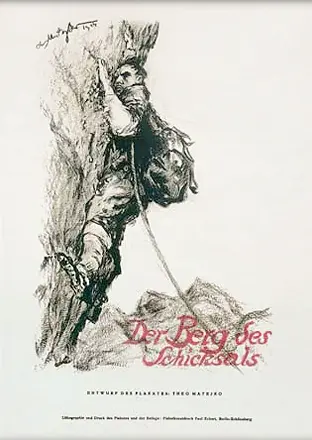
A definitive 6.6/10 rating for a film that redefined the boundaries of cult cinema. Der Berg des Schicksals remains a cornerstone of transgressive art.
The year 1924 marked a seismic shift in the grammar of visual storytelling, a moment when the camera escaped the confines of the studio to confront the sublime reality of the high Alps. Der Berg des Schicksals (The Mountain of Destiny) is not merely a film; it is the foundational text of the Bergfilm genre, a cinematic movement that fused German Romanticism with a burgeoning physical culture. Directed by the visionary Arnold Fanck, a man whose background in geology informed his aesthetic sensibilities, the film treats the limestone monoliths of South Tyrol not as backdrops, but as primary antagonists and divine entities. This is a world where the horizon is vertical, and the air is thin with the scent of destiny.
Unlike the melodramatic domesticity found in contemporary American imports like The Saleslady or the comedic frivolity of Frisky Lions and Wicked Husbands, Fanck’s work demands a visceral engagement with the elements. The plot, while ostensibly simple, functions as a framework for exploring the Nietzschean concept of self-overcoming. Luis Trenker, making his debut, brings a rugged, unvarnished authenticity to the screen. He was not an actor playing a climber; he was a climber whose existence was being captured on celluloid. This distinction is crucial. In an era where The Perfect Thirty-Six focused on the superficiality of form, Trenker and Fanck focused on the durability of the human spirit against the abrasive touch of rock.
The cinematography in Der Berg des Schicksals is nothing short of revolutionary. Sepp Allgeier and Fanck utilized heavy, hand-cranked cameras in conditions that would paralyze modern equipment. They captured the play of light and shadow—the chiaroscuro of the crags—with a precision that renders the Guglia del Diavolo as a living, breathing creature. The use of telephoto lenses to compress the space between the climber and the abyss creates a sense of vertiginous intimacy. We are not merely observers; we are tethered to the protagonist, feeling every finger-hold and every slip of the boot.
While films like Das Rätsel von Bangalor relied on exoticism to captivate audiences, Fanck found the exotic in the familiar European landscape, elevating the Alps to a mythic status. The mountain is a site of purification. The protagonist’s struggle is mirrored by the internal conflict between filial piety and the call of the wild. His promise to his mother represents the safety of the valley, the stagnation of the domestic sphere, and the weight of social obligation. The peak, conversely, represents a dangerous but essential freedom. This dichotomy is far more profound than the moralistic dilemmas presented in The Martyrdom of Philip Strong.
One of the most striking aspects of the film is the character of Hella, played with a quiet but fierce determination by Hertha von Walther. In the cinematic landscape of the 1920s, women were often relegated to roles defined by their relationship to men, as seen in The Lure of Youth. Hella, however, is a pioneer. She is a student who surpasses the master, not through luck, but through intellectual rigor and physical courage. Her decision to attempt the Guglia del Diavolo alone is an act of radical autonomy.
She gazes at the mountain with a scientific intensity, searching for the "key" to the ascent. This intellectualization of the climb contrasts sharply with the raw, masculine power of Trenker’s character. When she sets out into the storm, the film shifts from a study of obsession to a high-stakes survival thriller. The sequences of her battling the elements are harrowing, devoid of the theatrical artifice found in L'aventurier. Here, the danger is tangible. The snow is cold, the wind is biting, and the gravity is absolute.
The technical achievements of Der Berg des Schicksals cannot be overstated. Fanck was a pioneer of time-lapse photography and slow-motion, using these techniques to illustrate the rhythmic movement of clouds and the kinetic energy of a falling body. These visual flourishes were not mere gimmicks; they were essential to his mission of capturing the "soul" of the mountain. In comparison to the static staging of The Woman Above Reproach, Fanck’s camera is a dynamic participant in the drama.
The film also navigates the treacherous terrain of the human heart. The climber's mother, played by Erna Morena, embodies the collective anxiety of a generation that had seen its sons perish in the trenches of the Great War. Her fear is not just for her son’s life, but for the loss of the last vestige of her world. This adds a layer of tragic weight to the protagonist’s eventual decision to break his promise. It is a moment of profound irony: he must commit an act of betrayal to perform an act of salvation. This moral complexity is far more nuanced than the simplistic greed explored in The Money Mill or the social pressures of The Rack.
As we analyze the film within the broader context of Weimar cinema, it becomes clear that Der Berg des Schicksals offered a form of escapism that was grounded in physical reality rather than the phantasmagoria of Expressionism. While films like Dark and Cloudy delved into the shadows of the urban psyche, Fanck pointed his lens toward the light of the summits. This was a cinema of "health," of vitality, and of the indomitable will. It echoed the themes of Der Wilderer, where the rugged landscape serves as a testing ground for character.
Yet, there is a haunting quality to the film that transcends its heroic narrative. The mountain remains indifferent. It does not care if the climber succeeds or fails. This existential coldness is what makes the film so modern. It lacks the sentimentalism of Desert Blossoms or the ethnographic romanticism of Ubirajara. Instead, it presents a stark reality where man’s only significance is found in the effort itself. The climb is a temporary victory over the void.
The influence of Der Berg des Schicksals can be seen in everything from the propaganda films of the 1930s (such as The Hun Within, though in a much more sinister ideological context) to the modern-day documentaries like Free Solo. Fanck established the visual vocabulary for how we perceive high-altitude adventure. He taught us that the camera must be as agile as the climber, and that the silence of the peaks is more eloquent than any dialogue. The use of natural light, the emphasis on physical endurance, and the reverent treatment of the landscape are hallmarks of his style that continue to resonate.
In the final act, when the protagonist finally stands upon the summit of the Guglia del Diavolo, the triumph is bittersweet. He has saved Hella, and he has conquered the peak, but he has also shattered the peace of his domestic life. The mountain has taken something from him in exchange for the view. This is the "destiny" alluded to in the title—not a predetermined path, but the inescapable consequence of one's own nature. As the sun sets over the Dolomites, casting long, orange shadows across the snow, we are left with a sense of awe and a profound realization of our own insignificance.
Arnold Fanck’s Der Berg des Schicksals remains a towering achievement of the silent era. It is a film that demands to be seen on the largest screen possible, where the scale of the mountains can truly be felt. It is a reminder that cinema, at its best, is an act of exploration—a journey into the unknown parts of our world and ourselves. Whether you are a scholar of film history or a casual viewer looking for a visceral experience, this alpine epic is a mandatory ascent. It stands far above the mundane dramas of its time, a lone spire of artistic integrity in a sea of commercial fluff.
Ultimately, the film asks us: what are we willing to risk for a moment of transcendence? For Hella and the master climber, the answer is everything. In the thin air of the Guglia del Diavolo, the trivialities of the valley disappear, leaving only the rock, the sky, and the relentless drive to go higher. It is a message that remains as potent today as it was a century ago.

IMDb 4.4
1920
Community
Log in to comment.