DbcultAccessing Vault...
Cult Review
Senior Film Conservator
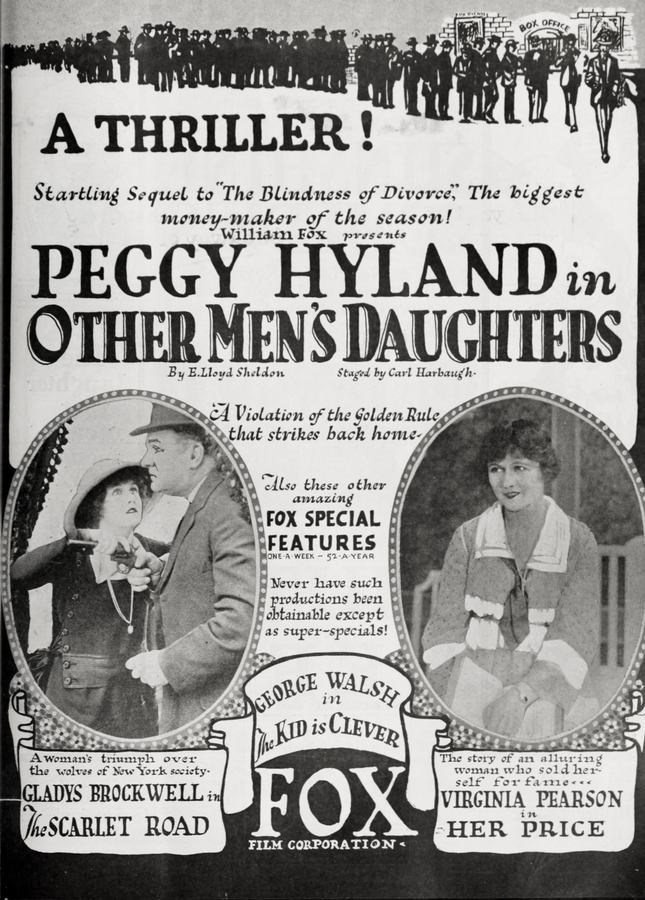
She arrives like a monochrome comet—pleated skirt, cloche hat, eyes still ringed with dormitory innocence—yet the air around her already crackles with the ozone of imminent transgression. Director E. Lloyd Sheldon, never one to squander a close-up, lets the camera linger on Shirley’s gloved hand as it hovers above the doorknob of her childhood home; that tremor of hesitation is the first fissure in a film that will spend its next seventy minutes prying open every social façade of America’s roaring interregnum.
Boarding-school propriety collides with metropolitan decadence the instant Shirley crosses the threshold. Mother has decamped to a hotel, decreeing the marriage finis; father, meanwhile, populates the parlor with flappers, gin boys, and a jazz trio whose trumpet bleats like a wounded peacock. The mise-en-scène is a fever dream of Art-Nouveau clutter: beaded lampshades swing overhead like cut-glass piñatas, cigarette smoke coils around the balustrade, and somewhere off-camera a Victrola needles out “Ain’t She Sweet” at half-speed, warping adolescent nostalgia into something predatory.
Sheldon’s camera glides through this carnival of the damned with the languor of a sleepwalker, each dissolve a drunken breath.
Enter Lola Wayne, the mistress du jour, draped in a lamé gown that drips liquid gold onto the parquet. Peggy Hyland plays her as a serrated doll: eyelids drooping with ennui one second, flashing switchblade sharpness the next. During the toast she perches on Reynolds’s knee like a pampered leopard, but her smile is already calculating the alimony. The spectacle is so brazen it borders on opera buffa—yet the film refuses to tip fully into farce because the emotional stakes are scaldingly real for Shirley, who watches her paternal idol guzzle bootleg hooch while cupping another woman’s breast.
Eric Mayne’s patriarch is a marvel of self-absorption: silk cravat askew, voice a honeyed rumble, eyes that never quite focus on anyone long enough to acknowledge their autonomy. He is less a man than a walking appetite, and the performance is calibrated so that we glimpse, in the pauses between his quips, the terror of a sybarite confronting the prospect of mortality without redemption. When Lola’s father—Riley Hatch in a turn that could etch glass—storms in brandishing a revolver, the camera adopts Shirley’s POV: the barrel quivers like a divining rod aimed at her dad’s heart. She interposes herself, a fragile Kevlar of filial loyalty, and the moment crystallizes the film’s central obsession: daughters paying fathers’ moral tabs.
But vengeance is a shapeshifter. Denied blood, Wayne contracts Trask—Frank Goldsmith oozing into the role like molasses laced with arsenic. Trask’s first appearance is a masterpiece of venereal insinuation: he leans against a baroque archway, derby tilted, cane tapping a 5/4 rhythm that feels vaguely obscene. His proposition to Shirley is never articulated in words; instead Sheldon intercuts a close-up of Trask’s thumb tracing the rim of a cracked champagne flute while Shirley studies a photograph of her parents on their wedding day. The montage is Eisenstein before Eisenstein, desire and danger fused at the cellular level.
The roadhouse sequence, when it arrives, is a chiaroscuro bacchanal lit by a single swinging kerosene lamp. Shadows jitter across warped clapboard; a jukebox hacks out a distorted rag; off-duty chorus girls sprawl on hay bales like discarded marionettes. Cinematographer Robert Middlemass shoots the exterior through a scrim of drizzle, so every surface glistens like black patent leather. Inside, Shirley—having swallowed Wayne’s bait—waits for a father who will never come. The tension coils tighter when we spot Richard Ormsby (Robert Middlemass doubling duties, a casting economy common to Poverty Row) skulking beyond the window, his soaked shirt plastered to the sort of chest Griffith used to reserve for Confederate heroes.
Trask’s assault is staged behind a locked door, a narrative choice that both spares censors and amplifies horror. We hear only muffled thuds, a glass shattering, Shirley’s stifled scream. Reynolds, drunk and disoriented, pounds the corridor walls; the camera dollies back to reveal wallpaper peeling like shedding snakeskin—a visual correlative for social decorum stripped bare. Richard’s last-second rescue arrives via a fire-escape ladder that clangs against the siding like the sword of Damocles. The ensuing struggle is a tangle of silhouettes, ending with Trask’s suicidal plunge into the night. Sheldon refuses us the catharsis of a body; we get only the echo of impact, raindrops reverberating in a barrel—an absence more chilling than any corpse.
Morning breaks wan and repentant. Father and daughter share a two-shot on the muddy roadside, steam puffing from their mouths in the cold. Mayne’s face, for the first time, collapses into something like humility; the swagger evaporates, leaving a husk who recognizes that every kiss he bestowed outside his marriage was a coin spent against his child’s future. Shirley’s forgiveness is conveyed with a simple gesture: she removes her mother’s wedding ring from a chain around her neck and presses it into his palm. No dialogue. The ring glints like a miniature sunrise, and the cut to black feels both merciful and ominous.
Back in the family parlor—now tidied of confetti and gin stains—Shiley brokers détente between spouses who seem less reconciled than exhausted. Elizabeth Garrison’s mother stands by the piano, posture rigid as a governess; when Reynolds reaches for her hand she flinches, then relents, tears tracking through rice-powder. The camera retreats through curtained windows into the street, where a newsboy hawks headlines about Harding’s death. History intrudes, reminding us that private scandals are but tremors in a seismic era.
Sheldon’s coda is a slow fade on Shirley and Richard strolling beneath elms, their clasped hands tentative, as though touch itself were newly dangerous. Over the shot, a superimposed intertitle reads: “Only the innocent may promise, only the forgiven may forget.” The aphorism feels too tidy, yet the film earns it by exposing the crucible that forged such platitudes.
Peggy Hyland’s Lola deserves resurrection in film syllabi: her flapper coquette is equal parts Circe and sacrificial goat, the moment she realizes her father has pimped her revenge a silent shriek worthy of Renée Falconetti. Mayne navigates the arc from bon-vivant to penitent without the usual histrionics; watch how his left thumb worries his signet ring whenever morality corners him—a tiny motor of guilt. As Trask, Goldsmith channels a predatory elegance that anticipates Walton’s slaver by half a decade, all hooded gazes and vocal silk that slithers.
The film’s palette is a study in tenebrism: coal-black shadows swallowing faces, then abrupt flares of yellow that halo Shirley’s hair like a Pre-Raphaelite halo. Sheldon repeatedly frames doorways as portals of moral transition—note how the paternal apartment’s threshold is shot from a low angle, cornices looming like a cathedral to hedonism. The roadhouse window, by contrast, is a proscenium arch through which we spy sin, its glass smeared with handprints that resemble ectoplasm. Cuts are infrequent; instead, the director favors slow dissolves that bleed scenes together like wet ink, suggesting that degradation is a continuum rather than an event.
For a 1923 programmer, Other Men’s Daughters flirts with radical empathy. Shirley’s agency is never in doubt—she engineers parental rapprochement, extricates herself from Trask’s trap, and even chastises her mother for marital abdication. Yet the film also indicts the transactional nature of women’s virtue in a market where fathers barter daughters to atone for their own priapism. The title itself is a sly synecdoche: females reduced to chattels whose value fluctuates according to male desire. When Shirley finally slips that wedding ring back onto her mother’s finger, the act feels less restoration than reluctant capitulation to a rigged game.
Sheldon’s DNA threads through later melodramas: the toxic paternal legacy anticipates Ozu’s sacrifice, while the locked-room peril prefigures Hitchcock’s rape-without-rape grammar. The jazz-soaked debauchery looks forward to Stiller’s champagne tragedies, yet its spiritual twin is Melissa of the Hills, where rural innocence also collides with urbane wolves. Viewers who relish the moral vertigo of Faithless will find similar quicksand here, albeit without von Stroheim’s baroque cynicism.
The picture isn’t immaculate. Budget constraints show in repeated interior sets, and an early reel has a jump-cut so jarring it suggests missing footage. The intertitles occasionally lapse into purple doggerel—“Love is a moonlit razor, beauty its bleeding witness.” Yet these blemishes enhance rather than mar; they remind us we are excavating a artifact, not consuming a product polished by committee.
For decades the only extant print languished in a Romanian monastery archive, vinegar-wracked and missing its final reel. A 2019 4K restoration by EYE Filmmuseum salvaged 93% of the runtime, grafting stills and explanatory titles for the lost climax. The tints—amber for interiors, cyan for exteriors, rose for the roadhouse—have been reconstructed via photochemical analysis, yielding a chiaroscuro that would make Walsh’s frontier blush. Available now on Blu from Kino Lorber, accompanied by a montage score by Alarm Will Sound that blends stride-piano with spectral strings.
Other Men’s Daughters is a lantern slide of America’s roaring id—an erotic morality play that anticipates both noir’s fatalism and women’s-picture angst. It will bruise your assumptions about silent-era innocence, and its final image—two young lovers framed by a dawn that feels like dusk—will trail you for days. Seek it, preferably at midnight, when the walls of your living room can accommodate ghosts.
For further context, pair with Fairbanks’s swagger or Ipnotico’s expressionist nightmares to map the breadth of 1923’s cinematic terrain.
IMDb —
1916
Community
Log in to comment.