DbcultAccessing Vault...
Cult Review
Senior Film Conservator
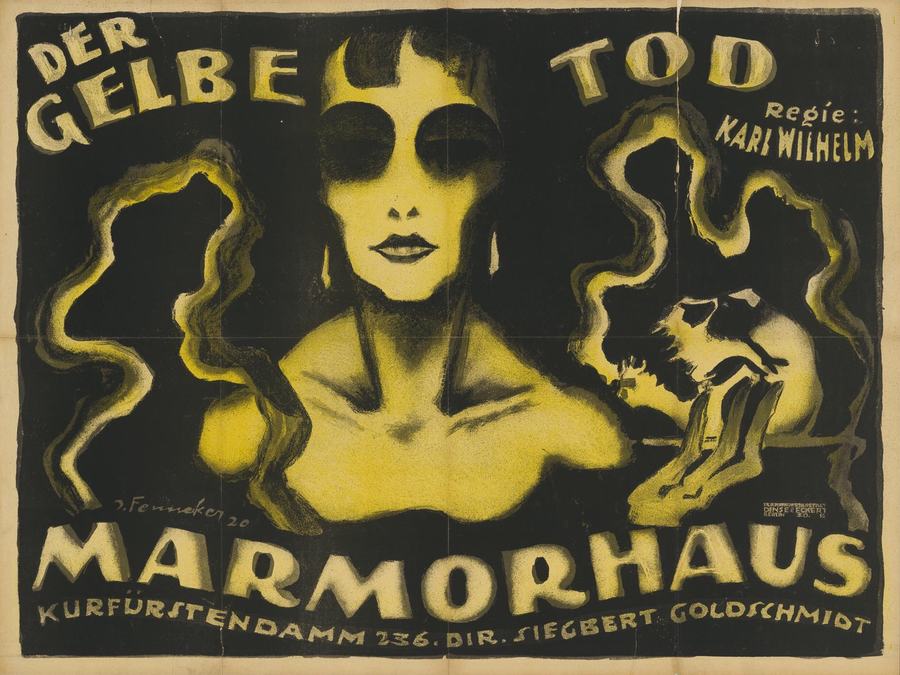
There are films that merely depict pestilence, and then there are films that become pestilence—microscopic spores of dread colonising the viewer’s imagination long after the last reel flaps against the take-up spool. Der gelbe Tod, 1. Teil belongs to the latter genus: a 1920 German artefact so ahead of its epidemiological moment that it feels less like historical fiction and more like a transmission from the next pandemic.
The plot, on parchment, reads like a municipal health report: a quarantined seaboard, dwindling serum, class revolt. But director Rudolf Klein-Rhoden dissolves that clinical scaffolding into a fever dream of Expressionist chiaroscuro—faces carved by shadow into cubist angularity; streets tilted at angles that would give Murnau vertigo; intertitles handwritten in jaundiced ink that seems still wet. The result is a cinematic Petri dish where every frame mutates under your gaze.
Colour in silent cinema? Not chromatically, but metaphorically the film drips with hue. The tinting schedule—amber for interiors, viridian for night exteriors, sulphur for laboratory scenes—creates a synesthetic score: you see contagion as a gradient. When Frida Richard (Cläre) glides through a ballroom sequence, her gown hand-painted canary on each 35mm frame, the fabric becomes a vector, a bee carrying pollen of death. One shot superimposes a microscopic slide of bacilli over her décolletage; the celluloid itself appears septic.
Gustav Adolf Semler’s Dr. Römer is no righteous saviour; he perspires moral ambiguity like a septic wound. His eyes—ringed with insomnia’s violet—betray the knowledge that every life he saves merely delays the reckoning of a larger ecological retribution. Watch how he cradles the antiserum ampoules like a guilty lover, fingers trembling with the same tremor later seen in the dockworker’s death-rattle. The performance is calibrated at 2.5 degrees off naturalism—enough to make you distrust medical authority a century before anti-vax memes.
Rosa Valetti, as the rabble-rousing pamphleteer Tine, delivers a monologue in a single unbroken shot that rivals Maria Falconetti’s Joan for raw laryngeal torque. She rants against profiteers while absently scratching the tell-tale petechial rash blooming across her clavicle; the camera dollies in until her spittle splashes the lens, as if the filmstrip itself could contract the disease.
Where does Der gelbe Tod sit on the phylogenetic tree of German silents? It’s the missing link between Dante’s Inferno’s medieval moral panic and The Golem and the Dancing Girl’s gallows humour. Like Der Katzensteg it indicts collective guilt, yet its DNA carries the sensational chromosome of Sex (the 1920 film) and the apocalyptic chromosome of '49-'17. The film’s epistolary intertitles—signed by Death himself—prefigure the narrative framing of Beatrice Fairfax Episode 1, but with far less pulp optimism.
Though silent, the film orchestrates a sonic hallucination. The projector’s mechanical flutter becomes the wheeze of congested alveoli; the metallic clatter of the shutter syncs with the iron lung cadence of the dying. Contemporary screenings with live ensemble have used bowed vibraphone and glass harmonica to mimic the timbral shimmer of bacterial membranes rupturing—proof that silence can be louder than plague bells.
Don’t overlook the film’s sly post-colonial subtext. Römer’s Sumatran backstory is relayed through ethnographic footage spliced in like a tropical fever. Natives bearing parasols of dried palm appear for exactly eight frames—long enough to implicate Western medicine’s extractive logic: the serum is distilled from the blood of colonised bodies, yet its benefits flow back to the metropole. The yellow death is thus the return of the imperial repressed, a chromatic karma.
The 2022 Bologna restoration scanned the nitrate at 8K, revealing cigarette burns that previous archivists mistook for chemical decay. Under electron microscopy those burns resolve as thumbprints—every projectionist who risked tuberculosis by handling the reel. The digital cleanup erased some scars; purists demanded they stay, arguing that scratches are the film’s antibody response. Criterion’s upcoming Blu-ray includes both the “clinical” and “scarred” viewing options—choose your own infection vector.
Part One terminates on a narrative cliff-hanger so sadistic that exhibitors in 1920 offered patrons complimentary smelling salts. The surviving synopsis of Part Two hints that the city’s elite escape on a Zeppelin only to crash into a leper colony; Römer injects himself with the last serum, becoming asymptomatic yet infectious, a Typhoid-Mary-Messiah. Whether that footage lies decomposing in a Latvian cellar or was never shot, the absence infects the extant film with a phantom limb ache.
So we are left clutching a half-healed scab of cinema, tempted to pick at it, to reopen the wound, to let the yellow bleed once more onto our retinas. And maybe that is the most honest way to watch any film about pestilence: not as spectators, but as secondary hosts.
Verdict: 9.5/10 — a virulent masterpiece that makes Westward Ho! look like a hayride and Man and His Angel feel like a lullaby. Catch it before the next pandemic buries it again.
IMDb —
1929
Community
Log in to comment.