DbcultAccessing Vault...
6/10
Senior Film Conservator
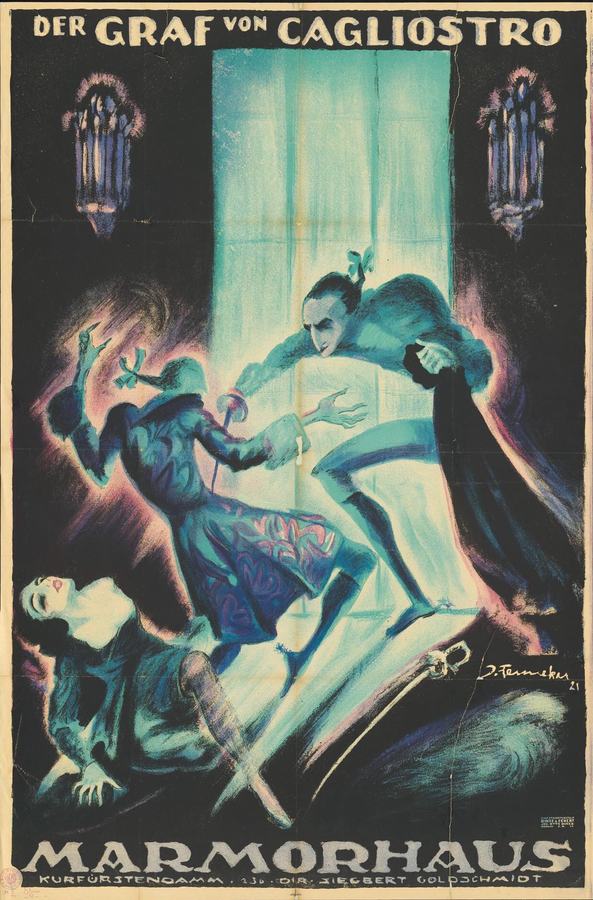
A definitive 6/10 rating for a film that redefined the boundaries of cult cinema. Der Graf von Cagliostro remains a cornerstone of transgressive art.
Stepping into the spectral glow of early 20th-century German cinema, one often encounters narratives steeped in expressionistic shadows and grand, often melodramatic, themes. Among these cinematic treasures, Der Graf von Cagliostro stands as a compelling testament to the era's fascination with historical spectacle and the enigmatic allure of the occult. This 1920 production, a collaborative effort from writers Robert Liebmann and Reinhold Schünzel, plunges us headfirst into the decadent, yet increasingly unstable, world of pre-revolutionary France, focusing its gaze on one of history's most captivating figures: Giuseppe Balsamo, better known to posterity as the audacious Count Alessandro di Cagliostro.
The film doesn't merely recount historical events; it conjures an atmosphere, a palpable sense of a society teetering on the precipice of profound change, ripe for exploitation by charismatic charlatans and genuine visionaries alike. Cagliostro, portrayed with a compelling blend of mystique and calculated charm, becomes the focal point through which we witness the anxieties and superstitions of an age. His arrival in Paris, shrouded in an aura of arcane knowledge and whispered scandal, immediately ignites the imagination of the French aristocracy. These are individuals, many of them members of the court of Louis XVI, who are simultaneously bored by their own privilege and desperate for any distraction, any promise of enlightenment or escape from their mundane, if luxurious, existence. Into this void steps Cagliostro, a master illusionist of the human psyche, offering glimpses into the future, alchemical transformations, and spiritual communion.
What makes Der Graf von Cagliostro particularly engaging is its commitment to portraying the psychological landscape that allowed such a figure to flourish. The film understands that Cagliostro's power wasn't solely in his 'magic,' but in his astute understanding of human weakness, ambition, and fear. He preys on the desperate desire for influence among the courtiers, the longing for love and beauty, and the universal fear of mortality. His séances are not just theatrical displays; they are carefully orchestrated psychological manipulations, designed to ensnare and empower him within the intricate web of Parisian society. This is a narrative that thrives on the tension between belief and skepticism, between the rational and the overtly supernatural, leaving the audience to ponder the true nature of Cagliostro's abilities – were they genuine, or merely the product of unparalleled showmanship?
The visual language of the film, typical of its period, uses dramatic lighting and elaborate set designs to enhance this sense of theatricality and grandeur. The lavish costumes and opulent interiors serve as a stark contrast to the underlying decay and moral bankruptcy that Cagliostro so expertly exploits. The film revels in the spectacle of court life, yet subtly hints at the storm brewing beneath the surface, a societal upheaval that Cagliostro, in his own way, both embodies and hastens. His presence is a destabilizing force, a catalyst for change, even if his motivations are purely self-serving.
The cast of Der Graf von Cagliostro delivers performances that are both nuanced and expressive, a hallmark of silent era acting. While the specific role assignments for each actor are not always explicitly detailed in historical records, the collective effort creates a vibrant tapestry of characters. Carl Goetz, Heinrich Jensen, Hanni Weisse, Ferry Sikla, Armin Seydelmann, Anita Berber, Conrad Veidt, Hugo Werner-Kahle, Hilde Woerner, Reinhold Schünzel, and Walter Huber each contribute to the film’s rich characterizations. One cannot discuss this film without acknowledging the magnetic presence of Conrad Veidt, whose capacity for embodying figures of intense, often unsettling, charisma was unparalleled. While his specific role here isn't Cagliostro himself (that honor likely fell to another, or perhaps was a collective portrayal through different facets), his very involvement suggests a commitment to exploring the darker, more complex aspects of human nature. Veidt, celebrated for his roles in classics like The Cabinet of Dr. Caligari, brought a unique intensity to every character he inhabited, and his contribution here, even in a supporting capacity, would undoubtedly elevate the film's dramatic weight. His ability to convey internal turmoil and a brooding intensity without uttering a single word was truly remarkable, making him a perfect fit for the atmospheric demands of silent cinema.
The supporting cast, including the formidable Anita Berber, known for her provocative performances and avant-garde lifestyle, would have brought a distinctive energy to the film's portrayal of courtly decadence. Her presence alone hints at the film's willingness to delve into the more 'lurid' aspects of Cagliostro's world, challenging societal norms and embracing a certain theatricality in her portrayal. The interplay between these actors, conveying emotions and intentions through exaggerated gestures and facial expressions, is fundamental to the film's communicative power. They collectively bring to life the credulity of the elite, the machinations of Cagliostro's inner circle, and the rising tide of discontent among the common people.
The narrative ingenuity behind Der Graf von Cagliostro can be largely attributed to its writers, Robert Liebmann and Reinhold Schünzel. Liebmann was a prolific screenwriter of the German silent and early sound eras, known for his ability to craft intricate plots and compelling character arcs. Schünzel, equally versatile, not only co-wrote but also directed and acted in numerous films, showcasing a comprehensive understanding of cinematic storytelling. Their combined talents ensure that the film is not merely a historical recreation but a dramatic exploration of themes that resonate beyond its specific setting. They understood the power of myth-making and the enduring appeal of figures who defy easy categorization, much like the Count himself. The script deftly balances the historical context with dramatic license, creating a compelling narrative that keeps the audience enthralled.
The brilliance of Liebmann and Schünzel lies in their ability to transform a historical figure, often relegated to the footnotes of history as a mere con artist, into a complex, almost mythical character. They imbue Cagliostro with an intelligence and ambition that makes his machinations believable, even captivating. The plot unfolds with a meticulous pace, gradually revealing the layers of his deception and the extent of his influence. The writers skillfully weave together various subplots involving the different characters Cagliostro encounters, each seeking something from him, thereby illustrating the pervasive nature of his influence across various segments of society.
In the landscape of silent cinema, Der Graf von Cagliostro occupies a unique space, bridging the gap between historical drama and the burgeoning genre of mystery and the occult. It shares thematic echoes with other films that explore the darker side of human nature or the manipulation of power. For instance, the psychological depth and the portrayal of a charismatic, manipulative figure might draw parallels to the complexities found in films like The Soul Master, which similarly delves into the influence of powerful individuals over others. While the specific narratives diverge, the exploration of control and psychological dominion remains a compelling through-line. The grand scale and historical setting, meanwhile, might remind viewers of other epic silent productions such as The White Sister, which also uses elaborate period details to transport its audience to another era, albeit with a different focus on moral and romantic dilemmas.
The film's exploration of secret societies and hidden agendas also finds resonance in the broader cinematic tradition. While not directly comparable in plot, the underlying tension of hidden forces at play can be felt in narratives like The Test of Honor, where moral integrity is challenged by unseen pressures. The fascination with mysticism and the supernatural, a key element of Cagliostro's appeal, was a recurring motif in early cinema, often used to create suspense or to reflect contemporary anxieties. This film, however, uses it to dissect the very fabric of belief and the mechanisms of mass delusion. It's a more sophisticated approach than a mere ghost story, offering a critical lens on societal credulity.
The dramatic tension and the focus on an individual's rise and fall against a tumultuous historical backdrop also bring to mind films that chronicle personal destinies intertwined with grand historical movements. The sense of foreboding and the eventual unraveling of Cagliostro's schemes, set against the backdrop of an impending revolution, give the film a tragic grandeur. It's a narrative that, in its own way, is as much about the decline of an old order as it is about the machinations of one man. This aspect can be subtly compared to the weight of societal changes explored in films like The Barrier, where environmental or social obstacles shape individual fates, or even the dramatic, often harsh, realities depicted in The Firing Line, albeit with vastly different contexts.
Beyond its immediate historical context, Der Graf von Cagliostro offers a fascinating reflection on the enduring human susceptibility to charismatic figures promising easy solutions or extraordinary powers. In an age saturated with information, the allure of the esoteric and the appeal of those who claim to possess privileged knowledge remains potent. The film, in its silent grandeur, speaks volumes about the timeless nature of belief, skepticism, and the perpetual dance between reality and illusion. It demonstrates that the desire for something beyond the ordinary, whether it be wealth, power, or spiritual enlightenment, can often blind individuals to the most blatant forms of manipulation.
The film's direction, while not explicitly attributed in the provided information, would have been crucial in orchestrating the complex performances and the elaborate mise-en-scène. The skillful use of light and shadow, typical of German expressionism, would have amplified the film's mysterious and foreboding atmosphere. The visual storytelling, a necessity in the silent era, would have been paramount in conveying Cagliostro's hypnotic power and the gullibility of his victims. The camera work, though perhaps less dynamic than later eras, would have been carefully composed to frame the grand gestures and intense facial expressions that defined silent acting. Every frame would have been designed to contribute to the overarching sense of enchantment and impending doom.
The legacy of Der Graf von Cagliostro lies not just in its historical accuracy or its dramatic narrative, but in its ability to capture the zeitgeist of both its subject and its own era. It's a film that asks profound questions about the nature of truth, the power of belief, and the fragility of societal structures when confronted by a force of pure, unadulterated charisma. It stands as a compelling piece of cinematic history, offering insights into the art of silent filmmaking and the enduring appeal of the legendary Count Cagliostro. For enthusiasts of historical drama, silent film, or tales of the arcane, this movie offers a rich, immersive experience that transcends the limitations of its medium. It's a journey back to an age where magic and reason clashed, and where the most powerful sorcery was often found in the human heart's deepest desires and fears.
The film's ability to maintain suspense and an air of mystery throughout its runtime is a testament to the masterful storytelling by Liebmann and Schünzel. They don't simply present Cagliostro as a villain; they craft him as an anti-hero of sorts, a product of his environment, whose actions, however self-serving, expose the hypocrisy and superficiality of the ruling class. This nuanced portrayal elevates the film beyond a simple morality tale, turning it into a social commentary wrapped in a cloak of historical intrigue and supernatural suggestion. It’s a compelling argument for the power of cinema to both entertain and provoke thought, even a century after its initial release.
In conclusion, Der Graf von Cagliostro is more than just a historical drama; it's a profound exploration of human nature, power dynamics, and the eternal struggle between enlightenment and deception. Its rich visual tapestry, compelling performances, and intelligent script make it a standout achievement of German silent cinema. It invites viewers to ponder the enduring questions of belief, manipulation, and the forces that shape history, proving that some stories, and some characters, are simply timeless.
IMDb —
1927
Community
Log in to comment.