DbcultAccessing Vault...
Cult Review
Senior Film Conservator
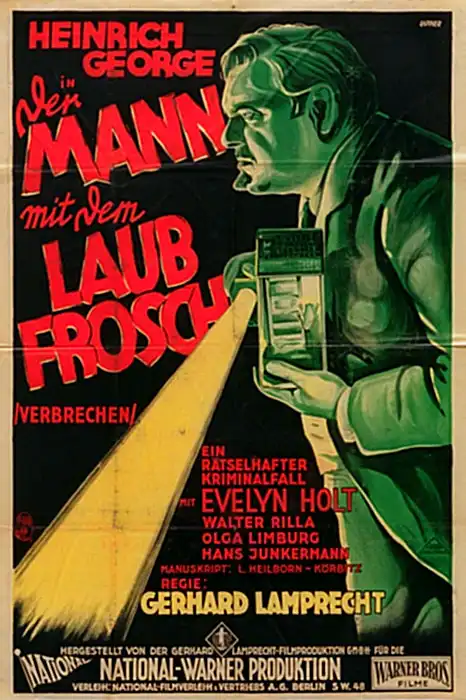
Alright, so Der Mann mit dem Laubfrosch – 'The Man with the Tree Frog.' 🐸 Right off the bat, you know this isn't going to be your average silent film. If you're a serious silent film enthusiast, someone who appreciates the oddball narratives and expressive acting of the era, you might actually get a kick out of this. But if you're just dipping your toes into black-and-white cinema, or you need fast pacing and clear motivations, you’ll probably find yourself a bit lost, or worse, bored. This one’s for the niche crowd, for sure.
The film just sort of *starts*, you know? No grand setup. We meet Herr Gustav Schmidt, played with such earnest, almost bewildered energy by Heinrich George. He’s a man of quiet habits, and yes, he has a tree frog. A very particular tree frog, named Klaus. It feels important, this frog, but it’s hard to tell if it’s a symbol or just… a frog. The way Herr Schmidt holds Klaus in his hand, looking at him with this intense, almost conspiratorial gaze, is one of those moments that just sticks with you. It’s so simple, yet so deeply weird.
The plot, if you can call it that, meanders quite a bit. It’s less about a linear story and more about a series of misunderstandings. There’s a tangled romance, naturally, involving a formidable Julia Serda, who plays Frau Braun. Her expressions are so *big*, sometimes she feels like she's acting for the back row of a massive theatre, even in close-up. Her character’s initial disdain for Herr Schmidt is palpable, almost a physical force on screen. You can almost feel the air crackle when they’re in the same room.
One scene, I remember, involved a chase through a rather crowded market. It wasn't particularly fast, more like a frantic shuffle. You could see people in the background just sort of *watching* the filming, which always gives these old movies a raw, unpolished charm. Alexander Murski, who plays the slightly villainous Baron von Kessel, had this wonderfully sneering grin that just screamed 'cad.' He didn’t even need a title card for you to know he was up to no good.
Then there's this whole subplot about a misplaced will. Or was it a letter? It gets confusing. The camera keeps cutting between different characters frantically searching through drawers and under cushions. It feels like the film is trying to convince us this document is the most important thing in the world. But honestly, I was more interested in how *everyone* seemed to dramatically throw their hands up in despair after failing to find it for the tenth time. It was a bit much.
The lighting in some of the indoor scenes is quite striking. There’s one shot of Frau Braun, framed by a huge, ornate window, and the light just pours in, highlighting her determined profile. It felt almost painterly. But then, a few minutes later, the lighting would be flat and functional. Very inconsistent. You get the sense they were experimenting on the fly.
And the frog, Klaus, reappears at the most unexpected times. At one point, Herr Schmidt is having a heated argument with someone, maybe it was Walter Rilla’s character, the stern Herr Müller, and the frog just sits on his shoulder. Completely unfazed. It’s such a small detail, but it just elevates the *peculiarity* of the whole thing. It almost feels like a deliberate comedic beat, but it's played so straight.
The film's pacing is definitely a slow burn. There are moments where you just watch characters walking for what feels like an eternity. Or sitting. Just sitting and thinking. No real action. It makes you wonder what was going through the director’s mind, Gerhard Lamprecht. Was it artful contemplation or just stretching the run time? Hard to say.
Evelyn Holt, playing the ingenue, Elsa, is lovely, all wide-eyed innocence. But her character often feels like she’s just there to be swooned over or rescued. Not a ton of agency. She has one scene where she drops a teacup, and her reaction is so over-the-top, a full body shudder, it was genuinely funny. I don’t think it was supposed to be funny, but there you go.
You can tell the movie *wants* to be dramatic. There are plenty of close-ups on trembling hands and furrowed brows. But sometimes, the melodrama just tips over into the absurd. Like when Heinrich Gretler's character, the grumpy landlord, suddenly bursts into tears over a broken vase. A broken vase! It was a moment that made me question everything I thought I knew about silent film emotional arcs. 😂
So, is it worth seeking out Der Mann mit dem Laubfrosch? If you've exhausted all the famous silent films and you're looking for something truly off-kilter, something that makes you think, 'What on earth did I just watch?' in the best possible way, then yes. It's a curiosity. A strange little gem, maybe a bit rough around the edges, but with a surprising amount of heart, and of course, a very memorable frog. Just don't expect it to make perfect sense.
IMDb —
1916
Community
Log in to comment.