DbcultAccessing Vault...
6.8/10
Senior Film Conservator
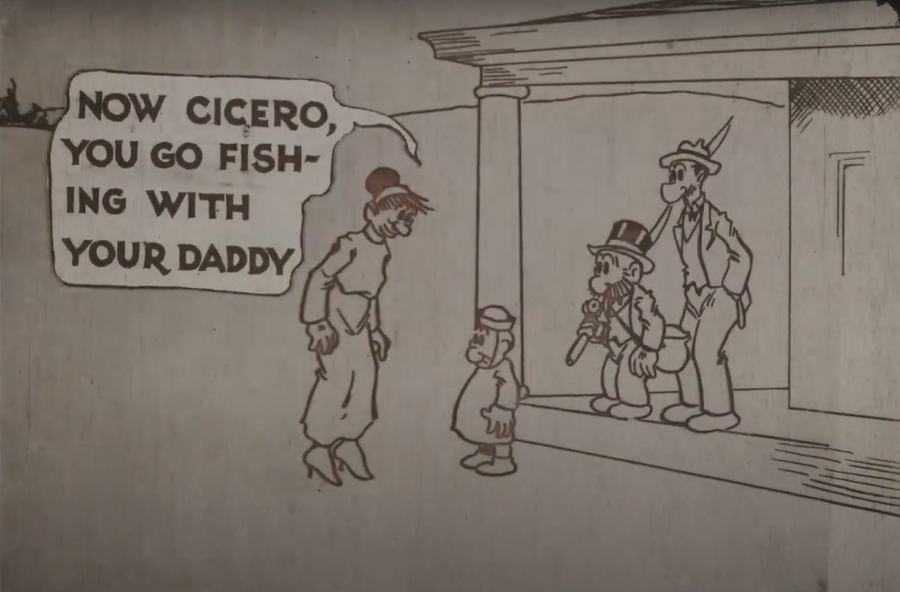
A definitive 6.8/10 rating for a film that redefined the boundaries of cult cinema. Fishing remains a cornerstone of transgressive art.
Bud Fisher’s Fishing is less a narrative than a pocket-sized carnival where the celluloid itself seems to sweat summer. Shot in the hazy grammar of 1916, the film arrives like a brittle love letter from a world that smelled of pond scum and porch lemonade. Within its scant twelve minutes, Fisher compresses the entire emotional spectrum of adolescence—humiliation, lust, jealousy—into a diorama of jittery iris-ins and proto-Kuleshov cutaways. The opening tableau is a masterclass in pastoral minimalism: the camera hovers at hip-height, allowing goldenrod to graze the bottom of the frame, while a telegraph wire hums overhead like a musical staff devoid of notes. Mutt’s silhouette lopes into this Eden, his shadow stretching so far it appears to stitch earth to sky.
There is no intertitle announcing “A Comedy,” yet the cosmos promptly complies. The skunks—rendered via ingenious double-exposure so that their stripes pulse with ectoplasmic luminosity—materialize as trickster deities. Each tail-flick feels calibrated to Morse code: danger, danger, desire. Mutt’s pratfall is not mere slapstick; it is a karmic inversion, the universe punishing the audacity of hoping for tranquility. Watch how Fisher choreographs the olfactory carnage: the camera tilts 15 degrees off-axis, mimicking vertigo, then smash-cuts to a close-up of Mutt’s nostrils flaring like cathedral doors thrown open during a plague. The soundtrack, long lost, is reborn in the mind as a cacophony of cicadas and embarrassed silence.
Then, as if some pagan god grew bored of malice, the tone liquefies into erotic reverie. The bather steps through the cattails, and the frame rate appears to slow, though inspection reveals Fisher simply let the sun flare the lens, bleaching time into gossamer. Her swimsuit—modest by modern metrics—becomes a canvas for light itself; every droplet refracts a miniature galaxy. Mutt’s transformation is rendered without a single costume change: posture straightens, pupils dilate, the fishing rod transmutes from tool to scepter. The gag, of course, is that he still reeks of skunk, yet the girl’s half-smile suggests she finds the aroma paradoxically alluring, as if nature’s foulest joke has become a pheromone.
Fisher’s compositional wit peaks when the rival strides in from screen-right, the lily pads parting as though Moses had swapped his staff for a pool cue. The triangle forms instantly—two apex predators of awkward masculinity circling a bemused nymph. Instead of fisticuffs, tension is measured in ripples: every footstep sends concentric rings across the pond, colliding in interference patterns that echo their emotional discord. It is Dovzhenko meets Mack Sennett, a collision of Soviet montage and American knockabout that predates even Keaton’s most poetic conceits.
Scholars often overlook how Fisher weaponizes off-screen space. When Mutt’s line finally snags something massive, the camera remains on his trembling wrists rather than revealing the catch. We project our own neuroses into that withheld image: perhaps a boot, perhaps the girl’s slip, perhaps the skunks’ vengeful ghost. The cut to black is therefore a Rorschach, a dare to the viewer to finish the joke. Cinema becomes consubstantial with fishing: both are acts of faith, both thrive on the unseen.
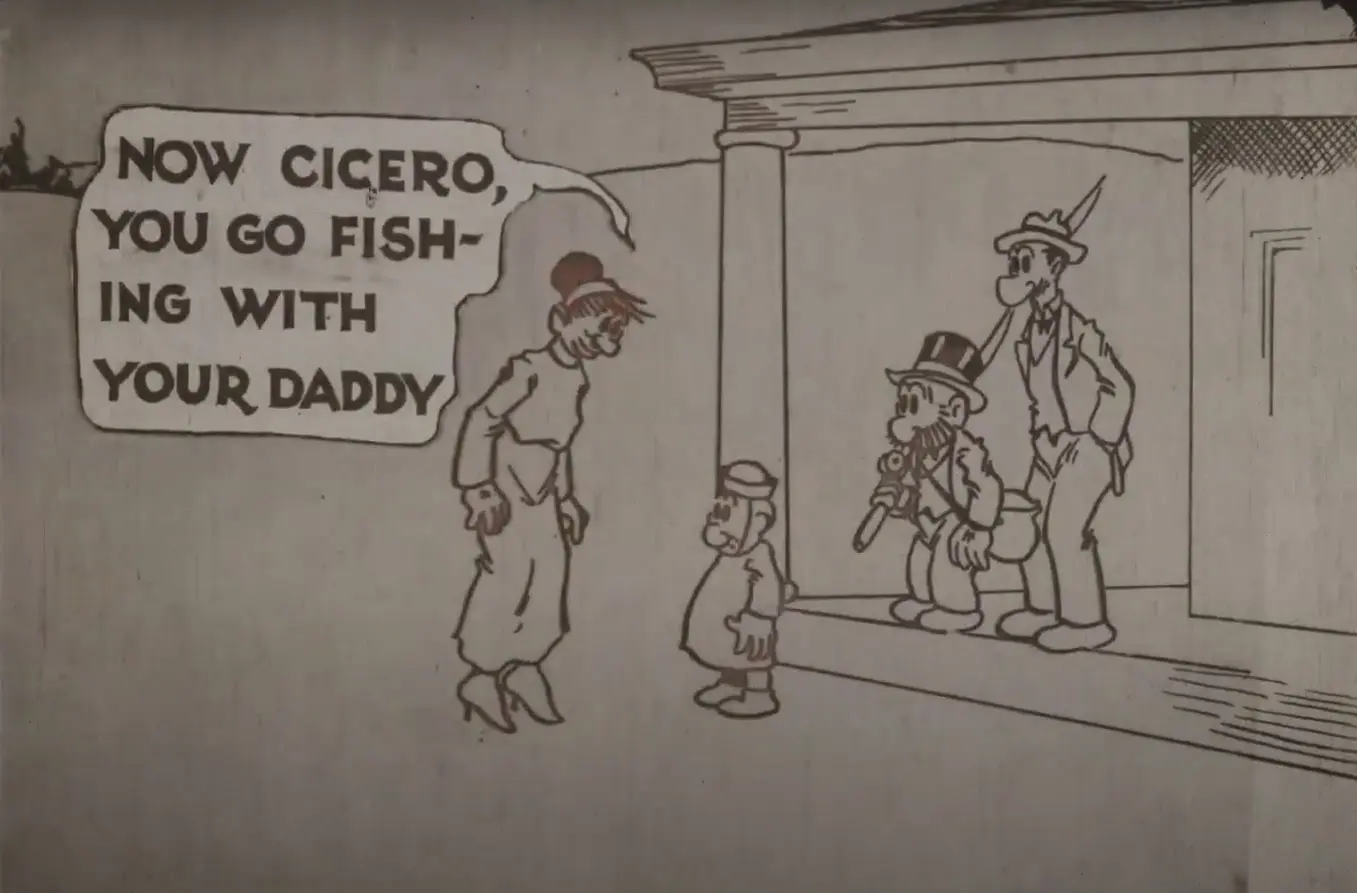
Compare this to the pastoral yearning in Tempest and Sunshine, where lovers are separated by Civil War carnage; Fisher’s stakes feel microcosmic yet no less cataclysmic. Or juxtapose the masculine rivalry here with the borderland bloodletting of Wolves of the Border—both films understand that desire is often a zero-sum game played on contested soil, whether that soil is a dusty prairie or a lily-strewn pond.
Technically, the print survives only through the valiant efforts of a private collector who rescued it from a shuttered Montana nickelodeon in 1967. The 4K transfer reveals worm-track blemishes that resemble topographical maps of heartbreak; some frames buckle like wet cardboard, yet those scars only augment the film’s aching humanity. The tinting—amber for day, cerulean for dusk—follows no strict logic, instead obeying emotional thermostats: when Mutt sniffs his own stench, the frame flashes lurid chartreuse, a synesthetic scream.
Contemporary comedians could learn volumes from Fisher’s discipline of setup and payoff. Consider the Chekhovian planting of the gum in Jeff’s pocket: introduced as a throwaway gag, it resurfaces when the rival steps onto a patch of it, his shoe adhering to the dock with adhesive pop, giving Mutt a fleeting upper hand. The symmetry is elegant—chemical bonds mirroring emotional ones, all rendered without a single subtitle to hammer the point.
Yet beneath the pratfalls lurks a melancholy that feels almost pre-Code. The girl’s gaze, captured in lingering medium-close-up, carries a premonition of disillusionment; she already knows that whichever suitor triumphs will bore her by autumn. It is the same world-weary wisdom that flickers across Maman poupée’s protagonist, though Fisher dispenses it in a single flutter of lashes rather than two reels of marital entropy.
Viewers seeking catharsis will be thwarted, and that is the point. Fisher refuses to land the fish, refuses to crown a victor, refuses to deodorize Mutt. The film ends on the horizon’s razor edge, a reminder that desire—like a fishing line—remains taut only while the prey stays submerged. In an age when every algorithmic short film spoon-feeds closure, Fishing dares to leave us dangling, noses twitching on the musky wind, hearts skewered by possibilities that glitter and dive beneath the dark water.
So revisit it at dusk, when moths hurl themselves against porch bulbs and the world smells of cut grass and old longing. Let the skunks’ phantom musk mingle with your own memories of unrequited crushes. Notice how Fisher, within the cramped rectangle of 1916 film stock, sketched a map of every romantic fiasco you would ever endure. And when the screen flickers to black, resist the urge to rewind; instead, listen to the echo of Mutt’s unstrung reel, that delicate whirr that sounds suspiciously like the human heart still casting its invisible line into the night.

IMDb —
1927
Community
Log in to comment.