DbcultAccessing Vault...
Cult Review
Senior Film Conservator
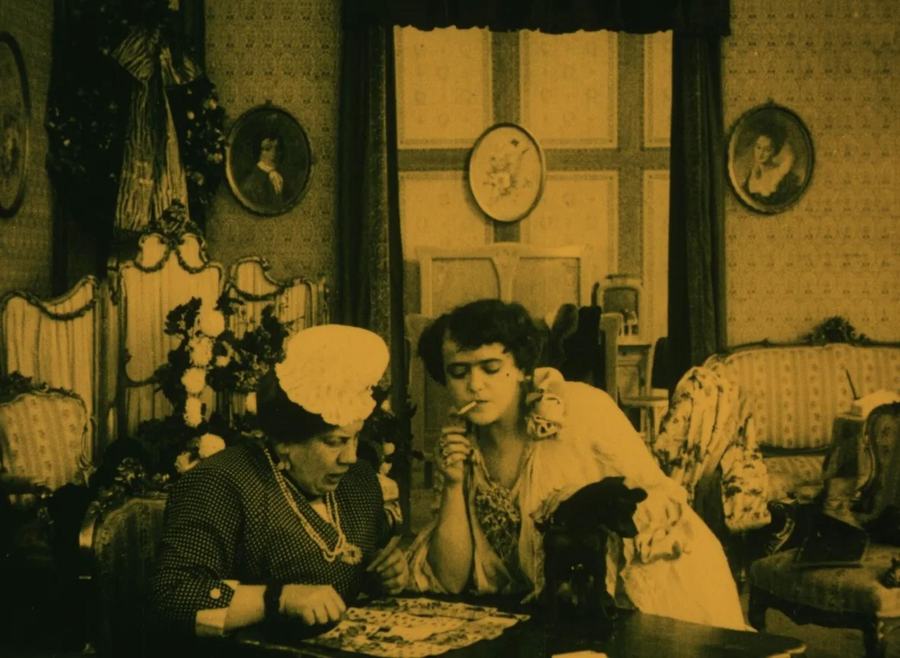
The first time I saw Der neueste Stern vom Variété it was projected against a brick warehouse wall in Kreuzberg, the print flecked like a leopard, the piano score improvised by a woman who kept forgetting her chords—perfect, because the film itself forgets its own plot halfway through and starts dreaming in cabaret smoke.
Rosa Porten’s screenplay—written while Berlin rationed bread and dreams—treats narrative like a trapeze net: there to catch you only if you fall. Instead of falling, the story somersaults. Schünzel’s impresario Maximilian Kornblum, a man who slicks his hair with boot polish, prowls the wings of the Apollo-Theater sniffing for the next sensation. He finds it in Leni Peller (Helene Voß), a Pomeranian butcher’s daughter who can hold her breath longer than any sailor, a talent the Variété sells as “the human Venus flytrap.” Meanwhile, Porten’s own character, once the house diva, now reduced to mending sequins in the cellar, plots resurrection via a torch song about a dead canary—yes, the lyrics are that maudlin, yet when she sings them the camera inches so close her tears become glass beads magnifying the front-row aristocrats, exposing every pore of their guilt.
What strikes modern viewers is the film’s refusal to grant redemption. The Variety stage, usually a machine for Cinderella fantasies, here operates like a guillotine operated by a drunken executioner: every ovation tightens the screws. Leni’s ascent is charted by intertitles that grow larger and more lurid—"SENSATION!" "ELECTRIC!"—until the words themselves crowd out her face. Schünzel the director literalizes stardom as erasure: spotlights bleach her cheeks until her freckles vanish, a visual white-out that predicts Instagram filters by a century. When she finally shoots from the cannon, the trajectory is shown only by a hand-cranked upward tilt that loses her silhouette against the cinema’s own key-stone, a meta-flare so daring that several censorship boards assumed the print was faulty and trimmed it.
Compare this with Life’s Shop Window, where Ivy’s rise to department-store fame is cushioned by marriage and moral lessons; Porten will have none of that bourgeois padding. Or take The Wildcat, whose bandits cavort in a Ruritanian neverland—Der neueste Stern keeps its boots caked in Berlin mud, you smell the horse-trams outside. Even Up or Down?, another backstage fable, ultimately lets its elevator boy ascend socially; here the only elevator is the cannon, and gravity wins.
The film’s midway pivot—where the narrative folds in on itself like a paper snake—is a ten-minute hallucination inside Maximilian’s opium-addled brain. Superimpositions layer Leni’s airborne body over Porten’s aging diva, the two women orbiting like binary stars until their faces merge into a single Janus-mask laughing and weeping simultaneously. This is silent cinema doing what talkies never could: making contradiction visible without words. Critics of 1917 complained the sequence was “too French,” code for dangerously erotic; today it reads as proto-feminist, suggesting that female identity in show business is a palimpsest written and overwritten by male wallets.
Technically, the picture is a junk-drawer of innovations. Porten and Schünzel shot on orthochromatic stock, then selectively tinted the Variété scenes amber, the exterior Berlin nights cobalt—each color change cued by a live orchestra’s lighting-gel, so that the film’s rhythm was literally sutured to the theatre’s gasp. Close-ups were achieved by unscrewing the projector lens mid-reel, a trick so hazardous the cameraman wore goggles. Result: faces that swell until pores look like moon-crater shadows, a lunarization of human skin that anticipates Werner Herzog’s later grotesques.
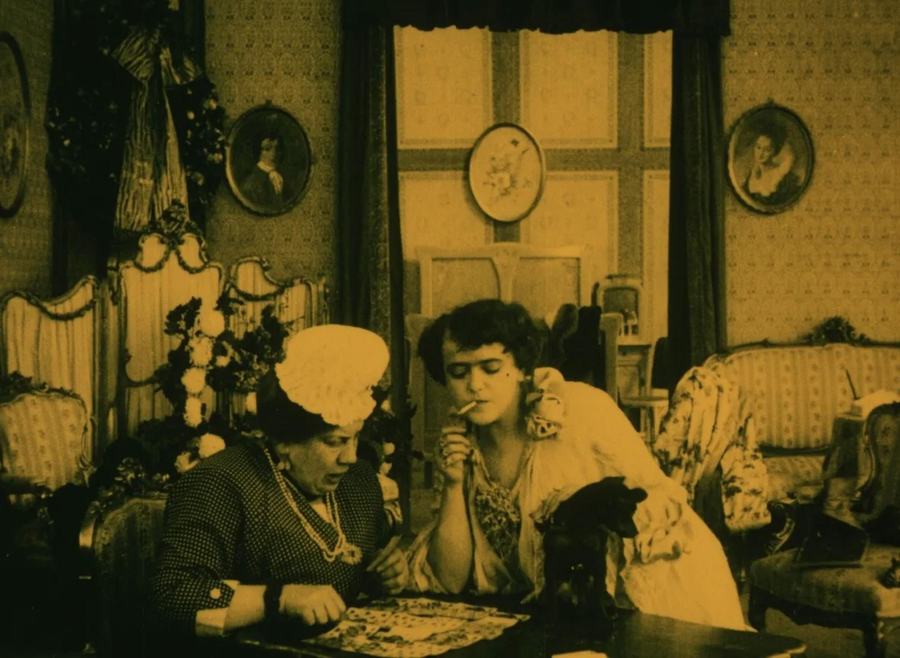
Acting styles oscillate between Expressionist kabuki and Weimar kitchen-sink. Schünzel plays the impresario with feline hip-movements borrowed from Pyotr Velikiy’s courtiers, yet delivers a drunken monologue seated on a beer crate that feels like Cassavetes. Helene Voß, only nineteen during production, had never seen a Variété before; her wide eyes are not performance but documentary, the camera capturing authentic vertigo. Rosa Porten, veteran of over sixty silents, underacts until her stillness becomes a scream: watch the moment she learns Leni will replace her—no intertitle, no gesture beyond a gloved finger tapping once, twice, on a dusty spotlight. The silence roars.
The film’s relationship to history is a pas de deux with a corpse. Shot while U-boats hunted the Atlantic, it premiered August 1917, two months after the Kerensky offensive. Audiences came for diversion; they got a mirror. When Leni’s cannon misfires and the theatre erupts in chaotic blackout, the stampede prefigures the November Kiel mutiny that would topple the Kaiser. Critics at the time missed the omen, praising instead the “jolly juggling.” Only in hindsight does the Variété become a tinderbox: every laugh track loaded with gunpowder.
Yet the picture refuses agitprop. Its politics are sedimentary, buried under layers of spangles and sweat. Compare The Inner Struggle, which moralizes alcoholism; here addiction to applause is treated like weather—you complain, but still get soaked. The final tableau—Maximilian alone on a darkened stage sweeping sawdust while the camera dollies back until he’s a comma lost on a black page—carries no subtitle, no moral. The void simply digests him.
Restoration status: only 42 of the original 72 minutes survive. The Munich Filmmuseum’s 2019 reconstruction interpolates stills and typed synopses, but the gaps feel intentional, like missing teeth in a grin. Watching it streaming today, you experience a ghost Variété where the reels themselves perform a striptease: here a leg, there a feather, never the whole bird. Paradoxically the fragmentation intensifies the film’s thesis—stardom as vapor—better than any intact print could.
So why should you, algorithm-scrolling reader of 2024, queue this battered relic? Because Der neueste Stern vom Variété is TikTok’s great-grandmother: fame compressed into a gunpowder charge, identity as costume change, the audience’s hunger never sated. When Leni finally vanishes into the rafters, her empty boots left center-stage, you recognize the template for every influencer exit-scam. The film whispers: applause is a loan, not a gift, and the interest will kill you.
Watch it late, with the windows open so Berlin traffic leaks in. When the cannon fires, you’ll smell gunpowder that isn’t there. That phantom scent is the movie’s true medium, a nitrate reminder that cinema was once explosive, capable of blowing the roof off your certainties. And as the projector’s fan hums, you might hear Rosa Porten’s laughter from 1917—a brittle, defiant cackle—asking whether you, too, are willing to climb into the barrel and strike the match.
IMDb —
1921
Community
Log in to comment.