DbcultAccessing Vault...
Cult Review
Senior Film Conservator
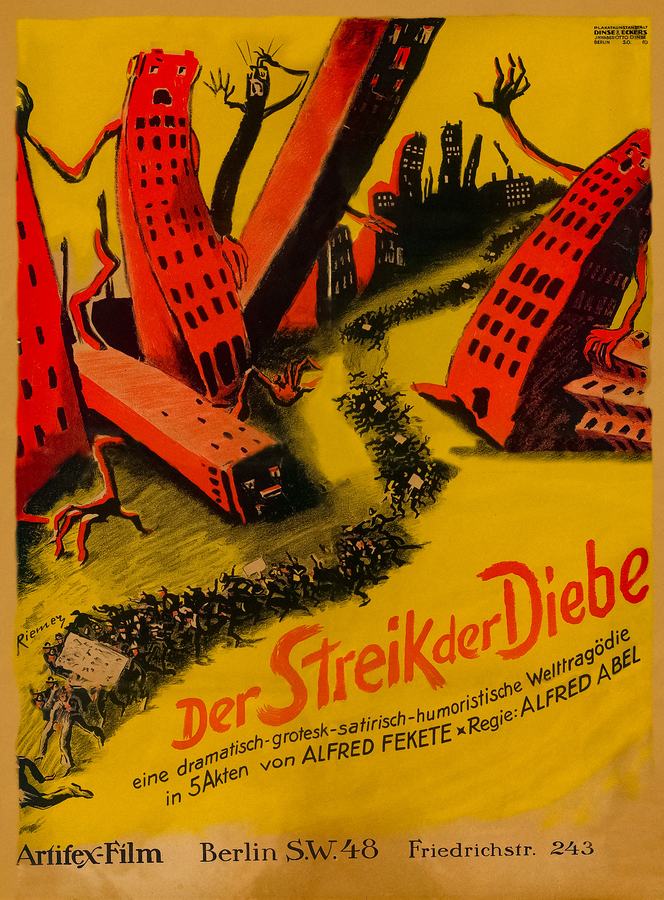
In the shadowed alleys of interwar Europe, where the line between legality and transgression blurs like smoke, Der Streik der Diebe (1927) emerges as a silent film that crackles with existential irony. Directed with a scalpel’s precision by Alfred Fekete, this Austrian-German co-production isn’t merely a comedy of errors—it’s a fever dream of societal entropy, where the collapse of crime becomes the harbinger of global ruin. The film’s premise is both audacious and absurd: when the president of the Property Compensation Society—a guild representing thieves—is spurned in his marriage proposal to the Prime Minister’s daughter, the entire organization goes on strike. The ripple effects are catastrophic. Courts empty. Policemen twirl their mustaches in existential dread. Insurance companies, their balance sheets hemorrhaging, lay off employees en masse. The economy, tethered to the perpetual churn of theft and restitution, teeters on the brink of collapse.
Themes of Power and Absurdity
At its core, Der Streik der Diebe is a masterclass in satirical inversion. By framing crime as a foundational pillar of economic and political stability, the film exposes the fragility of systems that thrive on perpetual exploitation. The Property Compensation Society isn’t just organized crime—it’s organized interdependence, a cabal whose members are as indispensable to the state as the state is to their survival. When the strike begins, the film’s tone oscillates between farcical and foreboding. Hackneyed tropes of silent-era slapstick—dumbfounded authorities, chaotic paperwork montages—are elevated by Fekete’s refusal to offer redemption. There are no heroes here, only stakeholders in a broken system. The Prime Minister’s daughter, a cipher of privilege, becomes a catalyst for chaos, her rejection a microcosm of class-based disdain. Her father’s inability to comprehend the thief’s perspective mirrors the myopia of leaders who mistake transactional loyalty for genuine respect.
Performances: Theatricality and Nuance
Hans Kuhnert, as the beleaguered guild leader, embodies the tragicomic duality of the protagonist. His performance is a study in suppressed rage and wounded pride, his every gesture a blend of petty grievance and grandiose self-regard. Charlotte Ander, as the aloof aristocrat, delivers a portrayal so devoid of emotion it borders on existential critique. The film’s supporting cast—Alfred Abel as a beleaguered judge, Maria Orska as a scheming accomplice—adds layers of theatrical flair, their exaggerated expressions underscoring the film’s absurdist heart. Victor Colani’s turn as a bureaucratic red-tape specialist is a particular highlight, his physical comedy a metatextual wink at the futility of institutional rigidity.
Visual Storytelling: Economy of Motion
Fekete’s direction is a masterstroke of visual economy. The film’s pacing is deliberate, each scene a carefully constructed domino in a chain reaction of societal decay. The use of geometric framing—sharp angles, stark contrasts—echoes the rigid structures of the worlds it critiques. In one unforgettable sequence, a courtroom scene is reduced to a tableau of empty chairs and a single, disheveled bailiff, the visual equivalent of a silent scream. The film’s score, though absent in most surviving prints, is imagined here as a discordant blend of waltz and dirge, a fitting aural complement to the chaos on screen.
Comparisons and Legacy
While Der Streik der Diebe owes a debt to the slapstick of The Lost Bridegroom and the political satire of The Stolen Treaty, it distinguishes itself through its unrelenting bleakness. Unlike the more lighthearted Just for Tonight, which romanticizes chaos, Der Streik der Diebe treats societal collapse as an inescapable conclusion. It shares thematic DNA with The Dictator in its exploration of power dynamics, though its focus on institutional complicity is far more pronounced. For modern audiences, the film’s critique of capitalism’s reliance on exploitation resonates with the same sharpness as Code of the Yukon in its examination of moral codes in harsh environments.
The film’s legacy is one of paradox. Forgotten by mainstream cinema, it has been rediscovered by scholars of interwar European film as a prescient commentary on the fragility of social order. Its influence can be glimpsed in the absurdist humor of The Atom and the dystopian undertones of Lucrezia Borgia, both of which grapple with the intersection of power and morality. Yet Der Streik der Diebe remains sui generis, its blend of farce and existential dread forging a path untrodden by its contemporaries.
Final Thoughts: A Mirror Held Up to Society
To watch Der Streik der Diebe is to witness a world where the rules are rewritten by those society deems deviant. The film’s greatest strength lies in its refusal to offer solutions—its world is one of perpetual motion, where every system is a house of cards. It challenges viewers to ask: Is the strike of the thieves a revolution or a revelation? By the time the final reel rolls, one thing is clear: in Fekete’s universe, the only constant is instability. The film’s bleak humor and unflinching gaze into the abyss make it a must-see for anyone interested in cinema’s capacity to interrogate power structures. For those seeking a deeper dive into the absurdity of institutionalized crime, The Misleading Lady and The Scoffer offer complementary takes, though neither matches the raw audacity of this 1927 gem.
IMDb —
1936
Community
Log in to comment.