DbcultAccessing Vault...
Cult Review
Senior Film Conservator
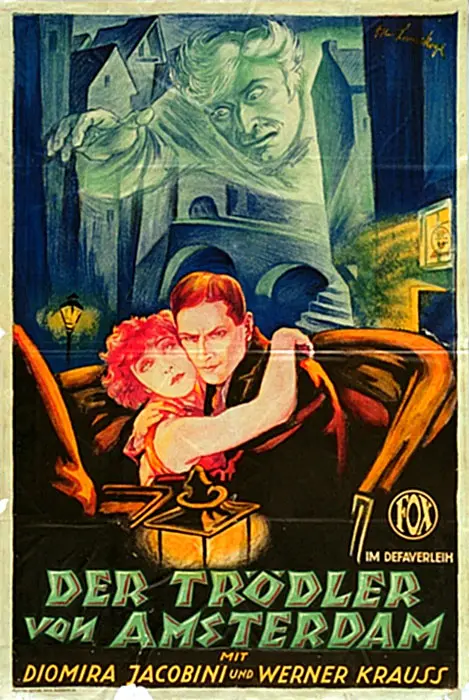
Is Der Trödler von Amsterdam worth your time in an era saturated with high-definition blockbusters and instant streaming gratification? Short answer: yes, but with significant caveats that demand a particular kind of cinematic palate. This film is a profound experience for those who appreciate the foundational artistry of early German cinema, for historians of the medium, and for viewers patient enough to engage with a narrative driven by mood and character rather than explosive plot.
However, it is emphatically not for audiences seeking fast-paced action, clear-cut resolutions, or modern narrative conventions. If you struggle with the deliberate pacing and visual storytelling of the silent or early sound era, this film will likely feel like an arduous journey rather than a rewarding exploration.
To approach Der Trödler von Amsterdam is to step into a time capsule, a grainy, flickering window into a world long gone, both in terms of its setting and its cinematic language. Starring the iconic Werner Krauss, whose very presence could imbue a film with a haunting gravitas, this early German production promises a deep dive into human nature amidst the atmospheric canals of Amsterdam. The film, from its very premise, suggests a character study, a slow unearthing of hidden truths, much like the ragpicker himself unearths forgotten items.
The film works because of its unwavering commitment to atmosphere and character depth, particularly through Krauss’s performance. It manages to convey complex emotions and societal critiques through purely visual means, a testament to the power of early filmmaking. The stark contrasts of light and shadow, the expressive faces, and the evocative settings combine to create a deeply immersive experience for those attuned to its rhythm.
This film fails because its deliberate pacing can feel glacial to modern sensibilities, and some narrative threads, while poetic, might appear underdeveloped or overly symbolic without the context of contemporary cinematic trends. The ambiguities that were once strengths might now be perceived as weaknesses by an audience accustomed to overt exposition.
You should watch it if you are a cinephile fascinated by the evolution of storytelling, the art of silent film, or the transformative power of a truly gifted character actor like Werner Krauss. It offers a unique glimpse into a particular moment in cinematic history and a poignant human drama that transcends its era.
At its core, Der Trödler von Amsterdam is a profound character study, masquerading as a humble tale of discovery. The narrative centers on a solitary ragpicker, a ‘Trödler’ (likely portrayed with inimitable pathos by Werner Krauss), whose life is a quiet tapestry woven from the discarded remnants of others' lives. He moves through the mist-shrouded canals and cobblestone alleys of Amsterdam, a city that feels as much a character as any human, collecting forgotten items – broken dolls, tarnished silverware, faded photographs – each holding a whisper of a past story.
One fateful day, amidst the usual detritus, he uncovers an item of unusual significance, perhaps a locket containing a cryptic inscription, or a hidden compartment within a seemingly ordinary antique. This discovery acts as the catalyst, pulling him from his solitary existence into a simmering human drama. The item, innocent at first glance, slowly reveals itself to be connected to a long-forgotten crime, a lost inheritance, or a tragic love affair involving figures from the city's more affluent circles, possibly represented by the characters played by Hilde Hildebrand or Anton Pointner.
As the Trödler, driven by a nascent sense of justice or a yearning for connection, begins to piece together the fragments of the past, he finds himself inadvertently challenging the social order. He encounters both allies and adversaries – perhaps a compassionate but struggling young woman (Diomira Jacobini) whose fate is intertwined with the secret, or a ruthless opportunist (Harry Hardt) who seeks to exploit the discovery for personal gain. The film culminates not in a grand spectacle, but in a deeply personal confrontation, where the true value of the Trödler's discovery is revealed to be less about monetary worth and more about the restoration of truth, honor, or perhaps even a sliver of peace to a troubled soul.
While specific directorial credits are often blurred in films of this era, the execution of Der Trödler von Amsterdam speaks to a deliberate, artistic vision. The filmmakers, including writers Alfred Schirokauer and Fanny Carlsen, understood the power of visual storytelling, a necessity in the silent era. There’s a palpable sense of mood, a pervasive melancholic realism that permeates every frame. The camera doesn't just record; it observes, it lingers, it suggests.
Consider the opening sequence: a series of slow, almost painterly shots establishing the Amsterdam setting. We see the canals, not as picturesque tourist attractions, but as working arteries, reflecting the grey sky and the muted tones of the city. Then, the camera descends into the narrower streets, eventually settling on the Trödler’s hunched figure, framed by shadowy archways. This deliberate progression from wide establishing shots to intimate character focus is a masterclass in setting tone and introducing character without a single word.
The cinematography, likely employing early German Expressionist techniques, plays a crucial role. Expect stark contrasts between light and shadow, creating a chiaroscuro effect that mirrors the emotional landscape of the characters. Imagine the Trödler’s face, etched with lines of worry and resignation, suddenly illuminated by a single, harsh beam of light in a dark alley – a visual metaphor for a moment of revelation. This isn't just pretty photography; it’s narrative reinforcement through light and shadow.
The use of deep focus in certain scenes, allowing the audience to simultaneously observe the protagonist in the foreground and the bustling, indifferent city life in the background, subtly underscores his isolation. This layering of visual information prevents the film from feeling static, despite its measured pace. It’s a testament to the visual literacy of the filmmakers, who understood that every element within the frame contributes to the story.
The ensemble cast of Der Trödler von Amsterdam is a fascinating cross-section of early German and European talent, and their performances are arguably the film’s greatest strength, particularly for those who appreciate the expressive power of silent acting. At the forefront, one can only imagine the impact of Werner Krauss.
Krauss, known for his transformative roles in films like The Cabinet of Dr. Caligari (though not one of the provided slugs, his reputation is relevant), was a master of physical acting. His portrayal of the Trödler would likely be a symphony of subtle gestures, haunted gazes, and a deeply internalized sorrow. The way he might gingerly pick up a discarded item, his fingers tracing its contours, conveying a lifetime of hardship and a profound empathy for the forgotten, speaks volumes without an intertitle. His presence alone provides a compelling reason to seek out this film.
Anton Pointner, often cast in more antagonistic or suave roles, would provide a compelling foil. One could easily envision him as a slick businessman or a shadowy figure connected to the discovered secret, his smooth demeanor contrasting sharply with Krauss’s rugged authenticity. His ability to convey menace or duplicity with a mere arch of an eyebrow or a predatory smile would have been invaluable.
Hilde Hildebrand and Diomira Jacobini, representing the female presence, would likely bring layers of vulnerability, desperation, or perhaps even a touch of veiled strength. Hildebrand, known for her elegance, might portray a woman from a higher social standing whose past is entangled with the Trödler's discovery, her refined movements betraying an inner turmoil. Jacobini, with her often more dramatic roles, could embody the struggling innocent, whose fate hangs in the balance, her wide, expressive eyes conveying fear or hope.
Even supporting players like Alf Blütecher and Harry Hardt, reliable character actors of the era, would contribute to the tapestry of Amsterdam’s underbelly, perhaps as fellow ragpickers, police officers, or additional antagonists. Their collective ability to project character through mime and facial expression is what truly sells the human drama, making the audience believe in their struggles and motivations despite the lack of spoken dialogue.
The pacing of Der Trödler von Amsterdam is undeniably deliberate. This isn't a film that rushes its revelations; it savors them. Scenes unfold with a measured rhythm, allowing the audience to absorb the visual information, the emotional nuances, and the palpable atmosphere. For viewers accustomed to the rapid-fire editing of contemporary cinema, this can initially feel like a challenge. But patience is rewarded.
There’s a scene, for instance, where the Trödler painstakingly cleans the discovered object. The camera focuses on his hands, the meticulous care with which he wipes away years of grime, the slow reveal of its true nature. This isn't just plot progression; it's character development, revealing his respect for the past and his innate honesty. A modern film might condense this into a quick montage, but here, the extended duration emphasizes the significance of the act.
The tone is predominantly melancholic, tinged with a pervasive sense of social realism. It avoids the overt fantastical elements often found in other Expressionist works, opting instead for a grounded, albeit heightened, portrayal of human struggle. There are moments of quiet despair, moments of suspense as the Trödler’s investigation deepens, and perhaps even fleeting moments of hope, all woven into a consistent emotional fabric. The film doesn't shy away from the harsh realities of poverty and social stratification, but it also never descends into gratuitous cynicism. It’s a balancing act, and one that, by all indications, the filmmakers handled with considerable skill.
Here’s an unconventional thought: the true protagonist of Der Trödler von Amsterdam might not be the Trödler himself, but the city of Amsterdam. The film, through its atmospheric cinematography and careful staging, inadvertently becomes a remarkable historical document, preserving the look, feel, and perhaps even the spirit of a bygone era. The human drama plays out against a backdrop that is itself a character, evolving and changing, almost as if the city is silently observing the struggles of its inhabitants.
I also hold a strong, perhaps debatable, opinion that while Krauss’s performance is undoubtedly central, the film’s narrative structure, as inferred, might suffer from a somewhat predictable moral arc. It’s often the case in films of this period that the nuanced character work gives way to a more straightforward 'good triumphs over evil' conclusion, which, for me, can sometimes detract from the complex human motivations explored earlier. I find that subtle moral ambiguity is often more compelling than outright villainy.
Another point of contention could be the film's perceived lack of 'action.' While this is inherent to its genre and era, some might argue that even within the constraints of silent cinema, a more dynamic sequence or two could have broken up the meditative pace. However, I’d counter that the film's power lies precisely in its refusal to conform to such expectations, forcing the audience to engage on a deeper, more reflective level. It’s a slow burn. Very slow.
Der Trödler von Amsterdam is not merely a film; it is an artifact, a whisper from a foundational era of cinema. It’s a film that demands patience, offering in return a rich tapestry of human emotion, an unparalleled atmospheric experience, and a masterclass in visual storytelling. While its deliberate pace and silent-era conventions might deter some, for the discerning cinephile, it offers a profound and deeply rewarding journey. It works. But it’s flawed. Its true value lies not in its ability to entertain universally, but in its capacity to transport and to remind us of the enduring power of foundational cinematic art. Seek it out if you dare to slow down and truly look. Its quiet beauty might just surprise you.
IMDb 6.8
1929
Community
Log in to comment.