DbcultAccessing Vault...
6/10
Senior Film Conservator
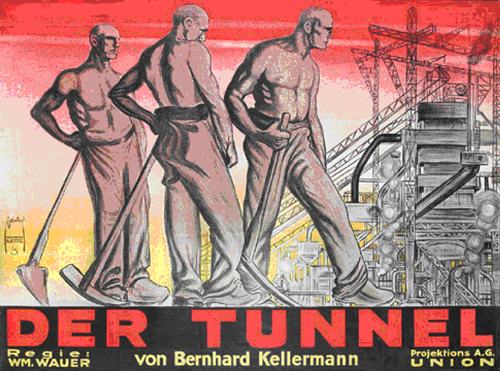
A definitive 6/10 rating for a film that redefined the boundaries of cult cinema. Der Tunnel remains a cornerstone of transgressive art.
Berlin, winter 1925: outside the Ufa-Palast am Zoo the air tastes of coal smoke and yesterday’s revolutions, but inside the projector births a parallel universe where the Atlantic Ocean is merely a puddle to be bridged by hubris and hydrostatic equations. Der Tunnel, newly restored in 4K by the Deutsche Kinemathek, arrives like a molten telegram from a century when cinema itself was an experimental drill boring into the psyche. Forget steampunk cosplay—this is the genuine article, brass rivets and all, pulsing with the reckless metabolism of a republic that fears it may already be a ghost.
Director William Wauer, better known for sculpting tormented portraits in the vein of Marga, Lebensbild aus Künstlerkreisen, trades easels for dynamos here. Together with novelist Bernhard Kellermann—whose serialized source text was the Game of Thrones of its day—he fashions a capitalist phantasmagoria whose closest modern cousin is Nolan’s Tenet re-shot by Fritz Lang on a cocaine comedown. Yet comparisons feel limp; Der Tunnel is its own feral species.
We first encounter Max Allan—played by Hans Halder with the angular desperation of a man who’s already sold his shadow—while he traces a finger across an oceanic map so vast it unfurls like a lover’s skin. His plan? A double-tracked tube 3 400 miles long, pressurized, air-conditioned, electrified, capable of shuttling express trains from Brest to New York in twenty-six hours flat. Investors guffaw until Allan unveils a scale model that exhales steam: a cathedral of copper and钨 steel glowing like a forge. In the silence that follows, you can almost hear wallets ovulate.
Cinematographer Carl Hoffmann (of The Labyrinth notoriety) shoots this revelation in an unbroken 360-degree pan that predates by ninety years the orbital bravado of Gravity. Every face—greedy, skeptical, aroused—passes through a lattice of projector-beam and cigarette haze, a living cartouche of European jitters circa 1925.
Of course utopias attract assassins. Enter the Consortium for Transatlantic Stability, a cabal of coal barons, ocean-liner magnates, and newspaper tycoons who meet in a cavernous boardroom whose walls are lined with stuffed polar bears—because nothing says enlightened self-interest like taxidermy. Their leader, Sir Reginald Clive (Friedrich Kayßler, channeling a reptilian majesty), pronounces Allan’s tunnel “a hemorrhage in the body politic of capital.” Translation: it will bankrupt every freighter from Liverpool to Lisbon.
From here the film mutates into a tetraptych of sabotage: stock-market raids, forged geological surveys, staged worker uprisings, and—most deliciously—a soprano femme fatale (Fritzi Massary) planted to seduce Allan and extract classified blueprints over champagne and foie gras. Massary, a real-life Berlin diva, slinks through the role as though it’s lined with ermine and arsenic. Her big number, “Ich grabe den Ozean”, is staged in a nightclub whose orchestra pit has been flooded; musicians play submerged in glass tanks, bubbles ascending like ascending scales. Preposterous? Indubitably. Mesmerizing? Like a siren with a gramophone.
Act two relocates to the Azores, where a prototype bore chews through basalt. Wauer intercuts actual footage of the North Sea tunneling experiments of 1923-24, lending a documentary chill to what might have played as mere expressionist swagger. When a pressure valve ruptures, seawater jets in at 1 000 psi; Hoffmann’s camera is inside the cascade, lenses fogging, film stock blistering. You taste brine. Workers—imported Italians, Irish, Senegalese—scramble up ladders while oxygen burns into nitrogen narcosis. One stevedore’s death mask lingers in close-up, eyes opalescent, mouth frozen mid-hymn. It’s the first time cinema records the rictus of the bends.
Meanwhile Allan, gaunt as a crucifix, grapples with doubt. In a midnight confession to his deputy (Felix Basch, doubling as co-star and production designer), he admits the tunnel may be “not a transit but a tomb.” The line is delivered inside a pressurized airlock whose curved walls distort faces into El Greco elongations—an economical visual metaphor for conscience under siege.
Back on land, newspapers scream of geological impossibility, of European workers displaced by American engineers, of the tunnel as a Jewish-Bolshevik plot to siphon Old-World gold. Such rhetoric feels eerily prophetic; in 1925 Hitler’s Mein Kampf was still languishing in remainder bins, yet the film anticipates the combustible cocktail of xenophobia and techno-anxiety that will soon scorch the continent. One montage crosscuts between a Berlin breadline and Wall Street tickertape, the edible and the intangible locked in a danse macabre. It’s a sequence that rivals the socio-economic vertigo of One Hundred Years Ago but with a modernist staccato that predates Eisenstein’s October.
Romance blooms, inevitably, between Allan and Dr. Vera Leidwitz (Rose Veldtkirch), a geochemist whose spectacles refract lamplight into twin supernovas. Their courtship transpires inside the tunnel’s service tram, a rattling iron coffin lit by carbide lamps that hiss like serpents. In one audacious set-piece, the tram stalls mid-Atlantic; they exit onto a maintenance platform, the ocean above them held at bay by eight meters of reinforced concrete. Vera removes her glove, presses a palm to the wall, and claims she can feel the pulse of the planet. The sexual tension is volcanic, yet Wauer withholds consummation until the final reel, when Vera’s respirator fails and Allan delivers mouth-to-mouth inside a decompression chamber—an inverted kiss where life is exhaled, not inhaled.
At the 2 000-meter mark a saboteur detonates a cache of dynamite. The blast is shown via a miniature model shot in reverse: debris coalescing back into a tunnel, then exploding again, a visual palindrome that suggests history’s compulsion to repeat its ruptures. Seawater floods the bore; 400 men drown off-screen, their absence more harrowing than any montage of flailing limbs. Allan survives, dragged into an air pocket where he hallucinates his own corpse beckoning from the rails—a nod to Wolfe; or, the Conquest of Quebec, though here the afterlife is a subway stop.
The disaster sequence runs twelve minutes without dialogue, only a score of theremins and timpani performed live in the cinema. Contemporary critics compared it to “the birth scream of the apocalypse”; modern ears may detect the DNA of every disaster film from Poseidon Adventure to Gravity.
Yet the tunnel rises again, phoenix-like, financed by a last-minute consortium of American suffragettes and Soviet trade unions—an unholy alliance that only the Weimar era could imagine. Wauer stages the relaunch as a secular Pentecost: pneumatic hammers pound in 5/4 time, sparks cascade like flaming tongues, Vera reads seismic data aloud in a cadence that approaches glossolalia. When the final rivet is driven home, the frame irises out on Allan’s face, streaked with mud and triumph, eyes hollowed by the knowledge that every miracle exacts a pound of flesh.
The epilogue is a single, unbroken shot from the POV of the inaugural locomotive as it streaks beneath the ocean. Bioluminescent jellyfish drift past portholes like fallen constellations; then the tunnel tilts upward, daylight explodes, and we emerge in New York Harbor to the sound of church bells and jazz. The film ends on a freeze-frame of the Statue of Liberty—her torch superimposed over Allan’s silhouette—leaving us to wonder whether progress is liberation or another collar.
Visually, Der Tunnel invents its own lexicon. Interiors are painted in umber and verdigris, the palette of a world still lit by whale-oil and ambition. Exterior night scenes were shot day-for-night using a cocktail of magenta filters and silver reflectors, lending the ocean a mercury sheen that feels alien yet primordial. The aspect ratio shifts from 1.33 to 1.85 whenever the narrative enters the tunnel—a trick predating Grand Budapest Hotel by nine decades. These anamorphic stretches are accompanied by a drop in frame rate from 22 to 18 fps, producing a stuttering, claustrophobic crawl that mirrors the workers’ nitrogen narcosis.
Though silent, the film was conceived with a meticulous sonic score for live orchestra: two pianos, three trumpets, a wind machine, and a siren whose pitch was keyed to the on-screen pressure gauge. Surviving cue sheets reveal directions such as “when rivet snaps, bassist strikes bridge with palm-muted violence” or “during Vera’s confession, flautist plays microtonal vibrato to suggest leaking hope.” Modern restorations sync a newly recorded version by the Berlin Radio Symphony, restoring the polyphonic assault that made 1925 audiences clutch their armrests.
Hans Halder’s Allan is less a hero than a wound that walks; his cheekbones jut like continental shelves, eyes sunken trenches. In moments of ecstasy he smiles too widely, as though aware the camera itself might devour him. Veldtkirch provides the film’s moral gyroscope, but even her certitude fractures—watch the micro-twitch when she learns the tunnel’s concrete formula contains crushed human bone, an economical nod to industrial cannibalism. Among villains, Kayßler exudes the velvet sadism of a man who could sell extinction futures on the Sabbath, while Massary’s nightclub soprano is all silk and shiv, a Marlene Dietrich before the mould was cast.
Cinephiles will detect pre-echoes of Metropolis’s subterranean cathedrals, yet Der Tunnel is less about mechanized dehumanization than the erotic terror of connectivity itself. Where Lang’s robots symbolize alienated labor, Wauer’s tunnel is a colonic probe into the planet, a penetration that excites and endangers both partners. Likewise, the film’s maritime paranoia anticipates Nankyoku tanken katsudô shashin, though here the ice is replaced by the crushing black of the Atlantic.
Conversely, Der Tunnel serves as a missing link between the serial heroines of The Active Life of Dolly of the Dailies and the techno-cynicism of 1970s conspiracy thrillers. Its DNA reverberates through Transatlantic Tunnel (1935) and even The Poseidon Adventure, yet none match the Weimar original’s existential dread.
Beneath its adventure skin, Der Tunnel is a treatise on speculative capital. Allan’s initial funding comes from a shell corporation registered in Liberia, a tax haven the film calls “the last refuge of honest theft.” When European banks balk, he courts American jazz millionaires and Soviet wheat commissars alike, arguing that geography is obsolete. The film’s most radical assertion is that nation-states are mere cartel fictions, easily dissolved by the solvent of venture capital. In 1925 this was heresy; in 2024 it reads like a headline.
Unlike the flapper caricatures in Three Strings to Her Bow, women here engineer their own destinies. Vera Leidwitz commands rooms full of male geologists, her slide rule slapping like a croupier’s rake. Even Massary’s nightclub soprano ultimately betrays the consortium, seduced less by ideology than by the prospect of authoring history. In a breathtaking insert, she records a phonograph warning of the coming blast, then mails the cylinder using the tunnel’s own pneumatic post—an act of sabotage committed via the very arteries of the enemy.
Der Tunnel is the first film to stage the ecological cost of mega-engineering. Workers perish not from villainy alone but from nitrogen bubbles, silicosis, and the psychic rupture of dwelling beneath two miles of ocean. In a scene cut from many prints, Allan orders the burial of 58 anonymous skeletons inside the tunnel walls, arguing that “every cathedral needs its reliquary.” The moment is filmed with the reverent horror of a pagan rite, prefiguring our guilty knowledge of the bones embedded in every skyscraper’s concrete.
For decades Der Tunnel survived only in a 63-minute abridgement unearthed in a Montevideo cellar. The 2023 restoration, funded by the EU’s “Heritage of Velocity” initiative, reassembled 93 minutes from a Portuguese bilingual print and a Russian censorship negative. Digital mildew was scrubbed frame-by-frame; tinting was recreated using surviving dye samples found inside an old Steenbeck. The result is a film that looks wetter, darker, more desperate than ever—nitrate reincarnated as prophecy.
Der Tunnel is not a relic; it is a detonation whose shrapnel is still falling. It warns that every dream of connection conceals a calculus of exclusion, that the same rails which deliver milk and letters also deport dissidents and dreams. Yet within its welded seams flickers an undammable optimism: the conviction that imagination, when alloyed with steel, can stitch continents and maybe—just maybe—heal the fracture of the human heart.
Seek it out on the largest screen you can find. Sit close enough that the carbide flare burns your retinas. When the final locomotive erupts into daylight, you will taste salt and coal, triumph and guilt, and you will understand why the twentieth century barked at the moon while shackling itself to the tracks of its own making.
IMDb —
1922
Community
Log in to comment.