DbcultAccessing Vault...
Cult Review
Senior Film Conservator
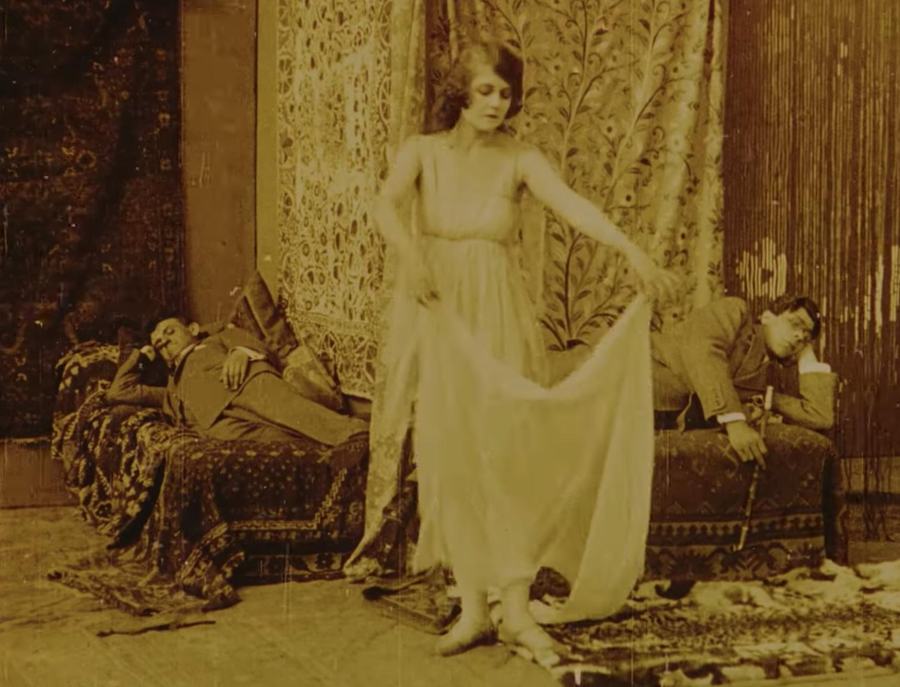
Berlin, 1912. Streetlights smear sulfur across wet cobblestones while the Spree River swallows refuse from three continents. Inside a cellar baptized Opiumhöhle, time drips like black honey down the neck of a glass pipe. Karl Schneider, a scenarist who reportedly sold his own blood to buy celluloid, projects onto this cavernous set the entire anxiety of a nation that has just discovered how habit-forming empire can be.
Emil Albes glides through the haze as Dr. Vollmond, pharmacist-cum-poet, cloaked in an astrakhan collar that smells of Chinese ports. Every gesture—tapping ash, uncorking vials—feels choreographed by some darker pharmacopoeia. Albes’s eyelids hang like half-drawn theater curtains; when they lift, you glimpse the footlights of a soul that has rehearsed its own demise. Compare his languor to the frantic dope fiends in Yachts and Hearts, or The Opium Smugglers; here, addiction is not hysteria but a slow, courtly bow to Thanatos.
Opposite him, Karl Falkenberg’s customs inspector Karsch stalks the frame like a Prussian Javert, but with the bureaucratic terror of a man who fears the ink on his own dossiers. Schneider’s script denies him a single villainous sneer; instead, Falkenberg lets the corner of his moustache tremble whenever he pockets a confiscated pouch. The performance is a masterclass in moral corrosion—think of it as the missing link between Wegener’s The Boy Girl and the bureaucratic evil that will, a generation later, stamp passports at Theresienstadt.
Lili, the proverbial Mädchen, is embodied by an actress whose name the surviving intertitles cruelly abbreviate to M. v. Buelow—Marie von Buelow, presumably. She drifts across the diegesis like a paper lantern caught in a sewer draft. Watch her pupils in extreme close-up: dilated to the diameter of small coins, they reflect not the set but the off-screen vacuum where Wilhelmine ambition has gone to die. In one hallucination sequence—tinted amber on the only extant nitrate roll—she peels a tangerine while seated on a dragon rug. Each segment bursts into a miniature map of Shandong, then dissolves into smoke. You will not witness such synesthetic bravura again until Buñuel slices the moon in Entre ruinas.
The film’s visual lexicon is a palimpsest. Ernst Hofmann’s Dr. Rasp, a physician who treats withdrawal with quotations from Nietzsche, occupies a surgery painted in arsenic greens that foreshadow Lang’s Dr. Mabuse. Meanwhile, the Opiumhöhle itself is a cavernous proto-Expressionist womb: rafters bend like whale ribs; wallpaper peels into calligraphic scars reminiscent of Lotte Reiniger’s early silhouettes. When cinematographer Max Ruhbeck (doubling as police prefect in the cast list) cranks the camera askew, chandeliers swing like pendulums in a nightmare courtroom. The cumulative effect is Berlin viewed through the wrong end of a kaleidoscope held together by morphine gum.
Sound, of course, is absent, yet the film vibrates with aural ghosts. Intertitles appear on scrolls shaped like smoke rings: „Der Rauch erinnert sich an seine Reise um den Erdball.“ One can almost hear the sizzle of lamp flames, the click of ivory beads on an abacus tallying human souls, the distant thud of the Kaiserliche Marine practicing gunnery in the Yellow Sea. Modern viewers conditioned to Dolby thunder may scoff, but Schneider weaponizes silence; it pools in the corners until you swear you can smell burnt poppy.
Narrative architecture is deliberately fractured. Acts bleed into one another like ink on wet rice paper. A subplot involving a forged bill of lading for a Hamburg-America steamer vanishes midway, only to resurface as an afterthought on Karsch’s clipboard. Such ellipses feel less like continuity errors than existential trapdoors. They anticipate the narrative lacunae of Arsene Lupin, where each absent jewel stands in for a moral lapse the Edwardian psyche refuses to audit.
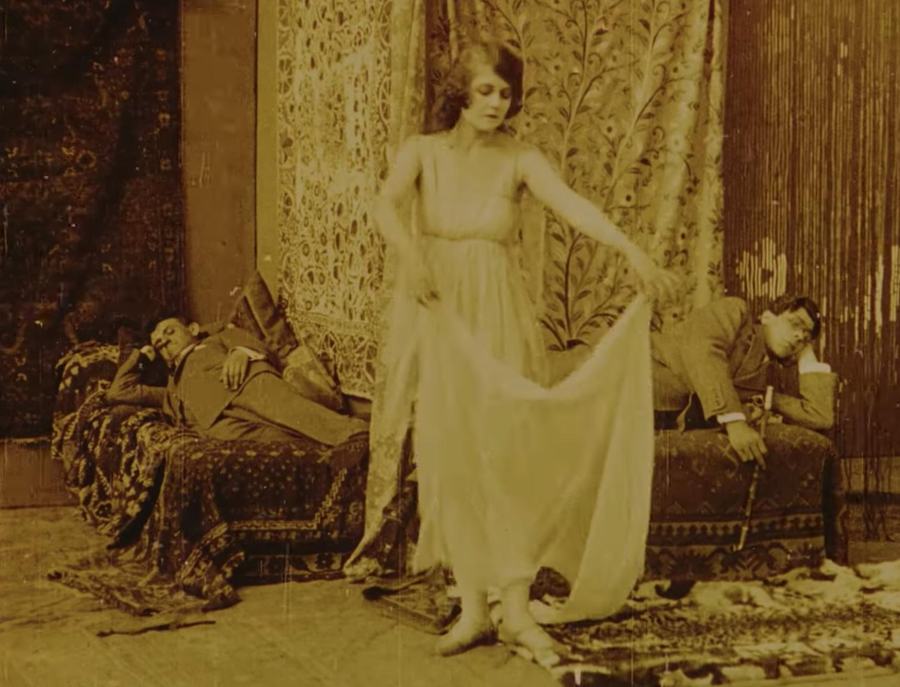
Comparative contextualization is irresistible. Where The Cabaret Girl froths narcotic decadence into champagne comedy, Das Mädchen distills it into absinthe-black tragedy. Where The Pearl of the Antilles exoticizes Caribbean sugar, Schneider indicts the Central European appetite for Asian bitterness. And while Karadjordje mythologizes the Serbian rebel as nationalist tonic, this film confesses that Germany’s true heroic gesture circa 1912 was the self-injection of colonial guilt.
Gender politics simmer beneath the soot. Lili’s body is contested terrain: Vollmond wants to preserve it in amber as testament to aestheticized ruin; Karsch wants to rescue it for the moral ledger; Rasp wants to dissect it for pathological exhibit. Yet von Buelow, in moments the camera cannot quite censor, reclaims the gaze. In a tableau so brief it flickers between two frames, she plucks the stethoscope from Rasp’s ears and loops it around her own neck like a dominatrix collar. It is 1912’s equivalent of the riot grrrl snarl—decades ahead of Petticoats and Politics.
The opium itself transcends prop status; it becomes an auteur. Schneider grants it subjective camerawork: slow dissolves from ceiling vents, lap dissolves into Lili’s irises, reverse tracking shots that suggest the drug is backing away from human culpability. In one bravura sequence, a single drop of tar falls in extreme macro, filling the frame until it morphs into a night sky over Qingdao. Constellations rearrange themselves into the silhouette of the Deutschland cruiser. The metaphor is blunt yet devastating—every puff exhaled in Berlin is a cannon shot fired in Shandong.
Critical reception at the 1912 Berliner Kinoball was bifurcated. Lichtbild-Bühne dismissed it as „küstenloser Dekadenzfilm,“ while Der Kinematograph praised its „Atmosphäre von ehrlicher Sünde.“ Today such polarized response reads like prophecy: the film is both anchorless and brutally honest. It has no coastline because imperial guilt knows no shore.
Survival status is tenuous. The only print, a 35 mm nitrate with Dutch intertitles, languished in a Haarlem attic until 1987. Restoration by the Bundesarchiv-Filmarchiv in 2019 added a tinting scheme extrapolated from chemical residue: sea-blue for exterior Berlin, ochre for the Höhle, sickly citron for hallucinations. The score commissioned for the re-premiere—composed for string quartet and two opium pipes struck like gongs—deserves release on vinyl.
Legacy threads snake through cinema history. The smoke-wreathed chiaroscuro prefigures Wiene’s Caligari by eight years. The idea of narcotic subjectivity as camera logic resurfaces in The Man with the Golden Arm, Trainspotting, even Enter the Void. Yet Schneider’s film remains more radical because it never yields to redemption. Lili’s final crawl into daylight is not recovery; it is the moment history itself ODs.
Viewing tips: watch at 3 a.m., projector bulb dimmed to 60%, volume of your own pulse turned up. Between reels, inhale not opium but lapsang souchong—its camphor reek approximates the celluloid’s ghost. Do not, under any circumstances, pair with Marrying Money for a double feature; the cognitive dissonance could fracture your temporal lobe.
In the end, Das Mädchen aus der Opiumhöhle is less entertainment than séance. It summons the spirits of 1912—not the brass bands or the goose-stepping sabers, but the midnight exhalations of an empire getting high on its own supply. When the final intertitle fades, you are left staring into the black afterglow, convinced that somewhere in Berlin the lamps still burn, the dragon still coils, and Lili’s pupils still eclipse the sun.
IMDb 3.4
1928
Community
Log in to comment.