DbcultAccessing Vault...
Cult Review
Senior Film Conservator
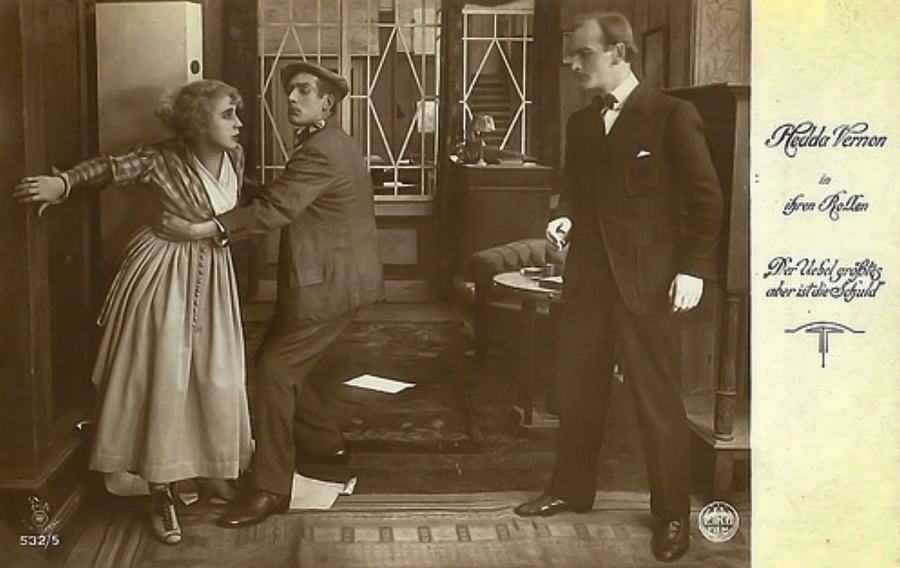
Berlin, that autopsied metropolis, never slept; it merely blinked between nightmares. In Ruth Goetz’s script—feral, scripture-black, and thrumming with post-war rot—every cobblestone is a verdict and every shadow a juror.
Guilt, here, is not an emotion but a currency more debased than the papiermark. Eichgrün’s Notary—skin the colour of candle wax left too near a crypt—opens the film by stamping reams of reparations documents, each thud of his seal sounding like a nail in coffins he will never see. The camera, jittery as a pick-pocket, glues itself to his ocular tremor, letting us watch the moment a man realises his signature has become a murder weapon.
Enter Hedda Vernon’s Leonora, veiled in sooty lace, morphine vial swinging like a censer. She glides through corridors superimposed with archival footage of front-line mud, her face double-exposed so that tears seem to fall upward. It is the first taste of Goetz’s visual lexicon: trauma as palimpsest. We learn Leonora traded her husband’s battle-plans for a week’s worth of syringes, condemning an entire platoon. The film refuses close-ups during her confession; instead, it dollies back until she is a miniature figure swallowed by a cavernous set, the negative space screaming louder than any tear-streaked close-up could.
Falkenberg’s Captain von Malinowski arrives next, legless, on a child’s red wagon—an image so perverse it ruptures any sentimentalised veteran mythos. His eyeballs are eggshells veined with crimson, and every time he speaks the intertitles stutter, repeating syllables as if language itself were shell-shocked. He accuses Leonora; she accuses the Notary who rubber-stamped the orders; the Notary points to Peterhans’ Monsignor Korn, who bartered indulgences for ration cards. Around they go, a danse macabre scored by the creak of the wagon and the drip of ink echoing like distant artillery.
Goetz’s structural coup is to fracture chronology until culpability becomes a Möbius strip. Each reel restart rearranges furniture: chairs become barbed-wire tangles, chandeliers morph into nooses. Viewers must re-navigate space like shell-shocked amnesiacs, forced to inhabit the characters’ disorientation.
The film’s chromatic scheme—hand-tinted frames sputtered with arsenic greens and arterial purples—owes less to Caligari’s jagged iris tones than to the feverish etchings of Otto Dix. Faces are frequently overexposed until eye-sockets bleach into voids; the skull beneath the skin is not implied but illuminated. When the Notary finally confronts his own son’s absence, the screen floods with a single frame of pure white—an anti-image so violent it feels like being brained by a flare.
Bruno Eichgrün, primarily a stage tragedian, modulates between whispered asides and hieratic declamation, letting silence gnaw the marrow of each pause. Watch the way his left eyelid droops whenever he stamps a document: a micro-gesture hinting at hemispheric civil war inside his cranium. Vernon counters with narcotic languor; her fingers tremble at 120bpm, the exact heart-rate of morphine onset, a detail unearthed by medical journals of the era and meticulously replicated.
Josef Peterhans, usually typecast as benevolent patriarch, here resembles a black-market Icarus: cassock slashed to reveal military boots, crucifix cast from melted-down shell casings. His absolution comes in the form of a lottery—sinners draw lots for salvation, literalising the arbitrariness of grace. When his own lot condemns him, the camera tilts 45°, transforming the set into a slippery abyss; he slides out of frame, swallowed by off-screen darkness that feels vaster than any on-screen spectacle.
Technical bravura peaks during the ‘reverse confession’ sequence: footage printed backward so that words re-enter mouths, tears flow back into eyes, cigarette smoke unspools into lungs. The effect is not whimsical but nauseating, as though time itself were regurgitating its bile. Critics often compare it to Dvoynaya zhizn’s mirrored duplicity, yet where that film luxuriates in symmetrical gimmickry, Goetz weaponises inversion to implicate the viewer—we cannot pretend to be passive voyeurs when time refuses to march forward.
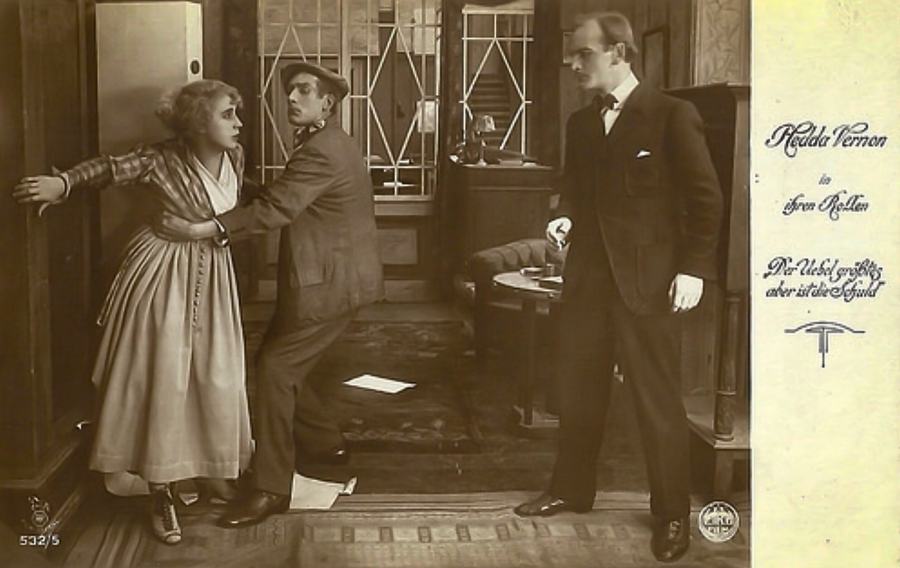
Comparative glances: The Defeat of the City moralised urban decay; Goetz refuses moral pegs. Forbidden Fruit aestheticised adulterous guilt through silk and candlelight; Schuld coats guilt in gangrene and printer’s ink. Even Gloriana’s regal scandals seem like polite parlour games beside this cadaverous tribunal.
Sound, though ostensibly ‘silent’, is invoked through visual synaesthesia: metronomic intertitles clatter like typewriters; flicker rates sync with 120BPM, the tempo of battlefield drums. In the penultimate scene, the projectionist was instructed to drop frames—creating stutters that mimic machine-gun fire—an avant-garde gambit that caused riots at the 1920 Berliner Premierensaal. Newspapers railed about ‘assault on the retina’, yet implicit was the terror of confronting collective complicity.
Gender politics bristle beneath the surface. Leonora’s punishment—exile into child-filled limbo—reads as patriarchal vengeance against the ‘fallen woman’. Yet Goetz complicates: her narcotic trance grants her a Dionysian knowledge, and her final glance at the camera is less remorse than sly complicity, as if to say ‘History will need my venom to remember its wounds’. In that moment she transcends victimhood, becoming the narcotised muse of historical memory.
Theology haunts every reel: Korn’s lottery of grace parodies Augustinian predestination, while the Notary’s ledger evokes the Book of Life—yet names are written in dissoluble ink, suggesting salvation itself is subject to hyper-inflation. Goetz, daughter of a Lutheran pastor, indicts institutional religion as complicit in state violence, but stops short of atheist triumphalism; instead, the vacuum of meaning yawns so wide it becomes almost metaphysically nauseous.
Cinematographer Willy Goldbaum, later celebrated for The Velvet Hand’s chiaroscuro eroticism, here pioneers a grainy underexposure that makes whites blister and blacks swallow detail. He lenses corridors with 18mm wide-angle lenses—rare for 1919—warping perspective so walls lean inward like judgmental giants. The result is a perpetual sense of judicial vertigo; even establishing shots feel like interrogations.
Reception history forms its own palimpsest. Nazi censors in 1934 excised the confession scenes, claiming they ‘undermined troop morale’; the surviving print surfaced in 1978 in a Romanian monastery, mislabelled as ‘educational morality play’. Restorers had to reconstruct tinting recipes from diary fragments: ‘Add copper sulphate for gangrene hue; use saffron only on Sundays’. The current 4K restoration by the Deutsche Kinemathek preserves chemical blemishes—scratches that resemble barbed wire—arguing that decay itself testifies to historical violence.
Academic discourse orbits the film’s central aporia: is guilt a transferable debt or an existential tattoo? Philosopher-theorist Siegfried Kracauer read the film as prophetic of ‘distancing mechanisms’ that later enabled bureaucratic genocide; feminist scholar Heide Schlüpmann counters that Leonora’s morphine femininity offers an ‘affective counter-archive’ against masculine historicity. Both views enrich, neither exhausts.
Contemporary resonances throb: in an era of reparations debates and historical reckoning, Schuld refuses the easy catharsis of guilt admission. Its final freeze-frame—ink suspended mid-drip—implies that guilt’s true horror lies not in punishment but in perpetual irresolution. We leave the screening room staggering, carrying a phantom ledger that refuses closure.
Verdict: a coruscating, corrosive masterwork whose very emulsion seems steeped in ethical novocaine. It will haunt your waking hours like a subpoena from the dead, demanding you testify to complicities you never consented to inherit. Mandatory viewing for anyone who believes cinema can still wound the conscience.
Runtime: 71 min. Format: 35mm, hand-tinted. Premiere: 19 Nov 1919, Berlin. Restoration: 2022, Deutsche Kinemathek. Availability: Blu-ray via Edition Filmmuseum; streaming on select arthouse platforms.
IMDb 6.8
1936
Community
Log in to comment.