DbcultAccessing Vault...
Cult Review
Senior Film Conservator
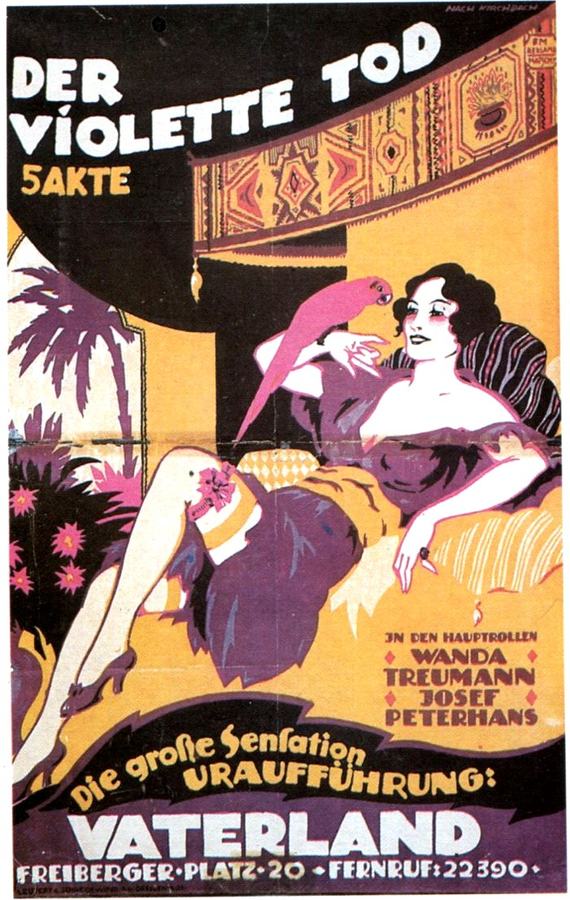
There's a particular kind of alchemy that occurs when light and shadow conspire to tell a story without a single spoken word. In the realm of early cinema, few films dared to plumb the depths of human psyche and societal anxieties with the audacious visual poetry of 'Der violette Tod' (The Violet Death). This cinematic artifact, a testament to the creative ferment of its era, transcends mere narrative to become an experience, a haunting meditation on the fragility of existence and the insidious allure of the unknown. It’s a film that demands engagement, not just passive viewing, pulling its audience into a world painted in shades of encroaching despair and fleeting beauty, all without the crutch of dialogue.
Robert Heymann, the visionary scribe behind this compelling piece, crafts a narrative that is both allegorical and viscerally immediate. The film unfurls in a bustling, yet subtly decaying, metropolis – a character in itself – where the relentless pulse of modernity seems to conceal a deeper malaise. Here, a mysterious affliction, dubbed 'Der violette Tod,' begins its silent, inexorable creep. This is no ordinary plague; it is a spectral blight, an almost spiritual ailment that manifests first as a subtle, almost imperceptible indigo flush beneath the skin, particularly around the temples and fingertips, before deepening into a vibrant, almost luminous violet. The victims are not the common folk, but predominantly the city’s most sensitive souls: its artists, poets, and musicians. They don't succumb to fever or physical decay, but to a profound, melancholic lethargy, their creative faculties fading into a quiet, beautiful oblivion. It’s a brilliant conceptual stroke, immediately setting the film apart from more mundane disaster narratives, elevating it to the realm of existential dread and artistic commentary.
At the heart of this unfolding tragedy is Dr. Elias Thorne, portrayed with compelling intensity by Josef Peterhans. Thorne is a physician of formidable intellect, yet one who stands apart from his peers, his mind too open to the unconventional. He dismisses the prevailing medical wisdom, intuiting that the malady is not of the body, but of the soul – a profound spiritual exhaustion perhaps induced by the relentless, dehumanizing pace of modern life, or perhaps a resonance with some cosmic sorrow beyond human comprehension. Peterhans imbues Elias with a captivating blend of scientific rigor and desperate vulnerability, making his character an anchor in the film's swirling currents of mystery. His performance is a masterclass in silent acting, conveying intellectual struggle, burgeoning terror, and profound love through subtle shifts in his gaze and the controlled tension of his posture.
The stakes are raised exponentially when Elias’s beloved fiancée, Clara, an ethereal dancer brought to life by the exquisite Gertrude Lobe, begins to exhibit the tell-tale violet blush. Lobe’s portrayal of Clara is nothing short of heartbreaking; her initial vivacity slowly gives way to a haunting fragility, her movements becoming less fluid, more deliberate, as if each gesture costs her immense effort. The camera lingers on her, capturing the insidious beauty of the disease as it claims her, turning her into a living, breathing canvas of sorrow. Her performance, much like that of Lillian Gish in the contemporaneous The Mystery Girl, conveys a deep inner turmoil and delicate strength, making her demise all the more poignant. This personal tragedy propels Elias into a desperate, almost obsessive race against time, blurring the lines between scientific inquiry and a frantic, almost spiritual quest for a cure.
In his increasingly frantic search, Elias seeks counsel from Professor Alaric, a reclusive alchemist brought to life by the formidable Otto Härtling. Härtling, with his gaunt features and piercing gaze, perfectly embodies the archetype of the enigmatic sage, speaking in riddles of ancient lore, the perilous allure of certain rare pigments, and the subtle, unseen energies they embody. His presence introduces a fascinating counterpoint to Elias's scientific rationalism, suggesting that some mysteries transcend empirical understanding. The contrast between their approaches highlights one of the film’s central thematic tensions: the eternal struggle between science and mysticism, logic and intuition. This dynamic is reminiscent of the intellectual and spiritual wrestling seen in films like The Sons of Satan, where characters grapple with forces beyond their immediate comprehension.
Adding another layer of intrigue is the enigmatic muse, Lilith, portrayed with captivating ambiguity by Wanda Treumann. A figure of both fascination and dread within the city’s artistic circles, Lilith seems to possess an uncanny immunity to the violet phenomenon, or perhaps, an even deeper, more intimate connection to it. Her presence is both a beacon and a shadow, her motives veiled, her gaze holding a secret knowledge that both repels and draws Elias. Treumann’s performance is a subtle marvel, embodying the femme fatale archetype with a German Expressionist twist – less overtly seductive, more mysteriously alluring, a silent siren whose very existence challenges Elias’s understanding of the 'Violet Death.' Her character serves as a potent symbol of the era's fascination with the exotic, the dangerous, and the aesthetically subversive, a theme subtly explored in films like Isterzannye dushi (Tormented Souls), which often delved into the complex inner lives and moral ambiguities of its characters.
The film's visual language is its most compelling orator. The cinematography, a masterclass in chiaroscuro, utilizes stark contrasts between light and shadow to amplify the pervasive sense of unease and foreboding. The oppressive grandeur of the cityscapes, with their towering, angular buildings, mirrors the psychological weight bearing down on its inhabitants. The use of practical effects to depict the violet blush, likely achieved through tinting or carefully applied makeup, would have been revolutionary for its time, creating a visual motif that is both beautiful and terrifying. The film’s aesthetic aligns perfectly with the burgeoning German Expressionist movement, where distorted realities and exaggerated emotions were conveyed through striking visual design. One can almost feel the influence of the movement in the way the sets might have been designed to reflect the characters' inner turmoil, much like the iconic angularity of 'The Cabinet of Dr. Caligari' (though not a direct comparison film, it serves as a touchstone for the era's visual ambition).
Robert Heymann’s screenplay is a marvel of economical storytelling, a necessity in the silent era. Every scene, every gesture, every intertitle must carry immense weight, propelling the narrative forward while simultaneously deepening the thematic resonance. Heymann avoids didacticism, allowing the unfolding drama and the evocative visuals to speak for themselves, trusting the audience to piece together the deeper implications of the 'Violet Death.' His writing is not merely a blueprint for action but a poetic framework for existential inquiry, inviting viewers to ponder the nature of consciousness, the cost of progress, and the inevitable dance with mortality. This intellectual depth, without sacrificing dramatic tension, is a hallmark of truly exceptional silent film writing, much like the intricate character studies found in The Might of Gold, which explored societal corruption with subtle but powerful narrative strokes.
Beyond its immediate narrative, 'Der violette Tod' is rich with thematic layers that continue to resonate. It is a profound commentary on the anxieties of the early 20th century, a period marked by rapid industrialization, social upheaval, and a growing sense of spiritual malaise. The 'Violet Death' can be interpreted as a metaphor for the soul's exhaustion in the face of relentless progress, the fading of artistic sensitivity in a world increasingly dominated by the mechanistic. It questions the very definition of progress, suggesting that for every leap forward, there might be a subtle, yet devastating, loss. The film also delves into the timeless conflict between scientific rationalism and esoteric belief, a battle waged within Elias himself as he struggles to reconcile his medical training with the inexplicable nature of the affliction. This dichotomy is explored with nuance, never fully endorsing one perspective over the other, but rather highlighting the limitations of human understanding when confronted with phenomena that defy conventional logic.
Furthermore, the film explores the transformative power of love and grief. Elias’s desperate fight for Clara is not just a scientific endeavor but a deeply personal, emotional odyssey. His journey into the heart of the mystery is fueled by a love that transcends fear, a willingness to confront the beautiful, terrible truth of his beloved's demise. The film asks: what does it mean to love someone in the face of inevitable loss? How do we find meaning in a world where beauty and decay are inextricably linked? This exploration of profound personal suffering and spiritual resilience finds echoes in films like Sadie Goes to Heaven, which, despite its different tone, grapples with themes of transcendence and the human spirit's endurance through adversity.
'Der violette Tod' is more than just a historical curiosity; it is a profound and unsettling piece of cinematic art that speaks to universal human experiences. Its meticulous craftsmanship, from the compelling performances of Josef Peterhans, Gertrude Lobe, Otto Härtling, and Wanda Treumann, to Robert Heymann’s thoughtful script and the evocative cinematography, ensures its enduring power. It reminds us of the incredible storytelling capabilities of the silent era, proving that complex emotions and intricate themes could be conveyed with an eloquence that often surpasses dialogue-heavy productions. For those willing to immerse themselves in its atmospheric depths, 'Der violette Tod' offers a haunting, beautiful, and deeply thought-provoking journey into the heart of a spectral affliction and the enduring resilience of the human spirit. It serves as a stark reminder that some of the most profound truths are often found not in loud declarations, but in the quiet, almost imperceptible whispers of the soul, much like the insidious spread of the violet death itself.
The film’s legacy lies in its bold exploration of themes that remain pertinent today: the impact of technological advancement on human well-being, the search for meaning in an increasingly secular world, and the eternal struggle between fate and free will. It is a film that rewards repeated viewings, each time revealing new layers of symbolism and psychological depth. Its influence can be seen in later works that explore psychological horror and societal decay, cementing its place not just as a silent film, but as a timeless piece of art that continues to provoke and inspire. It is a masterwork that deserves to be rediscovered and celebrated for its audacious vision and its enduring capacity to stir the soul, long after the final fade to black.
IMDb 6
1929
Community
Log in to comment.