DbcultAccessing Vault...
Cult Review
Senior Film Conservator
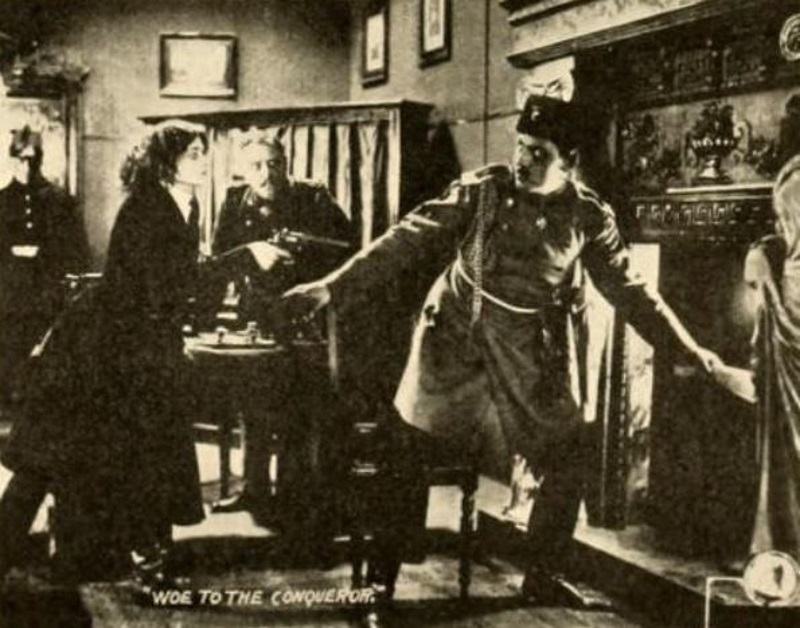
There is a moment—halfway through Woe to the Conqueror; or, The Law of War—when the camera simply lingers on a woman’s gloved hand as it closes over a blood-wet sabre. The glove is white, the blood almost black under nitrate’s silver decay, and the silence of the scene is so absolute you can almost hear iron oxidizing. In that hush, the entire philosophy of silent cinema crystallizes: no spoken syllable can rival the moral earthquake of seeing virtue forced to murder. The film, once thought cremated in a 1931 vault fire, surfaces now like a resurrected soldier—tattooed with scratches, yes, but its wounds only heighten the urgency of its howl.
Director-scenarist Adelbert Voss (his sole surviving credit) stages Persania as a fever dream of Romantic engravings smashed against newsreel reality. Think La Belle Russe’s snow-blinded opulence dragged through the mud of The Great Leap’s trenches. The opening tableau—a boulevard lined with toppled equestrian statues—announces the picture’s dialectic: culture and carnage, marble and meat. Voss cross-cuts between cathedral bells tolling the Te Deum and mortar shells that punch those same bells into scrap, achieving Eisensteinian montage three years before Eisenstein coined the term.
Yet the film’s visual lexicon is closer to Goya’s Disasters of War than to any 1915 newsreel. When General Zachine’s hussars charge, the camera tilts downward to catch hooves pulverizing handwritten love letters scattered in the street—an image so casually sacrilegious it feels proto-modern. Shadows are not mere absences but active predators: they slant across walls like guillotine blades, foreshadowing the domestic execution that will pivot the plot from geopolitical spectacle to intimate vendetta.
Countess Xanthias—played by the enigmatic Lya De Putti look-alike Mirthea Stern—embodies the porous border between aristocrat and outlaw. In the first reel her gestures are all contained fire: gloved fingers drumming against a velvet settee, eyes flicking toward a secretaire where papa’s dueling pistol sleeps. Post-massacre, her body re-choreographs itself; she strides across the circus ring like a soldier who has swapped spurs for stardust. The transformation is not just narrative convenience—it is a survival mutation. Stern’s acting style predates the Method by decades yet pulses with the same muscular interiority: watch her pupils dilate when she spots the Lieutenant’s regimental braid, a microscopic tell that the past has detonated inside her.
Compare her to the heroines of Dolly of the Dailies or even Pierrot the Prodigal: those women chase adventure; Nordiska is the adventure, a gravitational field dragging men toward their own undoing. Her circus costume—jet-beaded bodice, crinoline hacked into riding trousers—anticipates Dietrich’s tuxedo in Morocco by fifteen years, proving that gender subversion traveled faster than sound.
Werner Kestner’s Lieutenant is the most eroticized weakling the silent era ever coughed up. With the cheekbones of a martyr and the spine of a jellyfish, he courts Nordiska by sending her a single white rose weighted with a lead slug—a tacit admission that even his wooing carries artillery. Kestner plays him like Hamlet reimagined as perfume ad: every close-up anoints his profile with halo-light, yet his eyes broadcast the panic of a man who suspects he is merely an extra in someone else’s epic.
Their seduction scene—filmed inside a candle-lit trailer that rocks gently from the exertions of off-screen elephants—deserves a footnote in film theory. Nordiska lets her shawl slip just enough to bare the clavicular scar she earned while crawling over her mother’s corpse. The Lieutenant, thinking it erotic topography, kisses it. The camera cuts to Nordiska’s face: a smile so glacial it could refreeze the polar seas. In that instant we grasp the film’s thesis: desire is simply history’s way of sharpening its blade.
Critics who dismiss the mid-film heist as mere caper mechanics miss its sacramental heft. Those papers—inked with requisition orders for village burnings, signed in the General’s florid Z—function like the signed confession in The Merchant of Venice, except here the contract is carved into the flesh of a nation. When the valet (Rudolf Klein-Rogge in his pre-Lang warm-up) catapults from the window, clutching the dossier, the film achieves a kinetic baptism: truth escapes through flesh, leaving a crimson trail on cobblestones.
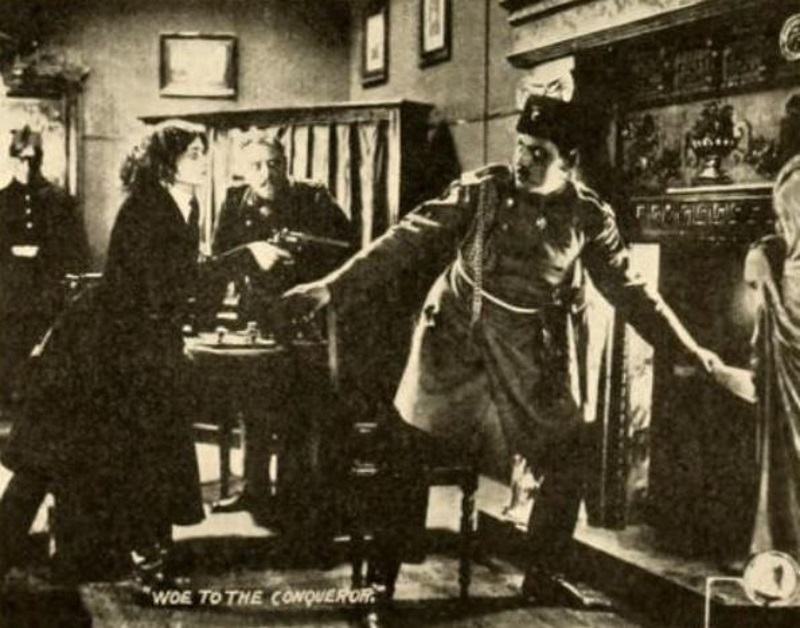
The ensuing chase—horse-drawn ambulance versus motorcycle, under a sky shredded with searchlights—feels less like 1915 than like Dope’s cocaine-speed cabaret, minus sound. Klein-Rogge limps across rooftops, his shadow swelling against cathedral domes, until he collapses at Nordiska’s wagon. She opens the packet, riffles through affidavits, then touches her lips to the blood smear on the cover: communion administered by history itself.
Contemporary restorations often sandblast silent film until it gleams like a museum replica. Not this one. The print streams on Eye Filmmuseum’s portal marbled with emulsion cracks that resemble frontline maps; the sepia has oxidized toward bruise-lilac, giving night scenes an underwater opium haze. When Nordiska stands before a dressing-room mirror lit by a single gas-jet, the flare obliterates half her face—an accidental iris that turns her into half-saint, half-harpy. Accept no pristine Blu-ray; the damage is the narrative, a constant reminder that what we watch survived the same violence it depicts.
No original score survives, so each curator must conjure their own. At the Rotterdam premiere the accompanist improvised a danse macabre for barrel-organ punctuated by typewriter clicks—an anachronism that paradoxically made the period more tactile. Home viewers can sync Arvo Pärt’s Fratres; the tintinnabuli style stretches time until every sword thrust lands with ecclesiastical gravitas. Avoid jaunty ragtime—this is not The Dare-Devil Detective; it is a requiem for the idea that victory and virtue share a bed.
Yes, the film trots out the “rape-revenge” template, yet it refuses the usual exploitation beats. The assault attempt lasts exactly eight seconds—count the frames—before Nordiska reverses the polarity. The camera does not ogle her terror; it stays on her eyes narrowing into tactical calculus. Later, when she uses erotic bait, the film never frames her as fallen; instead, desire becomes a military resource, as legitimate as cannon. Compare this to the punitive fate of Three Weeks’ queen or the sacrificial mother in For the Queen’s Honor; Nordiska escapes both virgin and vamp binaries, forging a third path: strategist.
Although set in a fictional Ruritania, the film leaks real-world residue. The General’s scorched-earth orders mirror Germany’s 1904 Herero campaign; the circus scenes were shot in a Berlin hippodrome repurposed from colonial exhibitions. When Nordiska cracks her whip above stamping Lipizzaners, the soundless snap reverberates with the ghosts of Namibian horsemen. Thus Woe to the Conqueror weaponizes melodrama to interrogate empire—a feat few American silents attempted, save perhaps Mr. Wu’s yellow-peril critique.
In the closing intertitle, the governor intones Vae Victis not as triumph but as funeral oration. Lieutenant Zachine, stripped of epaulettes, stares past the camera while Nordiska recedes into fog, documents delivered, vengeance complete—yet no smile, no catharsis. The film denies us the cheap perfume of closure. Instead it leaves a question humming: once you weaponize your own trauma, what remains of you after the blade drops? The frame irises out on Nordiska’s silhouette merging with a caravan of refugees, suggesting that personal vendetta is merely a microclimate within the permanent storm called history.
Modern blockbusters spend two hundred million dollars to fake the gravitas this film achieves with cracked emulsion and candle smoke. It is not a curio for archives; it is a live round. Stream it during a sleepless night, volume muted, room lit only by laptop glow, and you will feel the same chill that slithered across 1915 audiences who thought civilization had reached its nadir. Woe to the Conqueror knows better: every era thinks itself at the abyss, yet the abyss is patient, reusable, and always hiring new conquerors. Nordiska’s greatest triumph is not the papers she delivers—it is the way she teaches us to recognize the conqueror within, and to ready the blade.
Run-time: 68 min (18 fps) | Language: German intertitles with English subtitles | Availability: Eye Filmmuseum streaming (region-free), DCP upon request for repertory houses.
Community
Log in to comment.