DbcultAccessing Vault...
Cult Review
Senior Film Conservator
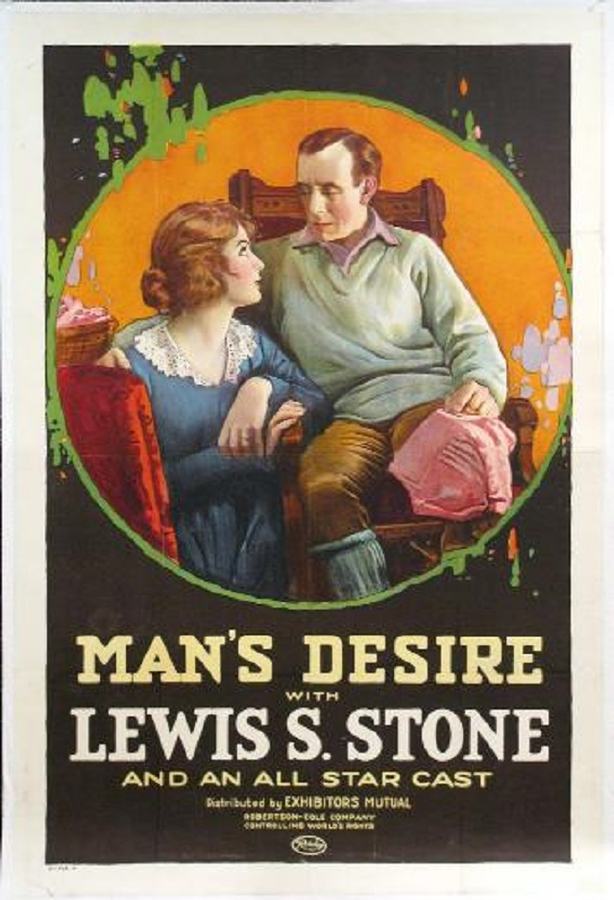
Emerging like a fever dream from Hollywood's silent adolescence, Man's Desire plants its boots deep in the mud-soaked psyche of the American frontier. Director William Dyer—better known for his acting chops in Under Four Flags—constructs a world where towering pines cast longer shadows than morality, and the scent of pine resin mingles with gunpowder and desperation. This isn't the romanticized wilderness of Code of the Yukon's gold-rush heroics; it's a suffocating ecosystem of base instincts, where men measure worth in board feet and bloodshed.
Lewis Stone’s Howard Patton simmers with weak-willed jealousy—a man crumbling like rotten timber beneath his wife’s calculated provocation. Watch how his fingers tremble when pouring whiskey, eyes darting between Vera’s décolletage and Tom’s impassive jawline. Jane Novak’s Vera is no simple vamp; she wields boredom like a stiletto. Notice the languid trajectory of her cigarette smoke in the cabin scenes—a visual manifesto of entrapment. When she traces a finger along the axe-notched dining table, it’s both seduction and territorial marking, a panther circling prey.
"Novak’s Vera doesn’t just flirt—she conducts psychological trench warfare. Each smile is a bayonet thrust against the monotony of frontier domesticity."
Yet the film’s seismic shift occurs when Bull Larkin lurches onto the screen. George C. Pearce delivers horror not through makeup (though his scarred knuckles tell tales) but through kinetic brutality. His first appearance—dousing his face in rotgut whiskey like baptismal water—establishes him as the dark inverse of Denton’s principled stoicism. This isn’t the cartoon villainy of The Vampires: The Terrible Wedding; it’s earthbound evil with sawdust in its hair.
Cinematographer Joseph Bennett transforms the logging camp into a mechanical Gehenna. The camera worships the sawmill’s piston-driven rhythm—a monstrous heartbeat that underscores every conversation. Watch how the crosscut saw teeth fill the frame during Tom and Howard’s partnership dissolution: metallic fangs mirroring their shredded trust. When dynamite finally ruptures the night, Bennett doesn’t show the explosion outright; we see its apocalyptic reflection in Mary’s wide pupils—a masterclass in subjective horror years before German Expressionism claimed it as trademark.
The costume switcheroo between Larkin and Dorgan’s corpse plays out in near-silhouette against burning timber—a danse macabre choreographed by flickering hellfire. Such visual economy puts later, talkier noirs to shame. Even the much-imitated finale in the Mexican cantina gains power through contrast: the lurid amber glow of paper lanterns against the preceding monochrome wilderness creates a feverish unreality, as if the characters have stumbled into some neon purgatory.
Beneath its masculine tumult, Man's Desire conceals startling feminist subtexts. Charlotte Burton’s Mary embodies the era’s coerced femininity—her marriage to Larkin a prison built from paternal obligation. Her journey from cowering victim to the woman who chooses silence (pregnant, guarding her past) reflects complex pragmatism. Compare her to the fortune-hunting sirens in Snares of Paris; Mary’s deception isn’t greed, but biological preservation. When she finally screams during the dance-hall abduction, it’s less damsel-in-distress troping than raw animal protest—a sound that vibrates your sternum.
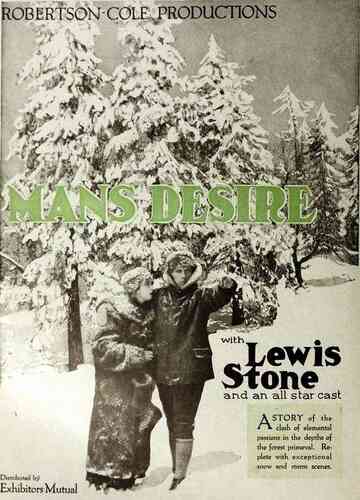
Prohibition serves as the film’s sly metaphor for repressed desire. Tom’s ban on liquor isn’t mere moralizing; it’s an attempt to dam the chaotic id that floods the camp. The whiskey Dorgan smuggles isn’t just alcohol—it’s liquid anarchy in Mason jars. Larkin’s trade thrives because he understands that men will always crave oblivion, whether through drink, violence, or Vera’s dangerous eyes.
Modern viewers conditioned by Tarantino-esque carnage may undervalue how Man's Desire weaponizes implication. Tom’s off-screen shooting registers not through gore, but through Mary’s crumpling posture—her spine folding like a broken umbrella. The dynamite sequence’s power lies in the absence of sound: the silent flash, then staggered reaction shots of loggers dropping axes in mute shock. This restraint makes the later gunplay in the cantina feel like sensory assault—bullets shattering bottles in showers of golden glass, each impact a punctuation mark in Larkin’s self-composed epitaph.
"Pearce’s Larkin doesn’t chew scenery—he poisons it. Every gesture feels like a bone about to snap beneath skin."
Contemporary parallels with Moral Courage are inevitable, but where that film sermonizes, Man's Desire dissects. When Tom spurns Vera, it’s not virtue but self-preservation—he recognizes her as emotional nitroglycerin. The film’s moral universe remains stubbornly gray; even Tom’s heroism carries the whiff of possessiveness when he reclaims Mary at gunpoint. Their escape to “another territory” feels less like a happy ending than a temporary ceasefire with trauma.
Recent 4K restoration unearths textures lost for decades: the quilting pattern on Mary’s calico dress, the terrifying clarity in Larkin’s nicotine-stained teeth, the way rain slicks the logging camp mud into liquid obsidian. These details amplify the film’s tactile nihilism—you can almost smell the wet wool and cordite. The meticulous grain structure in the forest panoramas predates Where D’Ye Get That Stuff?’s urban sprawl by half a decade, proving wilderness noir existed before city lights dimmed.
L.V. Jefferson’s screenplay deserves reappraisal for its terse poetry. Dialogue cards like “Some fires don’t need kindling” (uttered as Vera watches Tom chop wood) or Larkin’s “Whiskey’s just truth serum for cowards” land with aphoristic weight. The script’s structure—compressing betrayal, vengeance, and rebirth into 75 minutes—feels ruthlessly modern, closer to The Secret Code’s precision than Die Bettelgräfin’s melodramatic sprawl.
In the final calculus, Man's Desire endures not as a relic, but as a brutally contemporary examination of appetite—for power, for flesh, for oblivion. Its sawmill may lie in ashes, but its shadows still stretch across cinema, dark and inexorable as old growth timber at dusk.
IMDb —
1916
Community
Log in to comment.