DbcultAccessing Vault...
5/10
Senior Film Conservator
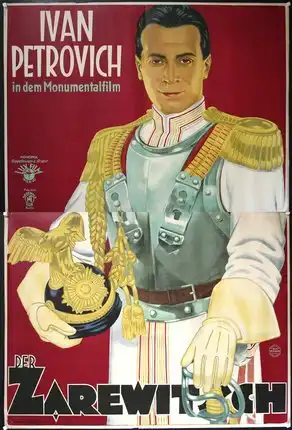
A definitive 5/10 rating for a film that redefined the boundaries of cult cinema. Der Zarewitsch remains a cornerstone of transgressive art.
If you are looking for the kinetic energy of late-period silent masterpieces, Der Zarewitsch isn't going to satisfy that itch. It is worth watching today primarily if you have an interest in the 'Ruritanian' romance subgenre or the work of the husband-and-wife directing team Jacob and Luise Fleck. It’s a film for viewers who appreciate the slow, deliberate pageantry of the 1920s European studio system. If you find courtly dramas and 'trouser role' tropes tedious, this will feel like a very long walk through a very cold palace.
Iván Petrovich carries the film with a performance that is surprisingly restrained for 1929. As the Tsarevich, he avoids the wild-eyed gesticulation common in earlier silents, opting instead for a heavy-lidded, brooding stillness. You can see the influence of the 'Latin Lover' archetype here, though Petrovich plays it with a distinctly Slavic coldness. In the early scenes, his character’s supposed misogyny is played less as a character flaw and more as a profound, almost clinical depression. When he is on screen, the film has a weight that it lacks elsewhere.
The chemistry between Petrovich and Marietta Millner (playing Sonja) is the film's intended engine, but it operates at a low simmer. Millner’s disguise as a male soldier—a central plot point—is, in typical cinematic fashion, completely unconvincing. She looks like a silent film star in a well-tailored uniform, not a soldier. However, the film is most interesting when it leans into the awkwardness of their early interactions. There is a specific scene in the Prince's private quarters where Sonja, still in 'boy' mode, has to navigate the Prince's physical proximity. The way Petrovich looks at her—half-suspicious, half-intrigued—creates a genuine tension that the script doesn't quite know how to resolve without falling back on cliché.
The Flecks were known for their efficiency, but here they show a real eye for the architecture of power. The sets are massive, and the camera often feels dwarfed by the high ceilings and ornate doorways of the palace. This isn't just for show; it emphasizes the Prince's isolation. Unlike the more experimental editing found in films like Hard Luck, the cutting here is traditional and steady. The lighting is the real star of the visual department. There are several night scenes where the deep blacks of the palace corridors are pierced by single light sources, creating a sense of Gothic dread that feels more honest than the romance itself.
One particular visual choice stands out: the use of mirrors. In several shots, we see characters reflecting in ornate, gilded glass before we see them directly. It’s a classic trope for a film about hidden identities, but the Flecks use it to highlight the 'performance' of royalty. Everyone in this film is playing a part, whether it's Sonja pretending to be a man or the Prince pretending to be a future ruler he has no interest in being.
The middle act of Der Zarewitsch drags significantly. Once the initial 'boy-as-girl' gimmick is established, the film settles into a series of repetitive scenes of court intrigue. Paul Otto and Albert Steinrück are perfectly fine as the scheming elders, but their long, title-card-heavy discussions about the fate of the throne kill the momentum. There is a lot of standing around in impressive rooms, and the editing rhythm becomes predictable. If you’ve seen other silent dramas of the era, such as The Snob, you’ll recognize the familiar pacing issues that plague stage-to-screen adaptations.
The tonal shifts are also a bit jarring. The film oscillates between a lighthearted comedy of errors regarding the disguise and a heavy, almost tragic meditation on duty. The scenes involving Paul Heidemann provide some levity, but they often feel like they belong in a different movie. The transition from a lighthearted garden stroll to a high-stakes political confrontation happens with the grace of a falling piano.
Modern audiences might find the 'disguised girl' plotline handled with a strange lack of curiosity. The film never really interrogates the gender dynamics it plays with; it uses the disguise merely as a plot device to get a woman into the Prince's bedroom. Compared to more daring silent explorations of gender and identity, this feels safe. However, watching Sonja attempt to mimic the stiff-backed posture of the palace guards provides some of the film's more human, less 'theatrical' moments. You can see Millner struggling with the heavy fabric of the costume, a detail that feels more real than the grand declarations of love later in the film.
Der Zarewitsch is a handsome, well-acted piece of late-silent cinema that suffers from a script that is too loyal to its stage origins. It lacks the visual bravado of the German Expressionist movement or the snappy pacing of American silents, but it offers a certain dignity and atmosphere. It is a film of small moments—a hand lingering too long on a shoulder, a shadow crossing a worried face—hidden inside a very large, very stiff royal pageant. It’s not essential viewing, but for those who enjoy the specific texture of 1920s European melodrama, it remains a fascinating artifact of a lost style of filmmaking.
IMDb 6.2
1927
Community
Log in to comment.