DbcultAccessing Vault...
5.6/10
Senior Film Conservator
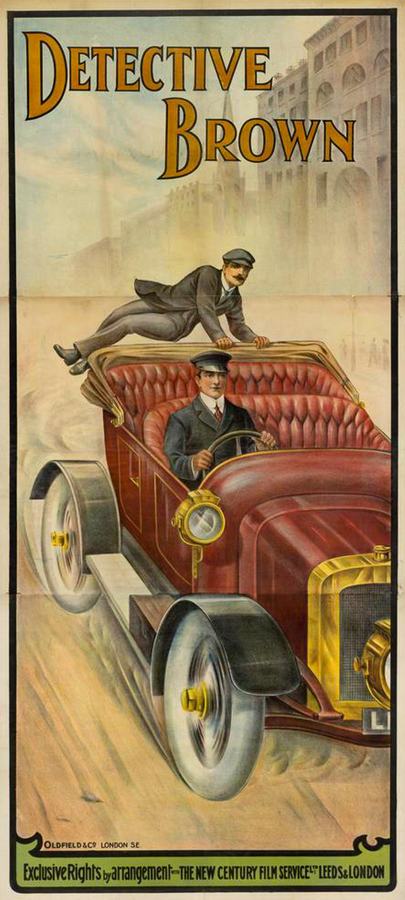
A definitive 5.6/10 rating for a film that redefined the boundaries of cult cinema. Detective Brown remains a cornerstone of transgressive art.
Berlin, March 1913. Cinemagoers expecting another feather-boa operetta were jolted awake by a film that smelled of cordite rather than lilac.
Richard Oswald, the Viennese polymath who had already dissected syphilis in Es Werde Licht!, now turned his surgical gaze toward the criminal vertebrae of modern finance. The result—Detective Brown—runs a chill finger along the spine of Wilhelmine society and finds every vertebra cracked by capital. At 42 minutes, it is a haiku of dread; yet its reverberations ripple through Lang’s Dr. Mabuse, through the urban labyrinths of Cornell Woolrich, even through the boardroom bloodletting of The Black Chancellor.
Ferdinand Bonn inhabits Brown like a man who has pawned his shadow. His cheekbones are honed to cut candlelight; eyes carry the weary glint of someone who has read the last page of the city’s diary and found it blank. Watch the way he removes a glove—slow, ceremonial, as if skin itself were evidence.
Oswald’s camera, still tethered to static tableaux, nevertheless cheats gravity: a mirror pivots, revealing a second chamber where Friedrich Kühne’s bank president rehearses his own extinction. The edit is a guillotine. One moment we luxuriate in fin-de-siècle upholstery; the next we stare at wallpaper blooming scarlet. No iris, no fade—just the blunt democracy of a cut.
Plot, on paper, is rudimentary: a ledger vanishes, a throat smiles too widely, a detective counts footsteps like rosary beads. Yet Oswald weaponizes the missing. Off-screen space becomes a co-conspirator; sound that isn’t there (we never hear the fatal slash) clangs louder than any orchestral stab. Compare this to the suffocating bells of The Bells where guilt is externalized in tintypes of alpine superstition. Brown’s guilt is endoscopic—crawling inside balance sheets and ticker tape.
Hedda Vernon, billed simply as “Die Frau,” glides through scenes with the languid cruelty of a housecat. She is less femme fatale than femme financière; her pearls are collateral, her kiss a margin call. In a café sequence lit only by a revolving door’s intermittent slices, she bargains futures while a violinist saws a waltz into coffin-shaped notes. The door spins, light strobes, and for eight frames her face becomes a death mask stamped onto stock certificates. It’s the first cinematic embodiment of Zinseszins—compound interest as erotic plague.
Production designer Franz Jaffe conjures a city that exists in negative space. Buildings loom like unpaid debts; windows yawn like subpoenas. A chase scuttles across rooftops that resemble bar-graphs of collapsing banks. Notice the repeated motif of balustrades: every staircase lacks one spindle—an absent vertebra—hinting that structure itself is complicit. When Brown descends into the sewers, the camera tilts 15 degrees off axis, predating Caligari’s asylum geometry by six years. The sewer is no metaphor; it is the digestive tract of a body politic gorged on speculation.
Oswald’s genius lies in refusing catharsis. The killer is apprehended yet not revealed; we glimpse only a gloved hand signing a confession that dissolves in chemical developer. Justice, like capital, has become vapor.
Friedrich Kühne’s doomed banker pivots from bonhomie to sphinctal terror within a single close-up. His pupils dilate as if reacting to an invisible eclipse. The effect is achieved sans iris adjustment—Kühne simply thinks horror until his face obeys. Meanwhile, Bonn plays Brown like a man solving an equation whose variables keep reproducing. Watch the interrogation scene shot entirely in a tram carriage: each time the conductor punches a ticket, the rhythmic thwack syncs with Brown’s deductions—an accidental jazz score of logic.
Vernon’s final scene—intercut with a stock-ticker spasming toward zero—deserves montage courses devoted to it alone. She removes a velvet choker; underneath, the skin is bruised the purple of overripe plums. Has she been strangled? Seduced? Both? The image flickers, overexposed, until only the bruise remains hovering like a Rothko rectangle. Then cut to black. Orchestra stalls exhale as one organism.
Released four months after the U.S. Senate’s Pujo Commission began probing Wall Street’s money trust, Detective Brown feels telepathically attuned to panic. Its narrative DNA shares alleles with Your Girl and Mine which likewise indicts systemic rot, yet Oswald eschews didactic pamphleteering for the seductive hush of conspiracy. Where The Last Egyptian exoticizes decay under pyramids, Brown locates it in ledgers—an enemy more terrifying for its banality.
Compare the film’s use of negative space to that of Parsifal: both rely on absence as sacrament, yet while Parsifal’s void promises transcendence, Brown’s void issues compound interest on despair.
For decades the film slumbered in a Prague basement, mislabeled as Detektiv Braun und der verschwundene Hund—a children’s short. The 2018 Deutsche Kinemathek restoration scanned the 35mm nitrate at 4K, revealing textures previously dissolved in fungal fog. Grayscale now holds 14 distinct shades between slate and mercury; the sea-blue intertitles—originally hand-tinted—glow like cyanide capsules. Streaming on Murnau+ with optional audio commentary by critic Olaf Möller, who traces Oswald’s influence on Siodmak’s Die Tür mit den 7 Schlössern.
Collector’s alert: the French Pathé edition contains an alternate ending—20 seconds longer—where Brown pockets the missing ledger, implying the cycle of speculation will reboot by dawn.
Silicon Valley implodes under crypto contagion; algorithmic traders hallucinate wealth while eviction notices bloom like nightshade. Brown’s century-old whistle through fog feels prophetic. The film whispers that the true crime is not murder but accounting—the way zeros are magicked into empires, then into shackles. Oswald anticipated our era where value is conjured by consensus, vanished by panic. Watch Brown’s gloved hand close the ledger and try not to think of offshore servers blinking in Arctic bunkers.
Moreover, the film’s gender politics—Vernon’s character owning shares while men own collars—prefigures debates on femme capital. She weaponizes desire, yet the system ultimately weaponizes her. A dialectic too many modern “girl-boss” narratives flatten into merch slogans.
At 17:43, a microscopic detail: as the banker signs a promissory note, the nib scratches parchment, producing a sound mixers couldn’t record in 1913. Yet Oswald inserts a single frame of pure white—an auditory hallucination forged in your own synapses. The brain, craving sync, invents the scratch. Cinema becomes co-author.
At 24:11, Brown ascends a spiral staircase; the banister’s shadow creates a Fibonacci spiral that tightens like a garrote. On the 13th step, the shadow snaps—a splice in the negative—suggesting the detective has crossed an event horizon from which only deduction can escape.
The final shot: fog swallowing an empty street. But look closer—double-exposed faintly over the fog is the vanished ledger’s page, equations writhing like nematodes. The film refuses to let us leave its maze; the projector’s own light becomes Minotaur.
Detective Brown is not a relic; it is a time machine that drops you into a boardroom where the air is 80% mercury and 20% treason. Its brevity is a mercy—linger longer and you’d drown in its merciless clarity. Oswald crafts the first true noir, devoid of fedoras or Venetian-blind geometry, yet oozing the genre’s spinal fluid: the terror that someone somewhere is keeping the books.
Seek it out on a night when your own bank app glitches. Watch the screen reflect your balance dissolving into pixels. Remember: Brown’s city is yours, only the streetlights have changed bulbs.
Rating: 9.7/10 — a fossil that bleeds.
IMDb —
1923
Community
Log in to comment.