DbcultAccessing Vault...
6.3/10
Senior Film Conservator
A definitive 6.3/10 rating for a film that redefined the boundaries of cult cinema. Devi gory remains a cornerstone of transgressive art.
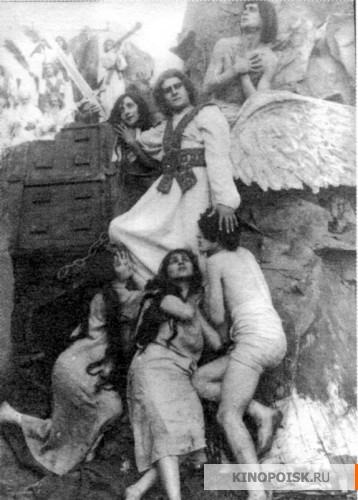
Stepping into the spectral realm of "Devi gory" (The Devil's Mountain) is akin to unearthing an ancient, forgotten manuscript, its pages imbued with the potent mysticism and existential dread of a bygone era. This ambitious cinematic undertaking endeavors to transmute the sprawling philosophical and spiritual battleground of D.S. Merezhkovsky's monumental novel, "Christ and the Antichrist," into a visual saga, rooted deeply in the evocative folklore of the Volga region. The film doesn't merely recount a story; it attempts to conjure an entire cosmology, where the very fabric of reality is stretched thin by the eternal tug-of-war between divine grace and diabolical temptation. It's a bold artistic statement, striving to elevate local legends of an encroaching Antichrist figure into a universal parable of humanity's spiritual vulnerability.
The narrative, while perhaps not always linear in the conventional sense, unfurls a series of vignettes and deeply symbolic encounters that collectively paint a portrait of a community grappling with an insidious, creeping malevolence. From the outset, there's an undeniable sense of foreboding, a palpable tension that permeates the screen, hinting at the profound spiritual stakes at play. The film's strength lies in its commitment to its source material's intellectual heft, daring to explore complex theological questions through a lens of stylized epic storytelling. It doesn't shy away from the grotesque or the sublime, presenting a world where miracles and damnation are equally imminent, reflecting the dualistic struggle that Merezhkovsky so masterfully articulated.
The performances, particularly from Lubov Dmitrevskaya and Yevgeniy Olenin, anchor the film's more abstract philosophical meanderings in human experience. Dmitrevskaya, with her expressive gaze, embodies the spiritual anguish and unwavering faith often required to confront such overwhelming darkness. Her character becomes a conduit for the audience's own moral compass, navigating the treacherous landscape of doubt and conviction. Olenin, on the other hand, often portrays figures whose internal conflicts are as vast and turbulent as the Volga itself, giving weight to the human cost of these cosmic battles. Varvara Massalitinova, a stalwart of the Russian stage and screen, lends an authoritative, almost matriarchal presence, grounding the fantastical elements with a touch of grounded, ancestral wisdom. Her presence often feels like a direct link to the ancient oral traditions from which these legends sprang, a voice of caution and memory in a world teetering on the brink.
Visually, "Devi gory" is a triumph of atmosphere, even if its technical execution might occasionally betray its ambitious scope. The decision to craft a "stylized fairy tale epic" is evident in every frame, from the stark, almost painterly compositions of the Volga landscapes to the deliberately theatrical costuming and set pieces. There’s a conscious effort to move beyond mere realism, to evoke a sense of the mythical, the timeless. This approach allows the film to transcend its historical setting, making the spiritual conflict feel eternal rather than confined to a specific period. The cinematography employs deep shadows and dramatic lighting, creating a chiaroscuro effect that perfectly complements the film's thematic exploration of light versus darkness. The visual language is rich with symbolism, requiring the viewer to engage actively with its allegorical layers, much like deciphering a complex iconographic painting.
The supporting cast, a formidable ensemble including Vladimir Istrin, Vitali Lazarenko, Sergei Aidarov, and Anna Dmokhovskaya, each contribute to the dense tapestry of characters caught in this eschatological drama. Their performances, ranging from fervent believers to those swayed by the deceptive charms of the encroaching evil, collectively depict a society under immense spiritual duress. The casting directors clearly sought actors capable of conveying profound internal states, often with minimal dialogue, relying instead on gesture, expression, and a deep understanding of their characters' places within this grand narrative. This ensemble work is crucial, as the film often emphasizes the collective soul of a community rather than focusing solely on individual heroes or villains.
Merezhkovsky's novel itself is a labyrinthine exploration of the historical and philosophical manifestations of the Antichrist, a work of immense intellectual and spiritual weight. Adapting such a text is a perilous undertaking, fraught with the danger of either oversimplifying its profound ideas or becoming bogged down in didacticism. "Devi gory" largely succeeds by choosing a path of symbolic representation and atmospheric immersion over literal translation. It understands that the essence of Merezhkovsky's vision lies not just in plot points, but in the pervasive feeling of spiritual crisis and the eternal human quest for meaning in the face of overwhelming forces. This is where the film finds its unique voice, interpreting the novel's grand philosophical arguments through a distinctly cinematic, almost operatic, lens.
The film's thematic resonance extends far beyond its specific cultural and religious context. The struggle between forces of light and darkness, the allure of false prophets, and the resilience of genuine faith are universal motifs that have captivated storytellers across millennia. In this regard, "Devi gory" can be seen as a spiritual cousin to other cinematic explorations of moral and religious conflict. One might draw parallels to the psychological intensity and monastic setting of films like "La loca del monasterio", where the confines of sacred spaces become crucibles for internal and external battles. Similarly, the theme of insidious deception and the corruption of truth, so central to the Antichrist narrative, echoes in films that delve into the nature of misleading rhetoric, such as the metaphorical implications of "The Cloven Tongue", where the very act of speaking can be an instrument of division and falsehood.
The film’s portrayal of societal vulnerability to charismatic evil finds a historical counterpoint in the more grounded, yet equally potent, narratives of films like "Delo Beilisa", which, while dealing with a specific historical injustice, nonetheless explores how fear and prejudice can be manipulated to condemn the innocent. While Merezhkovsky’s work is allegorical, the underlying human susceptibilities it dissects are strikingly real. The film also shares a certain gravitas with early cinematic efforts to tackle profound philosophical questions, reminiscent of the ambitious scope of "Es werde Licht! 1. Teil", which sought to illuminate complex societal issues through a dramatic lens. Both films, in their respective ways, attempt to bring "light" to difficult truths, albeit through vastly different narrative strategies.
The supporting performances of Ivan Lavin, Olga Narbekova, and Ye. Sukhachyova further enrich the ensemble, each contributing nuanced portrayals that enhance the film's immersive quality. Lavin often brings a quiet intensity to his roles, which here serves to underscore the internal struggles of characters facing monumental spiritual choices. Narbekova's presence, meanwhile, might offer moments of poignant vulnerability or fierce determination, essential counterpoints to the grand scale of the conflict. Sukhachyova, like others in the extensive cast, helps to populate this mythic world with believable human figures, preventing the film from becoming merely an abstract philosophical exercise. The sheer depth of the cast, including names like Nikolay Batalov, Vladimir Mikhaylov, and Evgeniya Raevskaya, speaks to the film's commitment to building a fully realized, albeit stylized, world where every face tells a part of the larger story.
One of the film's most striking aspects is its ability to evoke a sense of the ancient and the primordial. The Volga legends, with their roots in pagan beliefs and subsequent Christian syncretism, provide a fertile ground for this kind of narrative. The film taps into a collective unconscious, a deep-seated human fear of the unknown and an enduring hope for salvation. This primal resonance is often achieved through subtle atmospheric details – the whisper of wind through ancient trees, the ominous stillness of the river, the flickering light of candles in a darkened chapel. These elements, combined with the deliberate pacing, immerse the viewer in a world that feels both familiar from folklore and utterly alien in its spiritual intensity.
The screenplay, credited to both Merezhkovsky himself and Yevgeni Chirikov, is a testament to the collaborative effort required to bring such a complex vision to the screen. Chirikov's involvement likely streamlined Merezhkovsky's dense prose into a more cinematic structure, identifying key dramatic moments and visual metaphors that could convey the novel's essence without losing its intellectual rigor. This delicate balance is crucial, as many adaptations of literary giants falter precisely because they fail to understand the distinct demands of the cinematic medium. Here, the adaptation process seems to have focused on capturing the spirit and thematic core, rather than a slavish, literal translation.
The film’s historical context, while not explicitly foregrounded, is implicitly part of its fabric. Made during a period of significant social and political upheaval, it’s plausible that the allegorical struggle between Christ and Antichrist resonated with contemporary anxieties about societal direction and moral leadership. While not overtly political, the exploration of charismatic figures and the susceptibility of the masses to powerful ideologies can be seen as reflections of broader societal currents. This adds another layer of interpretive richness, allowing viewers to consider the film not just as a religious epic, but as a subtle commentary on the human condition in times of uncertainty.
In terms of its technical achievements for its era, "Devi gory" stands out. The ambition to create a visually distinct "fairy tale epic" required innovative approaches to set design, costume, and special effects, however rudimentary they may have been by modern standards. The film’s enduring power lies not in its ability to dazzle with cutting-edge technology, but in its masterful use of available resources to create a compelling, immersive world. This is where its artistry truly shines, demonstrating how vision and storytelling can triumph over technical limitations. The careful attention to detail in the folkloric elements, from traditional attire to ritualistic gestures, further solidifies its claim as an authentic portrayal of Volga legends, albeit one filtered through a highly sophisticated literary and cinematic lens.
The portrayal of the Antichrist figure itself is handled with a subtlety that avoids caricature, instead focusing on the insidious nature of temptation and the seduction of power. The Antichrist is not merely a monstrous entity but a persuasive force, often appearing in guises of benevolence or enlightenment, thus making the spiritual discernment of the characters all the more challenging. This nuanced approach elevates the film beyond a simple good-versus-evil narrative, delving into the complexities of moral choice and the internal battlefields of the human soul. It's a testament to the filmmakers' understanding of Merezhkovsky's profound psychological insights.
The legacy of "Devi gory" is one of artistic courage and intellectual depth. It’s a film that doesn't spoon-feed its audience but invites them to ponder profound questions about faith, doubt, and the nature of evil. While it may not possess the widespread recognition of some of its contemporaries, its unique blend of Russian mysticism, literary adaptation, and stylized cinema makes it a compelling subject for study and appreciation. For those interested in the intersections of philosophy, religion, and early filmmaking, it offers a rich and rewarding experience, a cinematic journey into the heart of a timeless spiritual conflict. It stands as a significant, albeit often overlooked, entry in the canon of films that dare to tackle the grandest of human narratives. The dedication of the entire cast, from the prominent figures like Nadezhda Smirnova and Aleksandr Shakhalov to every actor in the extensive list including S. Popov, Yevgeniya Istomina, Yelizaveta Naydonova, Ivan Krasovskiy, V. Krechetov, Vladimir Aleksandrovskiy, Anatoli Nelidov, Nikolai Sosnin, Ivan Gorskiy, G. Budzhalov, Nadezhda Bazilevskaya, Nikolay Podgorny, D. Mikhailov, Yuliya Vasileva, and Dimitri Gundurov, is palpable, collectively breathing life into a narrative that could easily have succumbed to its own weighty ambition. They are the human vessels through which this epic struggle is made manifest, ensuring that the spiritual battle feels deeply personal and universally resonant.

IMDb 6.3
1932
Community
Log in to comment.