DbcultAccessing Vault...
Cult Review
Senior Film Conservator
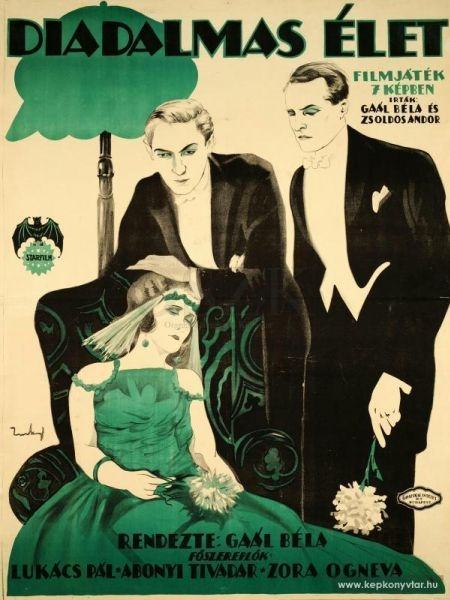
In the annals of cinematic history, certain films, despite their profound artistry and thematic resonance, often reside in the shadowed corners, awaiting rediscovery. Béla Gaál's 'Diadalmas élet' (Triumphant Life) is precisely one such cinematic artifact, a Hungarian drama from an era when silent narratives spoke volumes through gesture, expression, and the potent power of suggestion. This film, a masterwork penned by Andor Zsoldos and Gaál himself, plunges into the tumultuous waters of ambition, artistic compromise, and the often-elusive nature of true triumph. While its narrative might echo the struggles of countless artists across time, the specific cultural tapestry of early 20th-century Hungary imbues it with a unique, haunting luminescence.
At its core, 'Diadalmas élet' is a searing character study, anchored by the magnetic performance of Paul Lukas as István, a composer whose genius is matched only by his poverty. Lukas, a performer of immense depth and nuance, crafts István not as a mere archetype, but as a flesh-and-blood individual wrestling with the very fabric of his being. His portrayal captures the fervent idealism of an artist on the precipice of greatness, the gnawing desperation of one denied the means to create, and the slow, insidious corruption that accompanies a Faustian bargain. The subtle shifts in Lukas's gaze, the tension in his posture, and the almost imperceptible changes in his demeanor communicate volumes, painting a portrait of a soul caught in an increasingly suffocating embrace.
The narrative architecture of 'Diadalmas élet' is both elegant and devastating. We are introduced to István, a man whose lifeblood is music, whose every waking moment is consumed by the aspiration to compose a symphony that will transcend his humble origins and echo through eternity. His muse and moral compass is Elza, portrayed with luminous sincerity by Zora Ogneva. Ogneva’s Elza is not merely a romantic interest but an embodiment of unadulterated belief, her eyes reflecting both the hope and later, the profound heartbreak of witnessing her beloved's descent. Her performance is a masterclass in understated emotion, conveying a world of feeling through subtle expressions and gestures. She is the anchor against which István’s ambition is tested, the pure note against his increasingly discordant existence.
The catalyst for István's moral compromise arrives in the form of Baron Károly, brought to life with chilling precision by Tivadar Abonyi. Abonyi eschews overt villainy, instead crafting a character whose menace lies in his sophisticated manipulation and the insidious nature of his control. Károly is not a cartoonish antagonist; he is a man of culture and power who understands the vulnerabilities of artistic temperament. His patronage, initially appearing as a benevolent act, slowly but surely tightens its grip, demanding not just artistic output but ownership of István's very soul. This dynamic of a powerful patron exploiting an artist's need for resources is a timeless theme, explored in various forms across cinematic history, though few capture its psychological toll with such raw honesty as 'Diadalmas élet'.
The film excels in illustrating the gradual erosion of István’s integrity. It's not a sudden fall, but a slow, agonizing surrender, each concession chipping away at his artistic freedom and personal happiness. The visual language of the film, even without the benefit of sound, is remarkably articulate. One can imagine the cinematography using stark contrasts between the vibrant energy of István's early creative fervor and the sterile opulence of the Baron's world, eventually merging them into a suffocating blend. The editing would likely employ deliberate pacing, allowing moments of quiet introspection to resonate deeply before accelerating into scenes of dramatic confrontation.
The thematic tapestry of 'Diadalmas élet' is rich and multifaceted. It delves into the universal struggle between idealism and pragmatism, the corrupting influence of power, and the profound cost of sacrificing one's true self for superficial acclaim. István's journey mirrors the dilemma faced by many characters in cinema who grapple with societal expectations versus personal authenticity. For instance, one might draw parallels to the protagonists in films like The Soul of Broadway, where the allure of the stage and the demands of commercial success often clash with artistic purity, or even the tragic romanticism of Drama na okhote, where passions and societal constraints lead to irreversible consequences. The film's exploration of class distinctions and the barriers they impose on individual aspirations also brings to mind the social commentary found in Barriers of Society, albeit with a focus here on the artistic rather than purely economic struggle.
The supporting cast, though perhaps less prominent, contribute significantly to the film's immersive atmosphere. Éva Horváth, Lujza Székely, Böske Gerõffy, and Bobby Walter, among others, would likely embody the various facets of Budapest society – from the gossiping elites to the struggling artists, forming a vibrant backdrop against which István's drama unfolds. Their collective presence helps to solidify the social pressures and expectations that ultimately shape István’s choices. The writers, Andor Zsoldos and Béla Gaál, demonstrate a keen understanding of human psychology, crafting a narrative that feels both grand in its scope and intimate in its emotional impact.
The climax of 'Diadalmas élet' is particularly potent. The public performance of István's 'masterpiece' is a moment pregnant with irony and tragedy. It is a triumph in the eyes of society, a testament to his 'success,' yet for István and for Elza, it is a hollow victory, a monument to a soul lost. The film's power lies in its ability to make the audience feel the weight of this emptiness, to understand that not all triumphs are truly victorious. This profound sense of a Pyrrhic victory resonates with narratives like The Forbidden Room, where secrets and hidden truths ultimately unravel carefully constructed facades, or even the intricate moral dilemmas presented in Das Spiel von Liebe und Tod.
Béla Gaál's direction is a testament to the sophistication of early Hungarian cinema. His ability to convey complex emotional states and intricate plot developments without spoken dialogue is remarkable. One can imagine his use of symbolic imagery, perhaps a wilting flower representing István's fading artistic spirit, or the imposing architecture of the Baron's estate dwarfing István, visually emphasizing his loss of autonomy. The pacing, though perhaps slower by modern standards, would have been meticulously crafted to build tension and allow the emotional beats to land with maximum impact. The film's aesthetic would have been characterized by an elegance befitting the era, with lavish costumes and sets for the high society scenes contrasting sharply with the more humble, yet soulful, environments of István's early life.
The film's enduring relevance stems from its universal themes. The struggle to maintain artistic integrity in the face of commercial pressures, the seduction of power, and the ultimate search for personal authenticity are issues that continue to challenge artists and individuals across all walks of life. 'Diadalmas élet' serves as a poignant reminder that the most significant triumphs are often not those celebrated publicly, but those achieved internally, in the quiet reclamation of one's true self. It's a narrative that speaks to the very soul of creative endeavor, questioning the price of success and the definition of a truly 'triumphant life'.
Considering the constraints of silent film production, the achievements of 'Diadalmas élet' are even more impressive. The careful casting, the intricate character development, and the powerful thematic exploration all point to a film that was ahead of its time in its psychological depth. It encourages viewers to look beyond superficial success and to consider the deeper, often hidden, costs of ambition. While it may not feature the high-octane thrills of a Lightning Bryce or the intricate espionage of The Marked Woman, its drama is far more internal and, arguably, more profound. It's a film that resonates long after the final frame, prompting introspection about one's own values and aspirations.
The performances, particularly from Lukas and Ogneva, are the beating heart of this film. Lukas’s transition from an earnest, hopeful artist to a celebrated but hollow figure is masterfully executed. Ogneva’s silent anguish, as she witnesses the erosion of the man she loves, is equally compelling. Their chemistry, though constrained by the stylistic conventions of the era, is palpable, making their eventual estrangement all the more heartbreaking. The film's exploration of love, not as a simple romantic trope, but as a force that both inspires and challenges, adds another layer of complexity. Elza's love for István is not blind; it is perceptive and ultimately demands integrity, a quality that István finds increasingly difficult to uphold.
In essence, 'Diadalmas élet' is more than just a historical curiosity; it is a timeless piece of cinema that offers a powerful critique of societal values and the often-perilous journey of artistic creation. It asks uncomfortable questions about what we truly value – fame or authenticity, wealth or integrity, superficial triumph or genuine peace. Its legacy, though perhaps less globally celebrated than some of its contemporaries, lies in its unflinching honesty and its deeply human portrayal of a soul's struggle for meaning in a world that often prioritizes appearance over substance. It stands as a testament to the power of early Hungarian cinema to deliver narratives of profound emotional and intellectual depth, a true gem for those willing to unearth its silent brilliance.
The film's exploration of internal conflict, where the true battle is waged within the protagonist's own conscience, sets it apart. It eschews simplistic good-versus-evil dichotomies, instead presenting a more nuanced reality where even well-intentioned choices can lead to devastating outcomes. This complexity is a hallmark of truly great drama, allowing for multiple interpretations and fostering a deeper engagement with the characters' plights. It's a narrative that, much like the intricate melodies of a symphony, builds towards a powerful crescendo, not of resolution, but of profound realization and the enduring weight of consequence. Gaál and Zsoldos craft a world that feels both specific to its time and place, yet universally understood in its human dilemmas, reminding us that the 'triumphant life' is often the one lived with integrity, regardless of external validation.
The meticulous attention to detail in the film's production, from the period-accurate costumes to the evocative set designs, would have immersed the audience fully into István's world. These elements are crucial in silent cinema, as they must convey context and atmosphere without the aid of dialogue. One can envision the lavish ballrooms of Baron Károly's estate, gleaming with an artificial splendor that contrasts with the humble, yet artistically rich, garret where István first dreamed. This visual storytelling is not merely decorative; it is integral to the narrative, reflecting the characters' social standing and emotional states. Such careful world-building is reminiscent of the detailed period pieces like Blue Blood, where the environment itself becomes a character, subtly influencing the unfolding drama.
Ultimately, 'Diadalmas élet' offers a compelling, if melancholic, reflection on the human condition. It’s a film that resonates with anyone who has ever grappled with the tension between personal ideals and external pressures, between the desire for recognition and the yearning for authenticity. It’s a powerful reminder that the most profound victories are often not those that garner public applause, but those achieved in the quiet, resolute defense of one's own soul. For those who appreciate the artistry and emotional depth of classic cinema, especially from less frequently explored national traditions, 'Diadalmas élet' is a compelling and deeply rewarding experience, a silent masterpiece that speaks volumes about the enduring struggles of the human spirit.

IMDb —
1925
Community
Log in to comment.