DbcultAccessing Vault...
4.7/10
Senior Film Conservator
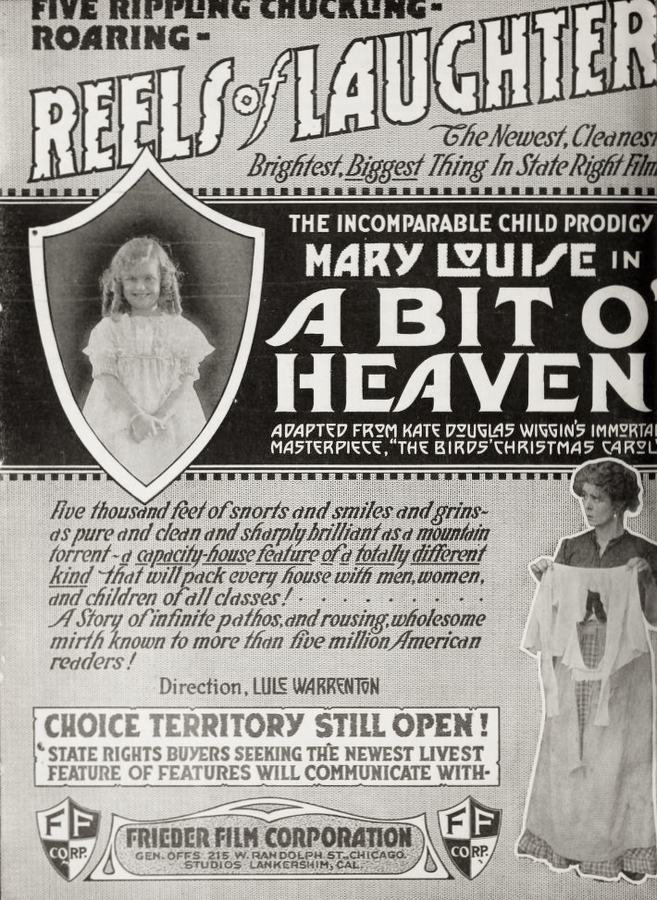
A definitive 4.7/10 rating for a film that redefined the boundaries of cult cinema. A Bit o' Heaven remains a cornerstone of transgressive art.
Somewhere between the first flickering intertitle and the iris-in that seals Carol Bird’s final breath, A Bit o’ Heaven performs a miracle almost unthinkable in 1917: it convinces the viewer that tenderness itself can be a narrative engine.
Director Marshall Neilan, armed with a scenario lifted from Kate Douglas Wiggin’s The Birds’ Christmas Carol, refuses the sentimental scaffolding we expect from Victorian invalid tales. Instead he positions the camera at the intersection of two Americas—gilded interiors where gaslight glints off mahogany, and alleyways where frostbitten children trade marbles for crusts—and allows the collision to detonate quiet revelations about charity, spectacle, and the price of looking.
Carol, incarnated by seven-year-old Mary Louise, is no tubercular angel swooning on lace. She is a strategist, a miniature impresario who understands that her dwindling heartbeat is currency. From her chaise-longue citadel she surveils the Ruggles tribe through a prism of window glass, rewriting their deprivation into a narrative she can steward. The performance she scripts—Christmas dinner at the Bird estate—becomes both gift and ransom: a way to purchase her own exit with pageantry.
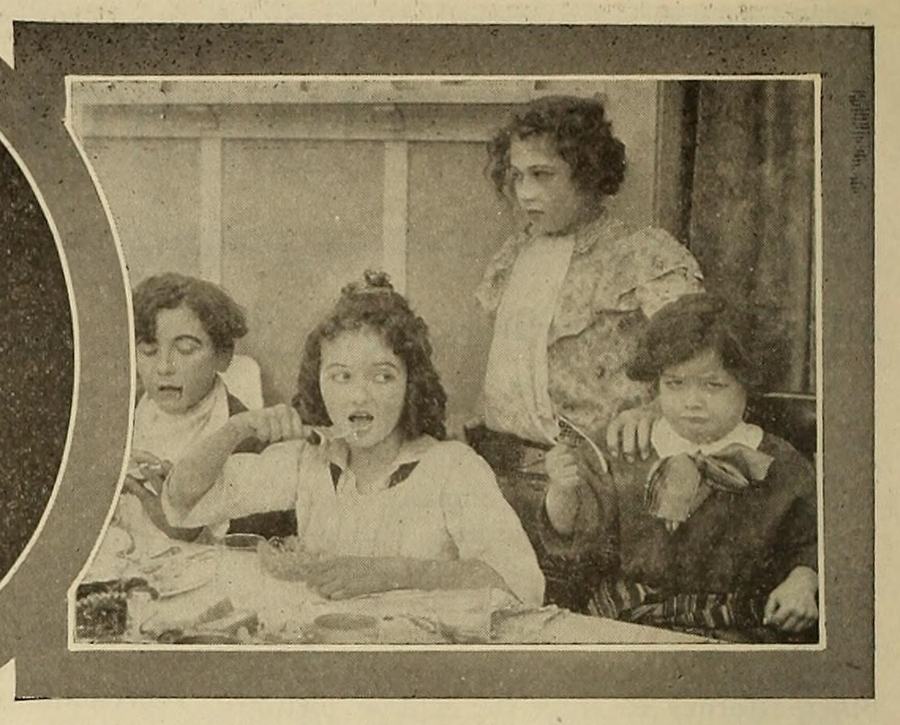
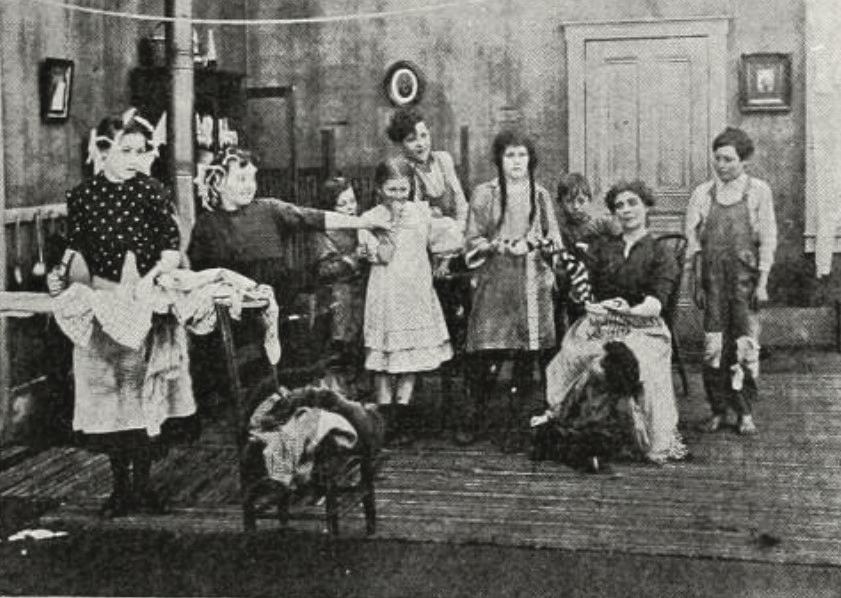
The Ruggleses answer that summons like troupers drafted for an epic. Sarah Maude, the eldest, shoulders the epistolary errand, clutching the engraved invitation as though it were a papal bull. Back in the tenement, widowed Mrs. Ruggles (Ella Gilbert in a performance that oscillates between harried majesty and comedic finesse) marshals her nine into a hygiene battalion. The sequence is a masterclass in working-class ingenuity: stockings bartered for future candy treaties; soap scum scoured off necks with newspaper and lye; hair curled using tongs heated on the stove until they hiss like snakes.
Neilan photographs these preparations with an intimacy that borders on anthropological reverence. The camera lingers on Peory’s mortification as she wriggles into black-and-white-striped hosiery—garments that roar of borrowed respectability—then tilts up to catch Mrs. Ruggles’s conspiratorial wink: “Nobody’ll fergit she’s got ’em on.” In that instant the film locates its ethical north: dignity is not woven into fabric but ignited through self-mockery and nerve.
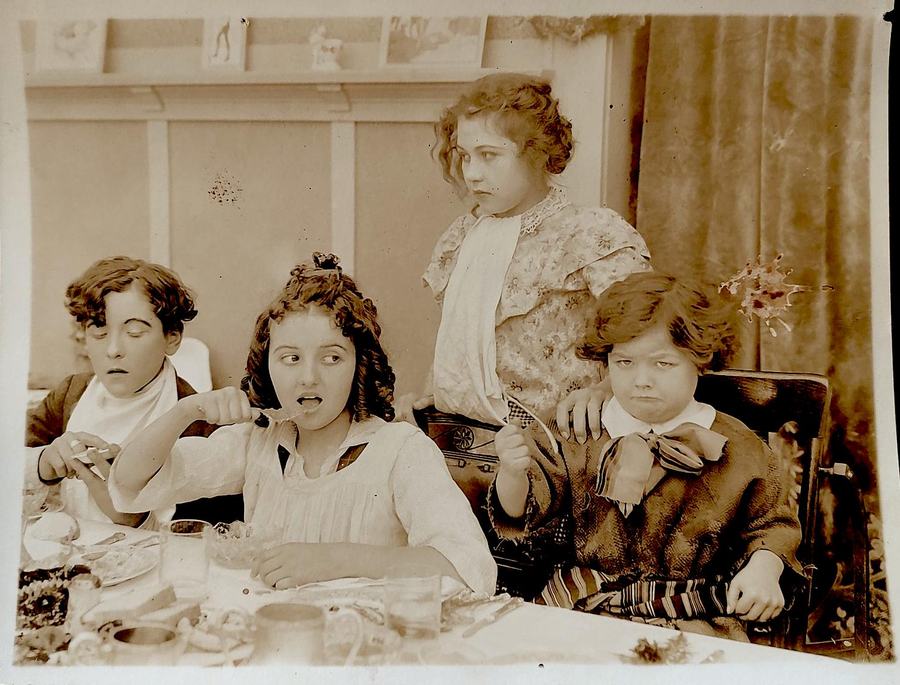
When the clan finally parades up the mansion’s front steps, the mise-en-scène performs a volte-face. The cavernous dining room, decked with holly and starched linen, swallows their chatter whole; cutlery multiplies like alien weaponry. Yet Neilan resists the easy gag of proletarians awestruck by plenty. Instead he allows appetite to become anarchy: Larry (Gertrude Messinger, a tomboy scene-stealer) wolfs down goose until his cheeks blanch chartreuse; a rogue cranberry slides off a knife and stains the damask like a gunshot. The camera watches at child height, so every gulp and belch acquires the grandeur of an operatic chorus.
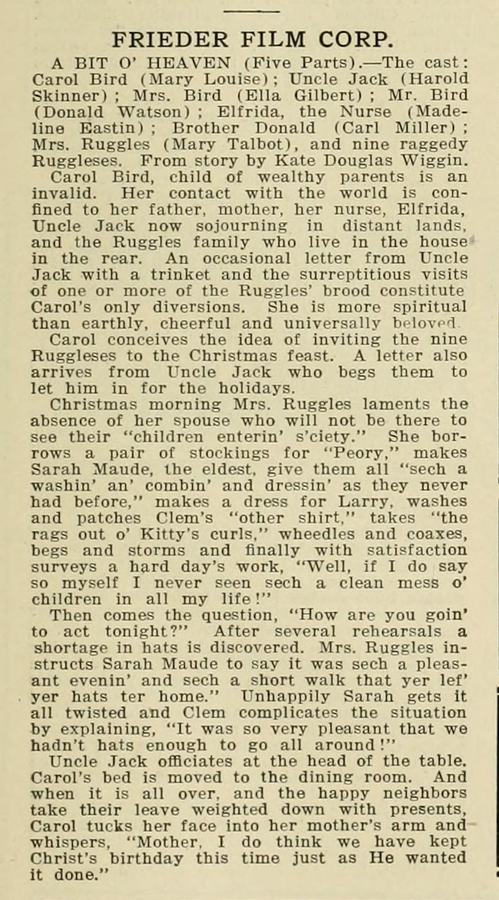
At the table’s head sits Uncle Jack, globe-trotter and resident raconteur, played by John Sterling with the swagger of a man who has outrun typhoons and now chooses to outrun grief. His toast—to “the kingdom of childhood, passport-free”—raises glasses but also suspends time; for three silent seconds the film double-exposes his tanned visage over Carol’s pallid profile, suggesting that adventure and infirmity are merely opposing time zones in the same merciless atlas.
Carol herself never leaves her invalid chair. Yet Neilan grants her the film’s most kinetic moment: a dolly-in that glides across cranberry sauce and guttering candles until her iris fills the frame, pupils dilated with the narcotic joy of orchestrated communion. She has achieved what every director secretly covets—total authorship over reality—only to realize the bill is due immediately.
Postprandial, the guests swarm the Christmas tree, a towering cedar dredged in tinsel and wax angels. Presents are dispensed with democratic exuberance: tin locomotives for the boys, celluloid dolls for the girls, and for Mrs. Ruggles a copper saucepan whose sheen mirrors her tear-streaked face. The children exit into snowy dusk, pockets clanking, breath forming cartoon balloons in the cold. Neilan cuts from their diminishing silhouettes to a bedroom where Carol reclines against maternal arms, the color of candle smoke already tinting her lips.
Her final line, delivered in intertitle relief—“Mother, I do think we have kept Christ’s birthday this time just as He wanted it done”—floats like a paper boat on a dark tide. The camera holds her profile until the light drains, then irises out on the Christmas tree, its candles guttering in synchronicity. Fade to black. No afterlife, no resurrection tableau; only the echo of cutlery still vibrating in the viewer’s skull.
Shot on the edge of winter at the old Paragon Studios, A Bit o’ Heaven makes virtuosic use of natural light. Cinematographer David Abel (later lauded for Pat and Mike) back-lights windows with muslin diffusers so snowflakes become a confetti of silver halide. Interiors contrast carbon-arc glare with strategic pools of shadow—look for the moment when Carol’s hand rests on a velvet armrest, knuckles glowing like alabaster while her face recedes into umber dusk. The effect anticipates the chiaroscuro of The Stain in the Blood by nearly a decade.
Editing rhythms alternate between long, contemplative takes and staccato inserts—boots scraping ice, a stray cranberry rolling across parquet—creating a visual counterpoint that heralds Soviet montage while still servicing Victorian sentiment. The result is a film that feels paradoxically modern: a 20-reel heart wrapped in a 5-reel package.
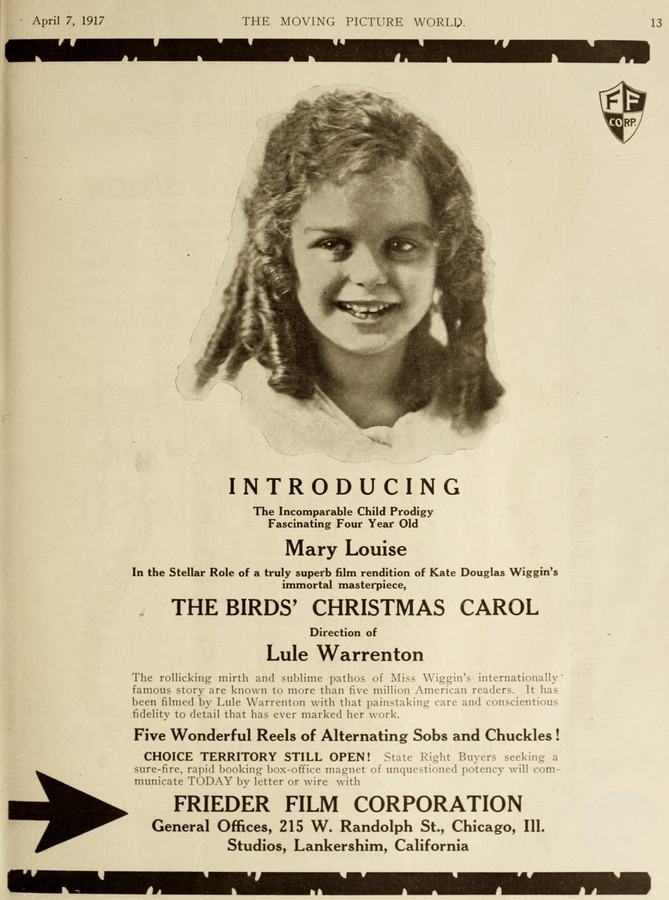
Mary Louise, barely seven during production, carries the narrative weight without succumbing to the era’s penchant for mawkish pantomime. Watch her eyes during the dinner scene: they flicker from dish to guest, tallying pleasures like a banker counting coins, while her fingers drum a silent waltz on the afghan. It is a portrait of omnipotence housed in fragility.
Ella Gilbert, as the widowed matriarch, delivers a masterclass in comedic restraint. Her aside—“Nobody’ll fergit she’s got ’em on”—is punctuated not with a broad wink but with a micro-shrug, shoulders rising like a pair of parentheses around an unspoken world of class anxiety. The moment would not feel out of place beside Bea Lillie’s brittle sophistication or even The Misleading Lady’s screwball cadence.
Among the Ruggles brood, Gertrude Messinger’s Larry steals every frame. Her gastric distress, rendered through puffed cheeks and crossed eyes, walks the tightrope between Chaplin slapstick and something more tender—the dawning recognition that appetite has moral consequences.
Though released without synchronized score, surviving cue sheets recommend a patchwork of carols, folk airs, and strategic silence. Contemporary exhibitors report that during Carol’s death scene many pianists struck a single sustained chord, then allowed the room to absorb the hush—an aural void more devastating than any lament. The absence of sound becomes the film’s final character: a requiem stitched from negative space.
Read today, the film vibrates with uneasy resonance. Carol’s charity is indisputably benevolent, yet it hinges on exhibition: the poor must dine onstage, their gratitude measured in audible oohs and aahs. Neilan seems aware of the paradox; he repeatedly frames Mrs. Bird in foreground mirrors, her reflection doubled like a spectator watching her own largesse. One wonders how the story would unfold under the gaze of Warning! The S.O.S. Call of Humanity’s militant suffragette or the merciless class scrutiny of The Market of Vain Desire.
Yet the film also grants its working-class subjects agency. Mrs. Ruggles negotiates candy treaties, dictates grooming protocols, and ultimately reclaims her children from the estate’s gravitational pull. The Ruggleses arrive as supplicants but depart as conquistadors, pockets bulging with loot, dignity intact.
For decades A Bit o’ Heaven languished in 16mm classroom abridgments, its snowy imagery chalked up to moralizing pap. Then came the 2014 4K restoration by the Library of Congress, scanned from a mint-condition 35mm nitrate at 8K resolution. Suddenly the striped stockings acquired zebra urgency; the goose skin revealed every follicle; the final iris-in resembled nothing less than a solar eclipse viewed through a keyhole.
Modern critics now cite the film as proto-neorealist, anticipating De Sica’s Sciuscià in its use of non-professional children and location texture. Others detect the DNA of Love’s Pilgrimage to America’s immigrant tableaux or the melancholic festivity that threads through Little Lady Eileen. Most importantly, the film survives as a time-capsule of Christmas myth-making before Coca-Cola red and Hallmark sheen calcified the holiday into commodity.
If your Yuletide ritual demands only twinkle-filtered optimism, stay with the made-for-TV canon. But if you crave a tale where joy and mortality share the same cracked plate—where a child’s dying wish crystallizes into both miracle and indictment—then let A Bit o’ Heaven haunt your December. Keep tissues within reach, yes, but also keep your intellect switched on; this is a film that rewards the heart without insulting the mind.
Stream the 4K restoration on Criterion Channel, or hunt down the Blu-ray paired with Neilan’s sprightly Rose of the Alley for a double bill of class-conscious silent gems. However you access it, dim the lights, silence your phone, and let the candles gutter. Carol Bird is waiting to remind you that heaven is less a destination than a guest list—scribbled in trembling ink, annotated with laughter, paid for in full at closing time.
IMDb —
1918
Community
Log in to comment.