DbcultAccessing Vault...
4.4/10
Senior Film Conservator
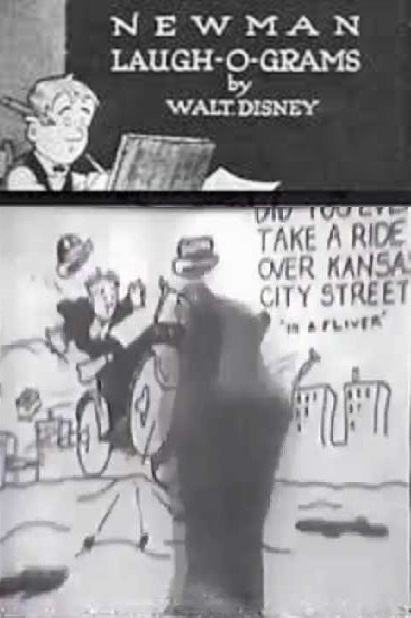
A definitive 4.4/10 rating for a film that redefined the boundaries of cult cinema. Did You Ever Take a Ride Over Kansas City Street 'in a Fliver' remains a cornerstone of transgressive art.
Walt Disney’s *Did You Ever Take a Ride Over Kansas City Street ‘in a Fliver’* is a fleeting yet resonant slice of cinematic history. Created in the early 1920s, this single-frame animation feels less like a film and more like a living postcard of a city in motion. With no dialogue, no linear narrative, and a runtime that barely exceeds two minutes, the piece thrives on its ability to evoke atmosphere and character through pure visual storytelling. It is here, in these brief moments, that Disney’s genius begins to crystallize—a fusion of technical rigor and artistic intuition that would later define American animation.
The film opens with a wide shot of Kansas City’s streets, where the interplay of light and shadow gives life to the cobblestones and storefronts. A streetcar glides past, its wheels etching a rhythmic pulse into the pavement, while pedestrians—etched in bold, almost caricatural lines—move in a choreographed blur. Disney’s camera lingers on a group of children, their laughter implied through exaggerated, playful gestures, and a stray cat that pirouettes up a lamppost, its tail curling like a question mark. These vignettes, though fleeting, are imbued with a sense of purpose; they are not mere sketches but fragments of a larger urban symphony.
What elevates *Did You Ever Take a Ride Over Kansas City* beyond a simple cityscape is Disney’s meticulous attention to detail and his pioneering use of animation techniques. The single-frame format, while rudimentary by today’s standards, allows for a hyper-observational quality. Each frame captures a specific moment with the clarity of a photograph, yet the transitions between frames are imbued with a fluidity that suggests movement beyond the static. Disney’s use of negative space is particularly striking; the empty sidewalks and open windows create a sense of depth and possibility, as though the city itself is breathing.
The animation’s surrealism is another hallmark. A cloud morphs into a grinning face, a bird’s shadow stretches into a comically elongated silhouette, and a passing car’s reflection ripples like liquid. These touches, while whimsical, serve a deeper function: they humanize the urban landscape, making it feel alive and slightly magical. This blend of realism and fantasy is a precursor to Disney’s later works, such as *The Tiger Lily* (The Tiger Lily), where the boundaries between the real and the imagined are equally porous.
Placing *Did You Ever Take a Ride Over Kansas City* within the broader context of early 20th-century cinema reveals its importance as both a technical and cultural artifact. At a time when animation was still in its infancy, Disney’s focus on mundane, everyday scenes was radical. While contemporaries like Winsor McCay were experimenting with fantastical narratives (*Gertie the Dinosaur*), Disney’s Kansas City film reflects a quieter, more introspective vision. It is a document of urban life in transition—a city caught between the agrarian past and the industrial future.
The film’s emphasis on movement and rhythm also echoes the influence of European avant-garde cinema. The rapid cuts and kinetic energy bear resemblance to the works of German Expressionists and French Impressionists, though Disney’s approach is more rooted in American pragmatism. This duality—European artistic ambition and American storytelling—would become a defining feature of his work, as seen in *Sodoms Ende* (Sodoms Ende), where similar themes of urban decay and renewal are explored through a darker, more abstract lens.
When compared to Disney’s other early works, *Did You Ever Take a Ride Over Kansas City* occupies a unique space. Unlike *Mrs. Plum’s Pudding* (Mrs. Plum’s Pudding), which leans into slapstick humor and domestic satire, this film is more observational, almost anthropological in its approach. It shares similarities with *Schools and Schools* (Schools and Schools) in its focus on institutional life, but where the latter film critiques educational systems, *Did You Ever Take a Ride Over Kansas City* celebrates the vibrancy of urban life.
Technically, the film’s single-frame technique is a stark contrast to the more fluid animations of *What Ho, the Cook* (What Ho, the Cook), which showcases Disney’s growing mastery over motion. Yet, in its restraint, *Did You Ever Take a Ride Over Kansas City* feels more intimate, as though the viewer is peeking through a window into a world both familiar and foreign. This tension between the personal and the universal is a recurring theme in Disney’s oeuvre, culminating in the sweeping narratives of *The Great Redeemer* (The Great Redeemer).
The legacy of *Did You Ever Take a Ride Over Kansas City* lies in its role as a catalyst for Disney’s later innovations. The film’s emphasis on atmosphere and character over plot would influence the tone of *The Guilty Egg* (The Guilty Egg), where humor is derived from visual gags rather than dialogue. Its urban setting, meanwhile, prefigures the bustling metropolises of *Ikarus, der fliegende Mensch* (Ikarus, der fliegende Mensch), where the conflict between individual ambition and societal norms is explored through similarly dynamic settings.
Yet, perhaps the most profound influence of the film is its quiet assertion of animation as a medium for capturing the subtleties of everyday life. This ethos would later crystallize in Disney’s more mature works, such as *Her Moment* (Her Moment), where the interplay of light and shadow becomes a metaphor for emotional resonance. The Kansas City film, in its brevity, serves as a reminder of the power of observation—a lesson Disney would carry with him through his entire career.
Viewing *Did You Ever Take a Ride Over Kansas City Street ‘in a Fliver’* today is to witness the birth of a cinematic language that would go on to define an era. It is a film that thrives on its contradictions: a technical experiment that feels emotionally resonant, a document of urban life that transcends its time. In its fleeting moments, Disney captures not just a city, but the very essence of animation itself—the ability to turn the mundane into the extraordinary, to see magic in the everyday.
For modern viewers, the film is a humbling reminder of the roots of the medium. It invites reflection on how far animation has come, while also celebrating the timeless appeal of simplicity. As Disney’s camera pans over the Kansas City streets, it is not just a city that is being captured, but the boundless potential of a young artist on the cusp of greatness.
Community
Log in to comment.