DbcultAccessing Vault...
Cult Review
Senior Film Conservator
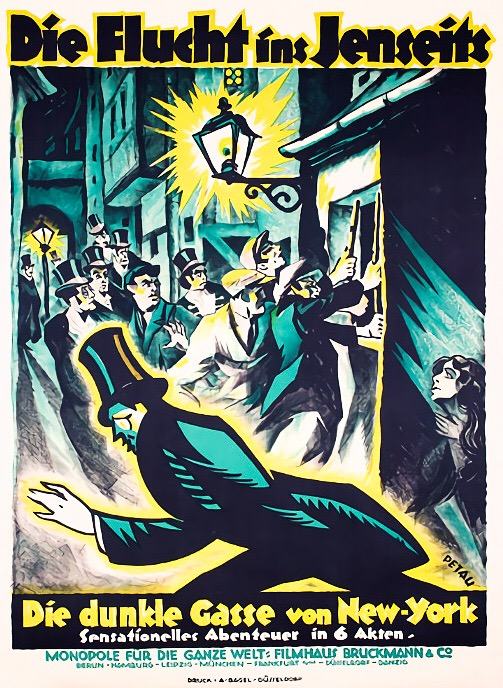
In the pantheon of early German cinema, few works capture the paradoxical allure of the American metropolis with as much visceral dread as Die Flucht ins Jenseits oder: Die dunkle Gasse von New York. Released in 1921, a year defined by the burgeoning aesthetic of German Expressionism, this film stands as a fascinating intersection between the gritty realism of the 'Kammerspielfilm' and the visionary nightmares that would later define the noir genre. Director and writer Franz Seitz crafts a narrative that is less about the physical geography of New York and more about the cartography of a fractured psyche.
Seitz, a name synonymous with the foundational years of German film production, approaches the 'Dark Alley' not as a scenic location, but as a psychological state. While contemporary American productions like High Speed focused on the kinetic energy of the modern age, Seitz chooses to linger in the stagnant pools of the underworld. The pacing is deliberate, almost agonizingly so, mirroring the protagonist's descent into an inescapable fate. The cinematography avoids the frantic cuts seen in Sporting Life, opting instead for long, lingering shots that allow the shadows to creep toward the edges of the frame.
The visual language here is one of entrapment. Every doorway is a mouth; every alleyway a throat. Unlike the whimsical artifice found in The Patchwork Girl of Oz, which used the medium to expand the boundaries of the possible, Seitz uses it to contract the world until it becomes a coffin. There is a palpable sense of weight in every frame—a gravitational pull toward the 'Jenseits' (the beyond) that gives the film its haunting title.
Charles Willy Kayser delivers a performance that anchors the film’s high-concept melodrama in a recognizable human suffering. His face, often caught in harsh, high-contrast lighting, becomes a landscape of its own. He doesn't merely act; he undergoes a visible erosion. This is a stark contrast to the more theatrical performances found in earlier silent works like The Curse of Iku, where the horror was often externalized through exaggerated gesture. Kayser’s terror is internal, quiet, and devastating.
Supporting him, Ernst Rückert and Max Weydner provide the necessary friction. Their interactions are charged with a subtextual violence that suggests a world where trust has been completely eradicated. Grete Reinwald and Marie Louise Jürgens offer glimpses of a femininity caught in the crossfire of this masculine decay, yet they are never merely victims. They are participants in a social dance that leads invariably to the grave. The ensemble works with a synchronicity that suggests they are all moving toward the same inevitable conclusion, a trait shared by the doomed characters in An Alpine Tragedy.
To understand the significance of Die Flucht ins Jenseits, one must look at how it deconstructs the 'city film' trope. While Sliakot bulvarnaia explored the mud and grime of the boulevard as a social critique, Seitz elevates this to a metaphysical level. The 'Dark Alley' of New York is not just a place where crimes happen; it is a purgatory. The film lacks the optimistic momentum of The Man Who Dared, replacing it with a cynical realization that the system is not merely broken—it is designed to destroy.
Even when compared to the crime-centric narratives of Calibre 38 or the identity-driven drama of Pudd'nhead Wilson, Seitz’s work feels more primordial. It taps into an atavistic fear of the dark that predates the modern city. The New York depicted here is a fever dream, a collection of German anxieties projected onto a distant, mythic America. This 'imagined geography' was a staple of Weimar cinema, where the 'West' represented both ultimate freedom and ultimate corruption.
The technical execution of the film is remarkably sophisticated for 1921. The use of depth of field to create a sense of layering within the 'dark alley' sets it apart from more flatly staged productions like Bill's Baby. Seitz and his cinematographers manipulate the frame to create a sense of voyeurism; the audience is not just watching the characters, they are stalking them. The lighting design, which utilizes the 'Rembrandt' style to isolate faces in a sea of blackness, prefigures the work of Fritz Lang and F.W. Murnau.
Furthermore, the film's relationship with nature is worth noting. While Nature's Handiwork or On the Banks of Allan Water find solace or beauty in the natural world, Die Flucht ins Jenseits presents a world where nature has been entirely supplanted by the artificial. There are no trees here, no flowing rivers—only the cold, unyielding surfaces of the industrial age. Even the 'water' in this film is the stagnant, oily puddle of a New York gutter, far removed from the idyllic scenes in Die badende Nymphe.
As the narrative reaches its crescendo, the 'Flight into the Beyond' takes on a dual meaning. Is it a literal escape from the law, or a final, desperate leap into the unknown to escape the self? The ambiguity is the film’s greatest strength. Unlike the restorative arc of The Man Who Found Himself, Seitz offers no easy redemption. The protagonist is caught in a loop of his own making, a cycle of transgression and penance that can only end in the silence of the 'Jenseits'.
The film’s influence can be seen in the later 'Straßenfilme' (street films) of the late 20s, which continued to explore the moral ambiguity of the urban environment. However, Seitz’s 1921 effort has a raw, almost primitive power that later, more polished films often lacked. It feels like a transmission from a lost world, a celluloid ghost that continues to haunt the history of cinema. The kinetic energy of Sorvanets is replaced here by a heavy, atmospheric dread that sits in the stomach long after the final intertitle has faded.
To watch Die Flucht ins Jenseits oder: Die dunkle Gasse von New York today is to witness the birth of a specific kind of cinematic melancholy. It is a film that understands the inherent loneliness of the crowd and the terrifying intimacy of the shadow. Franz Seitz didn't just make a crime movie; he made a film about the weight of existence. It is a challenging, often bleak experience, but for those willing to brave the 'Dark Alley', the rewards are profound. It remains a vital piece of the Weimar puzzle, a dark mirror reflecting the anxieties of a world teetering on the edge of an abyss.
Reviewer's Note: The restoration of this film is crucial for a complete understanding of the transition from early detective serials to the sophisticated psychological dramas of the mid-1920s. Its lexical diversity in visual storytelling remains a high-water mark for the era.
Community
Log in to comment.