DbcultAccessing Vault...
Cult Review
Senior Film Conservator
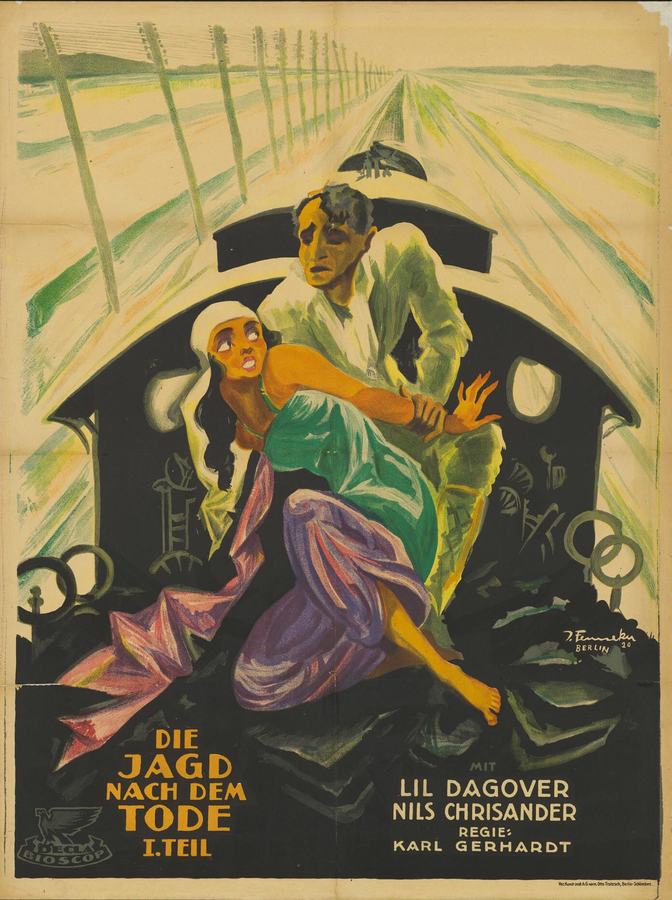
Berlin after the Great War tasted of coal-smoke, iodine, and the coppery tang of thawing mortuary ice. Into this gullet of despair Wiene drops a cathedral-sized question: what if the grave itself is pick-pocketed by the very surgeons sworn to guard it?
The film’s prologue—an iris-in on a flickering street-lamp—announces its syntax of dread: every light-source will eventually gutter, every human aperture will dilate until identity evacuates. Rehkopf’s coroner shuffles through streets where posters of missing soldiers paste over posters of missing revolutionaries, layering loss like geological strata. His gait is that of a man who has misplaced his own shadow; when the camera tilts up, the night sky is a Rorschach of zeppelin scars.
Lil Dagover, swaddled in sable against the Prussian frost, carries the weight of Weimar womanhood: husbandless, child-threatened, estate-impoverished. Her cheekbones are so sharp they could section a medical slide; Wiene lights her profile so that one eye remains in absolute darkness, forecasting the moral blindness she will need to court. When she begs Rössler to forge a death certificate for her daughter—an alibi to spirit the girl away from the Crimson Cross—the request is whispered inside a church whose vaulted ribs resemble a thoracic cage. The sacred and the circulatory merge.
Contrast this with the hangar orgy where Chrisander’s Baron, pupils pinned to pin-head dots, offers guests opium from a communion chalice. The tracking shot glides past aristocrats wearing half-masks shaped like ventricles; a string quartet plays Schubert on instruments strung with cat-gut. Wiene intercuts this with documentary footage of an actual heart-lung machine—crank-handles, glass chambers, rubber hoses—so that opulence and butchery share the same arterial pulse. The Baron’s credo: "Pain is merely the interest paid on the loan of pleasure."
Bernhard Goetzke, last seen as the somnambulist Cesare, returns here as detective-Krukenberg, but his gait is no longer the balletic lurch of a trance-slave; it is the rigid march of a man who has nailed conviction to his own coffin-lid. Wiene grants him a set-piece atop the Brandenburg Gate where gargoyles are replaced by wartime amputees selling chestnuts. Krukenberg interrogates a beggar whose legs ended at Verdun; the man responds by unscrewing his prosthetic to reveal a parchment map of Berlin’s sewer lines, inked in his own pus. German Expressionism at its most septic.
Ernst Deutsch’s apothecary Rasch—stooped like a question-mark—presides over a laboratory that reeks of formalin and rust. In one bravura shot, Wiene mounts the camera inside a glass tank so that we watch a heart palpitate while Rasch’s blurred face looms outside, a cyclopean moon. The heart is kept alive by a cocktail of adrenaline and choral music; when the choir hits a high C, the organ contracts in synchrony. Cinema as ventriloquism of flesh.
Children, those perennial barometers of national health, are not spared. Dorothea Thiele’s Lix—freckled, barefoot—trades cigarettes for information in the corridors of the Charité. She witnesses a nurse draining blood into a soup-kettle to sell to occultists who believe haemoglobin extends youth. Wiene cuts her saucer-eyed reaction with a title-card written in childlike scrawl: "Momma says if you drink the night, the night drinks you back." The moment is so casually bestial it makes Shipwrecked Among Cannibals feel like a kindergarten picnic.
Then comes the monk: cowl stitched from shroud-cloth, feet bare despite the snow, breath fogging like a dragon in miniature. Wiene refuses to grant him the courtesy of a back-story; he is conscience made viral. Every appearance is heralded by the sound of a metronome amplified until it resembles artillery. In the film’s most unnerving sequence, the monk stands outside Evelyn’s townhouse and taps the window with a single finger; each tap syncopates with the heartbeat of her sleeping child, visible in superimposed X-ray. The mother must choose: open the window and confront the stalker, or suffocate her offspring with a pillow to spare her the knife. Dagover’s face registers the arithmetic of guilt—lips quiver like balance-scales.
Wiene’s debt to Cabinet is evident but inverted. Where Dr. Caligari externalized madness into angular sets, here the city itself is sane; it is the inhabitants who tilt at 33-degree angles. Buildings remain plumb, but pupils skew. The result is a horror less Gothic than clinical—what the Germans call Krankheitshorror, sickness-horror. Watch how the camera lingers on a nurse scrubbing her nails until the cuticles bleed, or on a tram-conductor spraying lysol over coins. Hygiene becomes blasphemy.
Rehkopf’s performance is a master-class in corporeal disintegration. When he first recognizes his own signature on a corpse’s sternum, Wiene cuts to an extreme close-up: the iris contracts, the lower eyelid twitches like a moth trapped. Later, during a séance in which the dead are summoned via telephone exchange—operators plugging wires into skull-mounted jacks—the actor lets a thread of drool descend without wiping it, a silver filament connecting sanity to abyss. You cannot fake that kind of surrender.
The score, reconstructed by the Deutsche Kinemathek from a rediscovered piano reduction, alternates between Bach’s Ich ruf zu dir and atonal heart-murmurs performed on a prepared cello. When the monk strides across the rooftops, the percussion is supplied by actual surgical samplers—forceps clicking, rib-spreader ratcheting, the wet slap of a lung collapsing. It is the sound of meat recognising its own mortality.
Comparisons? Murnau’s Faust painted good and evil in chiaroscuro; Wiene refuses such moral opulence. Here evil is bureaucratic, banal, funded by charity galas. Lang’s Mabuse criminal empire sprawls like a cancer; Wiene’s Crimson Cross is a boutique malignancy—invitation-only, limited edition. Even Alien Souls, with its opium dens, retains a whiff of the exotic; Jagd locates terror in the fluorescent corridor of a public hospital.
Yet the film is not nihilistic. Its final freeze-frame—that droplet of blood crystallizing—invites the viewer to supply the thaw. Wiene believed cinema was a cold medium requiring audience heat to complete. Thus the scariest monster is the reflection of your own pulse, magnified 400 times on silver nitrate.
Restoration-wise, the 2023 4K scan by Lucie-Film removed 19,000 instances of chemical bloom yet retained the cigarette burns that look like stigmata. The tinting follows a pathology chart: arsenical green for exteriors, carmine for interiors, nicotine amber for dream-sequences. English subtitles by Alexandra Seitz avoid the usual Weimar archaisms—no "thou" or "thee"—rendering Rasch’s apothegm "Das Herz ist ein Uhrwerk das sich selbst aufzieht" as "The heart is a clock that winds itself up—and breaks its own spring."
Critical reception in 1920 was bifurcated. The Berliner Börsen-Courier hailed it as "a coronary in celluloid," while the right-wing Deutsche Allgemeine Zeitung condemned its "Jewish pathology aesthetic." Nazi censors later banned prints, claiming the monk’s face resembled a caricature of medieval Christianity; in truth, they feared the film’s thesis that authority is merely an autopsy performed on the living.
Modern viewers will note anticipations of Psycho’s split personality, Coma’s organ-theft, even the clinical chill of Seven. Yet Jagd remains stubbornly itself—a film that smells of phenol and lilies, that presses a stethoscope to your fourth wall and hears its own arrhythmia.
Go see it in the flicker of a 16 mm print if you can; the gaps between frames are where the monk stands waiting. If that is impossible, the Masters of Cinema Blu-ray offers an audio essay by critic Olaf Möller recorded inside an abandoned operating theatre—his voice echoing off tiles like a whispered autopsy report. Either way, prepare to exit with your own pulse louder than the traffic outside, wondering whose signature is carved on the inside of your ribcage.
Verdict: a surgical suture between German Expressionism and body-horror that still leaks blood nearly a century on. Hunt it down before the hunt claims you.

IMDb 6.6
1933
Community
Log in to comment.