DbcultAccessing Vault...
Cult Review
Senior Film Conservator
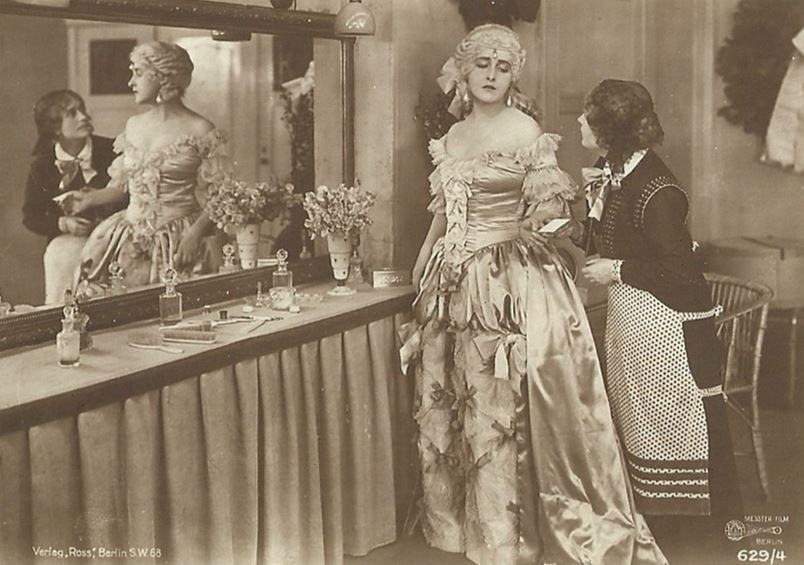
Robert Wiene’s name is duct-taped in film history to The Cabinet of Dr. Caligari, but one year later he dissected post-war malaise with a scalpel even sharper: Die lebende Tote—a fever dream that renders marriage asphyxiation and narcotic escapism in chiaroscuro so tactile you can smell the cabaret sweat.
The film opens with a static shot of a bourgeois drawing room so rigid it might be an architectural blueprint; Eva (Elsa Wagner) enters frame left, her silhouette bisected by a French window’s cruciform mullion—a visual overture that she is already fractured. A letter arrives: handwriting from a man whose name we never learn, only the inked ghost of past desire. Wiene cuts to a close-up of Wagner’s pupils dilating—not lust but terror, as though memory itself were a loaded revolver.
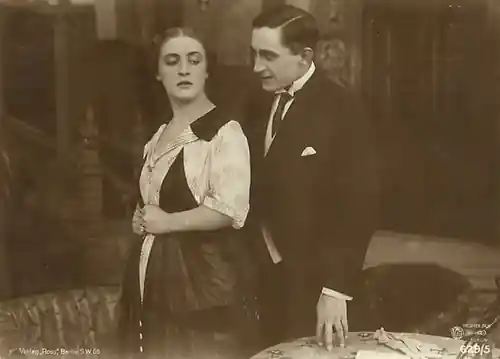
What follows is not so much plot as gravitational collapse. Eva steals rouge from her maid’s dresser, tiptoes past her children’s nursery, and boards an overnight train whose carriages throb like arteries. Wiene double-expresses the window, overlaying hurtling telegraph wires across her face; the world outside literally scars her skin. By dawn she is in Berlin’s Friedrichstraße, swallowed by electric signage that spells S-I-N in bulbs sputtering like faulty synapses.
The revue sequences borrow the angular production design of Caligari but tilt it twenty degrees further—staircases ascend into nowhere, cardboard crescent moons drip painted cyanide stars. Eva auditions with a poem so maudlin it circles back to sublime; the casting director, a corpulent satyr in white gloves, offers a contract sealed with a wrap of cocaine. Wiene’s camera pirouettes 360 degrees, fusing audience and performers into a single hydra craving sensation. In this danse macabre applause becomes indistinguishable from a death rattle.
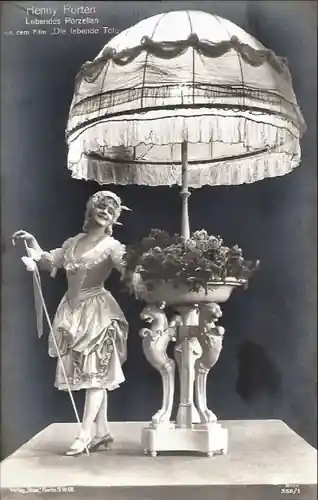
Elsa Wagner, heretofore typecast as porcelain maternal figures, flays herself bare. Watch her ribcage flutter beneath sequined costumes two sizes too small; observe how she modulates micro-tremors in her left cheek—a Morse code of dependency. When she first injects morphine, Wiene inserts a subliminal flash: a child’s porcelain doll shattering in slow motion. The cut is so brief you’ll question whether you hallucinated, which is precisely the point.
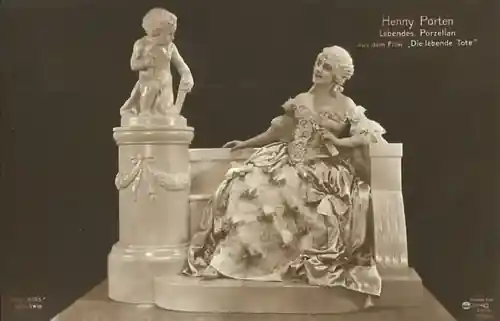
Carl Hoffmann’s cinematography renders every cigarette ember a miniature comet, every spotlight halo a celestial noose. Act II chronicles Eva’s ascent from chorus girl to marquee magnet, yet fame is shot like a forensic crime scene. Henny Porten cameos as a washed-up starlet whose tear-streaked powder forms a crustaceous mask—an omen Eva refuses to read. Meanwhile Paul Bildt plays the morphine supplier with the bureaucratic chill of an actuary; he tallies Eva’s veins like ledger columns.
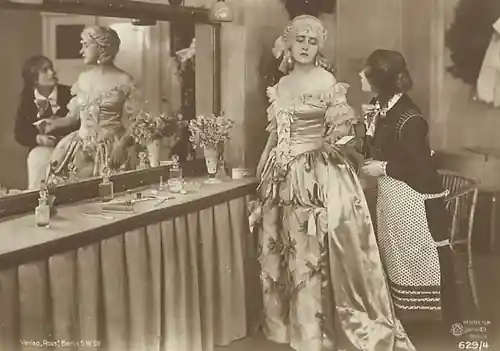
“I only wanted to breathe,” Eva scribbles on a hotel mirror in lipstick, the sentence half-erased by her own gloved hand—an epitaph for every Weimar woman who mistook emancipation for the right to self-destruct publicly.
Wiene’s montage accelerates: nightshade shadows, mercury flares, a bravura tracking shot through an opium den where bodies sprawl like discarded marionettes. The director superimposes a ticking metronome over Eva’s face, her heartbeat syncing to the mechanical pulse of modernity itself.
Unlike Cecilia of the Pink Roses, whose saintly suffering sanctifies patriarchy, or The Sins of the Mothers that punishes transgression with death, Die lebende Tote refuses moral scaffolding. Eva’s narcotic descent is not penance; it is ethnography. Wiene stages men as interchangeable ventriloquists: Carl Ebert’s impresario, Hans von Zedlitz’s financier, Ernst Dernburg’s predatory doctor—each projects onto Eva a fantasy she must embody. The tragedy lies not in her lost virtue but in the revelation that identity itself is a drug peddled by suppliers whose names she will never know.
Compare this with If the Huns Came to Melbourne, where female hysteria is a wartime aberration soon corrected by marriage. Wiene’s Berlin offers no such restoration; the final reel finds Eva backlit on an empty stage, footlights casting her shadow forty feet high—a colossus of absence. She delivers Hamlet’s “To be or not to be” soliloquy to an auditorium of vacant seats, her voice intertitled yet thunderous. Curtains fall, not with applause but with the thud of velvet against parquet—a sonic memento mori.
Because the film is silent, every sensory gap is ours to fill. Imagine the vinegar stench of sweat crystallized on velvet seats, the metallic tang of morphine hydrochloride on Eva’s tongue, the champagne aftertaste of bile when she wakes retching at 4 p.m. Wiene weaponizes absence; the lack of audible dialogue makes her wheezing breath (seen, not heard) a phantom soundtrack scratching inside your cranium long after the projector stalls.
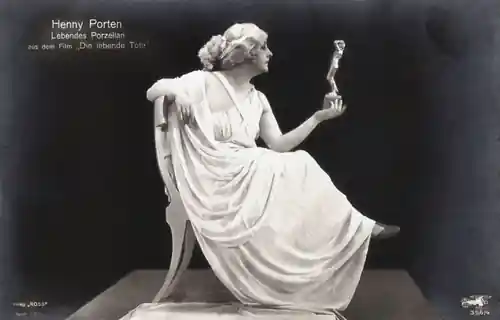
Restoration efforts by the Deutsche Kinemathek in 2022 salvaged a 157-minute tinted nitrate print from Buenos Aires. Tints alternate between nicotine amber and absinthe green—colors that throb like bruises. The new 4K scan reveals hitherto invisible details: a crucifix earring dangling from Eva’s infected lobe, the reflection of a noose in a champagne flute. Score composer Mica Levi cites the film as inspiration for Under the Skin, and you can hear why: both works use atonality to suggest epidermal crawl.
History loves a neat narrative, hence Wiene’s subsequent eclipsing by Lang and Murnau. Yet Die lebende Tote anticipates Pandora’s Box by eight years, offering a heroine whose sexual autonomy is neither demonized nor sentimentalized. Where Out of a Clear Sky deploys amnesia as a reset button for female desire, Wiene proffers memory as open wound. The film’s final intertitle, superimposed over Eva’s lifeless smile, reads: “She played every part but herself.” No redemption, no moral—only the echo of footsteps retreating down an alley we cannot see.
Region-free cinephiles should sprint for the Deutsche Kinemathek’s Limited Edition (slipcase drenched in #C2410C varnish). Extras include a 46-minute video essay by Tag Gallagher, who positions the film inside Weimar’s Nervous System, plus a commentary by Stefan Drößler unpacking Hoffmann’s depth-of-field mathematics. Be aware: the disc defaults to German intertitles; English subtitles are buried in the setup menu beneath “Untertitel.”
Region-locked viewers can stream via Kino Cult in 1080p, though the bitrate suffocates Hoffmann’s granular shadows. A 35 mm archival screening is touring North American cinematheques this autumn—if it lands within a train ride, sell plasma for a ticket. Nothing prepares you for the tactile flicker of nitrate, each scratch a dermatological blemish on Eva’s celluloid skin.
If Tangled Fates moralizes addiction as cosmic comeuppance and Cupid’s Day Off trivializes it as slapstick, Die lebende Tote occupies the razor-thin limbo between indictment and empathy. It is less a cautionary tale than a neurological map of patriarchal vertigo. Nearly a century before Euphoria, Wiene understood that spectacle devours the spectacle-maker, that the stage is built from bones of those who never chose to perform.
Seek it, not for historical footnote, but for the mirror it holds to contemporary insta-culture where selfhood is monetized in grams and filters. Eva’s powder-compartment compact may be 1921 Bakelite, yet swipe your phone under your eyes and witness the same abyss staring back—pixelated, powdered, perennially alive and dead.
IMDb —
1917
Community
Log in to comment.