DbcultAccessing Vault...
Cult Review
Senior Film Conservator
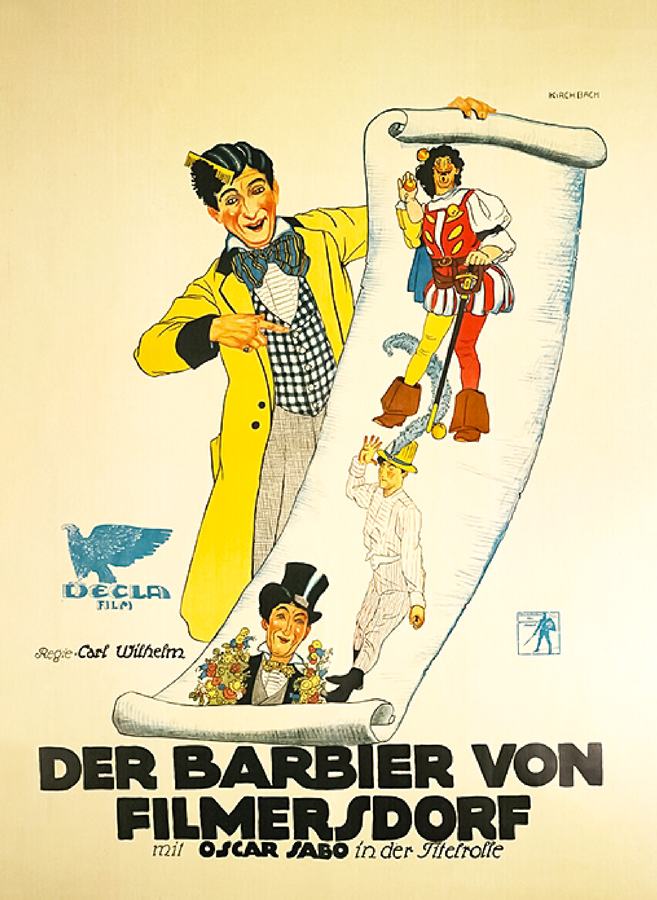
Oscar Sabo’s Der Barbier von Flimersdorf is not merely a film; it is a straight-edge incision across the carotid of Weimar-era denial, a lacework of nitrates and bile that glints even when the projector bulb gutters.
Imagine, if you dare, the slow rasp of a razor against gristle—each frame of this 1923 curiosity sounds precisely so. Set in a Rhine backwater that never saw a railway, the picture drapes its satire over the shoulders of Wilhelm Kuckuck, a barber whose surname translates to “cuckoo,” a bird both prophetic and ridiculed. Sabo, triple-hyphenate auteur, endows his protagonist with the lanky resignation of a man who has read Schopenhauer between bloodlettings. The village itself, Flimersdorf, is a palimpsest: half-timbered façades painted the color of stale beer, a river that serves as both baptismal font and sewer, and a bakery whose brick oven exhales almond ghosts every dawn.
Where contemporaries such as The Cave Man wallow in slapstick anachronism, Sabo stitches a Möbius strip of confession and betrayal. Wilhelm’s chair becomes a throne of absolution; every lathered cheek hides genealogies of collusion with the Prussian war machine. The plot’s vertebrae are not hinged on event but on the erosion of faces—literally. With each shave, the barber scrapes away not only stubble but the veneer of imperial loyalty, revealing scarred deserters, incestuous magistrates, and one pastor whose collar conceals the brand of a 1848 insurgent.
Anna Müller-Lincke’s Lenchen is the film’s soft tissue: her tuberculosis blossoms like a rose window, coughing petals of blood onto Wilhelm’s waistcoat. Their chemistry is never courtship—cinematographer Carl Wilhelm frames them in chiaroscuro so severe that their silhouettes fuse, a futile attempt to suture two wounds with a single stitch. When Lenchen offers Wilhelm a marzipan piglet, the moment lands with the weight of Eucharist; sugar and death share a tongue.
Silent cinema often ages into mime; here, the absence of speech distills performance to neural impulse. Sabo’s eyelids flutter like moth wings when he spies the baker’s branded arm—an entire treatise on post-revolutionary fatigue contained in a blink. Wolfgang Zilzer, later persecuted under Goebbels, incarnates Herr Stumpf with a gait that resembles parentheses; he encloses every scene in skepticism, his undelivered letters bundles of deferred history.
Compare this with Checkers, where performances ossify into mugging, or the operatic histrionics of Samson. Sabo’s ensemble instead vibrates at the frequency of bone—every tilt of the head, every tremor of the lip is an archaeological shard.
Carl Wilhelm’s lighting design is a fugue in umber and arsenic. Interiors drown in tungsten murk, exteriors blasted by overexposure that scorches the river into a strip of molten tin. Note the recurrent motif of mirrors: cracked, handheld, veined with mercury rot. When Wilhelm shaves himself, the reflection fractures into cubist splinters—an early, inadvertent nod to the coming fracture of German identity. The ferris-wheel climax, shot from a platform lashed to the spokes, prefigures the vertiginous terror of The Isle of the Dead, yet trades expressionist gloom for carnival phosphorescence.
Few silent films weaponize intertitles with such haiku brutality. When Wilhelm proclaims, “Ein Dorf ist ein Kamm—jeder Zahn eine Lüge” (“A village is a comb—every tooth a lie”), the text appears over a black frame, the letters themselves seeming to drip lather. The film’s scarcity of intertitles—only forty across seventy-two minutes—forces the viewer to inhabit the grain of the image, much like the suffocating dearth of dialogue in Anna Karenina pushes emotion onto shoulders and parasols.
Shot amid the Ruhr occupation and the shadows of Cuno’s inflation, Der Barbier von Flimersdorf vibrates with repressed civil war. The Prussian uniform scraps, the black-red-gold banner used as shaving cloth, the bayonets that end the carnival—all prophesy the stab-in-the-back myth that will soon metastasize. Unlike the escapist opulence of The Masqueraders, Sabo’s film confronts the viewer with the mildewed bandages of empire, refusing the anesthetic of nostalgia.
Lenchen’s body is the text upon which patriarchal history inscribes its fevers. Her tuberculosis is not mere ailment; it is the village’s cumulative guilt expectorated onto corset and hymnbook. When she offers Wilhelm the marzipan pig—an edible infant—she stages a perverse nativity: sweetness born to be devoured. Compare this to the saccharine martyrdom of Lena Rivers; Sabo refuses redemption. Her death rattle harmonizes with the ferris wheel’s iron aria, a duet of mechanism and flesh.
Against The Old Curiosity Shop: Dickensian sentimentality dilutes social critique; Sabo’s film wields pathos as scalpel, not salve.
Against The Unwelcome Mrs. Hatch: While Mrs. Hatch deploys melodrama to police bourgeois morality, Wilhelm’s blade slashes those very ramparts.
Against The Lost Paradise: Paradise seeks transcendence through landscape; Flimersdorf finds damnation in a breadcrumb.
For decades the sole print languished in an East-Berlin basement, its emulsion blistered like burned milk. The 2018 Arsenal-Foundation restoration, scanned at 4K from a 1960s safety duplicate, resuscitates Wilhelm’s razor in HDR brilliance. Grain swarms like midges; the sea-blue tint of the river now oscillates between turquoise and bruise, approximating the original stencil-color nitrates referenced in production diaries. The tinting schema—amber for interiors, viridian for river, rose for Lenchen’s fever scenes—obeys the emotional cartography of German diegetic tradition, outclassing the monochrome blandness of The Man o' War's Man.
A century onward, when beard culture swings between lumberjack excess and Silicon Valley stubble, Sabo’s meditation on masculine façades feels prophetic. The barbershop again becomes agora—only now the secrets traded are cryptocurrency tips and incel grievances. Stream the film on any tablet and witness how the ferris-wheel confessionary prefigures Twitter threads where shame is clipped 280 characters at a time.
Verdict: Imperative. Not optional cult curio but compulsory biopsy of national amnesia. Let its razor nick your retina; let Lenchen’s marzipan dissolve on your tongue like the Host that never forgives.
Seek the restoration. Turn off the lights. Hear the projector’s rattle become the village bell. And when Wilhelm’s blade finally sinks through the river, ask yourself which of your own lies is being shaved clean tonight.
IMDb —
1921
Community
Log in to comment.