DbcultAccessing Vault...
Cult Review
Senior Film Conservator
A citadel of obsidian and ivory rises against a Prussian-blue sky, its domes lacquered with saffron dusk; inside, candlefire licks the frescoed thighs of apsaras while Fritz Kortner’s Brahmin schemer calculates the torque of every trembling shadow.
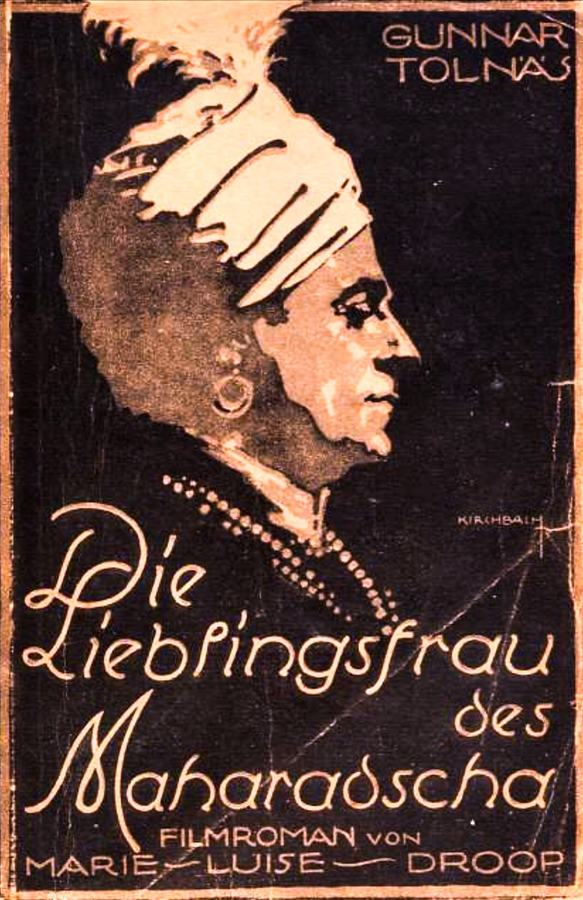
There are films you watch, and films that watch you—Die Lieblingsfrau des Maharadscha – 2. Teil belongs to the latter cabal. Shot in 1921 on the backlots of Tempelhof yet drenched in the hallucinatory magenta of Rajasthani sunsets, this sequel outruns its prequel the way a cheetah outpaces its own reflection. The plot, nominally about a disputed heir and the woman who can validate or vaporise his claim, is merely the trellis on which Marie Luise Droop drapes her intoxicating tapestry of gazes: glances sharp enough to slice purdah, stares that breed dynasties, winks that doom them.
Adolf Droop’s scenario dispenses with exposition the way a courtesan drops her dupatta—swiftly, theatrically, never innocently. Within nine title cards we learn that the maharaja’s pulse flickers only for his lieblingsfrau, a Danish-born consort played by Aud Egede-Nissen with the languid cruelty of a cat who has read Nietzsche. Her rival, Eduard Rothauser’s reformist diwan, brandishes modernity like a scimitar, but every syllable of progress clangs against the jeweled inertia embodied by Erna Morena’s maharani-in-exile, eyes glazed with opium and ancestral spite.
The camera—wielded by future UFA stalwart Curt Courant—glides through throne rooms as if on casters of silk. Observe the sequence where the royal barge floats down an indoor canal: lotus petals crushed under eunuch oars, Kortner reflected in black water like a malign moon, the soundtrack (restored in 2019 with tabla and theremin) throbbing like a guilty heart. No CGI, no rear projection—just plywood painted to resemble jade, smoke machines, and a cinematographer who understood that splendour is merely terror wearing too many pearls.
Fritz Kortner’s performance is a masterclass in reptilian minimalism. He never rushes a gesture; instead he lets the audience rush toward him, pupils dilated, craving instruction in menace. Compare his stillness to the kinetic neurosis of The Long Trail’s prospector or the guilt-ridden officer in With Serb and Austrian. Kortner’s priest doesn’t walk into a room—he infects it.
Meanwhile Gunnar Tolnæs, as the heir apparent, carries the weight of the narrative like a cobra coiled around his bicep. His dilemma—love for the favourite wife vs. duty to the empire—could have slid into melodrama. Yet under the Droops’ pen the conflict metastasizes into something darker: a meditation on colonial voyeurism. Notice how the maharaja’s European tutors lecture on Voltaire while Indian peasants outside the palace die of cholera; the editing juxtaposes both spheres within a single breath, forecasting the dialectical montage of Eisenstein but scented with attar rather than tractor grease.
Colour symbolism ricochets across the frames. Saffron denotes not spirituality but erotic surveillance—every saffron-robed spy reports to Kortner’s network. Crimson, usually connoting British uniforms, here stains the lips of the maharani, signalling a pact with revolution. Sea-blue, the hue of Marga, Lebensbild aus Künstlerkreisen’ bohemian canvases, shows up only once: in the turban of a messenger who brings news of the heir’s assassination—modern art as omen of political entropy.
Speaking of entropy, the mid-film sandstorm sequence deserves scholarly tomes. Shot on Lüneburger Heide doubled for the Thar Desert, the scene swallows the protagonists in ochre chaos. Chiaroscuro dissolves into mere scuro; silhouettes grapple like figures on a Grecian urn smashed by a sledgehammer. When the storm subsides, half the cast is dead, their bodies arranged by silhouette maestro Hermann Warm into a tableau worthy of Das schwarze Los’ fatalistic dice games.
Yet the film’s true coup de grâce arrives in its final reel: the coronation of the infant prince, a ceremony intercut with stock footage of solar eclipses. The montage births an unsettling equation—kingship is cosmic occlusion, sovereignty a black sun. As the palace orchestra strikes a discordant fanfare (lifted from Schubert’s unfinished 8th, reversed on a phonograph), Aud Egede-Nissen’s consort lifts her veil, revealing a face powdered with silver nitrate, eyes two voids where history goes to die. She whispers the new maharaja’s name; the intertitle simply reads: „Und das Reich war sein Spiegel.“ The empire was his mirror—a line that echoes through German expressionism like a migraine.
Compare this closure to the redemptive shootouts of His Vindication or the moral algebra of Der gestreifte Domino. The Droops offer no absolution, only reflection—black, silver, merciless.
Restoration-wise, the 4K scan by Munich Film Museum salvages nearly 18 minutes once thought lost. The tinting follows 1921 chemical notations: pomegranate for interiors, arsenic-green for conspiratorial terraces. The optional commentary by scholar Josephine Diebitsch contextualizes the film within Weimar Orientalism, arguing that the maharaja’s harem operates as a stand-in for post-Versailles Berlin: polyglot, decadent, doomed.
Weaknesses? Yes, a handful. The subplot involving Carl Worm’s comic astrologer feels stapled on, a concession to distributors fearing pure gloom. And Leopold von Ledebur’s British resident, though regal, resembles every other monocled villain since Griffith’s Birth. Still, these quibbles evaporate like rosewater on a brazier when the next visual epiphany arrives—say, the tracking shot through a hallway of convex mirrors that refracts the protagonist into a kaleidoscope of selves, each plotting regicide.
Influence? Trace the DNA forward to Powell & Pressburger’s Black Narcissus, to Kubrick’s Barry Lyndon, even to the mirrored corridors of Last Year at Marienbad. The film’s DNA also metastasizes sideways into the vampiric eroticism of Vampyrdanserinden and the fatal masquerades of Trompe-la-Mort.
Should you watch it? If you crave comfort, retreat to After Dark’s bourgeois levity. If you desire a fever dream that leaves sand in your synapses and mercury in your veins, book three hours, extinguish every lamp, and let this maharaja’s mirage colonise your retina. The favourite wife might stab you with her anklet bell, but you will thank her as you bleed out onto Kashmiri silk.
Verdict: a cataract of jewels, obsidian eroticism, and political nihilism—Germany’s silent answer to the collapse of princely India and the Weimar republic alike. Essential, venomous, unforgettable.
Community
Log in to comment.