DbcultAccessing Vault...
Cult Review
Senior Film Conservator
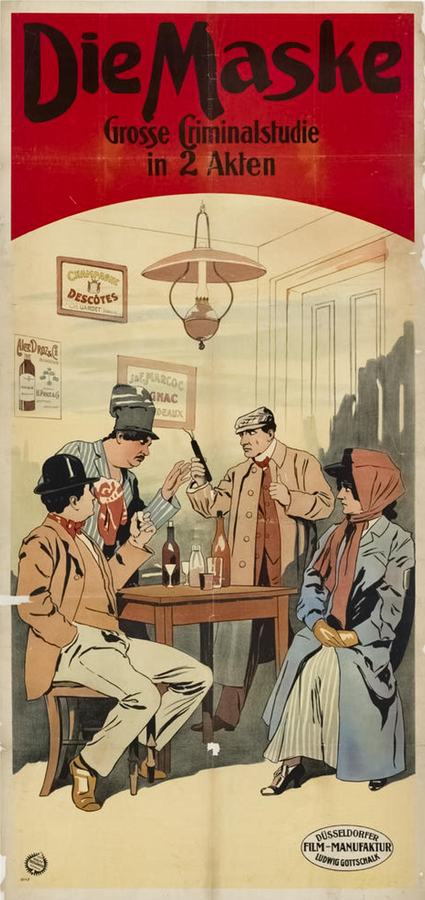
The screen is dark, and the only light comes from the faint glow of a flickering candle, casting shadows on the faces of the characters as they prepare for a performance. In Die Maske, directed by Eduard von Winterstein and written by Ewald André Dupont, the interplay of light and shadow becomes the metaphor for the film's central theme: deception and the masks we wear to hide our true selves.
The story unfolds in a theater, where a troupe of actors is rehearsing for a production. Fritz Schulz, one of the stars, is the central character, a man whose life is shrouded in mystery. His character, Helmut von Schön, is a man whose past is as murky as the night he lives in. As the story progresses, it becomes clear that each actor in the troupe is hiding a secret, and their performances on stage are merely a facade for their true selves.
The cinematography in The Passing of the Third Floor Back and Southern Justice can be seen as influences, with their focus on the psychological landscapes of their characters. However, Die Maske stands out with its raw and unfiltered approach, capturing the essence of silent film artistry at its finest. The absence of dialogue allows the actors to convey their emotions through facial expressions and body language, creating a richer, more nuanced performance than what was typical for its time.
At the heart of the film is Fritz Schulz, who brings a depth to his character that is both mesmerizing and haunting. His portrayal of Helmut von Schön is a masterclass in silent acting, where the slightest twitch of an eyebrow or the curve of a smile can tell a thousand stories. Schulz's performance is a testament to the power of the silent screen, where the absence of words allows the audience to fill in the gaps with their own interpretations.
The supporting cast, led by Eduard von Winterstein, Max Landa, and Eva Speyer, brings a collective depth to the narrative. Each actor's mask is as intricate as the next, and the film becomes a puzzle for the audience to piece together. Eduard von Winterstein, in particular, steals scenes with his ability to convey a range of emotions through a single glance. His character, a director with his own secrets, is a master manipulator, using the actors to uncover the truth about the masks they wear.
The film's exploration of identity and self-deception is one of its most compelling aspects. Through the metaphor of the theater, Die Maske delves into the complexities of human nature, questioning what it means to be authentic. The characters are not just actors on a stage, but also reflections of the audience, mirroring the ways in which we all hide parts of ourselves from the world.
The editing in Die Maske is a work of art in itself. The use of jump cuts and overlapping scenes creates a sense of disorientation, mirroring the characters' internal struggles. The editing style is reminiscent of the work of D.W. Griffith in The No-Good Guy, but with a more experimental edge. The film's editing is not just about moving the plot forward, but about creating a psychological landscape that is as oppressive as the characters' own struggles.
The film's score, composed by Wilhelm Diegelmann, adds a haunting dimension to the proceedings. The music is a blend of orchestral and atonal elements, creating a soundscape that is both beautiful and unsettling. The score is a perfect complement to the visual story, enhancing the emotional impact of each scene.
The ending of Die Maske is a masterpiece of ambiguity. The final scenes leave the audience with more questions than answers, inviting them to ponder the true nature of the characters and their masks. The film's conclusion is not a resolution, but a reflection, urging the audience to look within themselves and question the masks they wear.
While Die Maske is a silent film, it does not suffer from the limitations that might be associated with its era. The story is told with a clarity and depth that would be challenging to replicate in spoken dialogue. The film is a testament to the power of visual storytelling and the artistry of silent film.
For fans of early cinema, Die Maske is a must-watch. It is a film that demands to be seen and reseen, each viewing revealing new layers of meaning. The film is a reminder of the artistry that went into silent film and a tribute to the actors and directors who brought these stories to life.
The film's legacy is one of influence and inspiration. It has been a source of inspiration for later filmmakers, including Alfred Hitchcock and Fritz Lang, who have drawn on the themes and techniques of Die Maske in their own work. The film's exploration of identity, deception, and the human condition has resonated with audiences for generations, making it a timeless piece of cinema.
In conclusion, Die Maske is a silent film masterpiece that demands to be seen. It is a film that challenges the audience, invites introspection, and offers a rich, nuanced exploration of the human psyche. It is a film that stands the test of time and remains relevant to this day.
IMDb —
1926
Community
Log in to comment.