DbcultAccessing Vault...
Cult Review
Senior Film Conservator
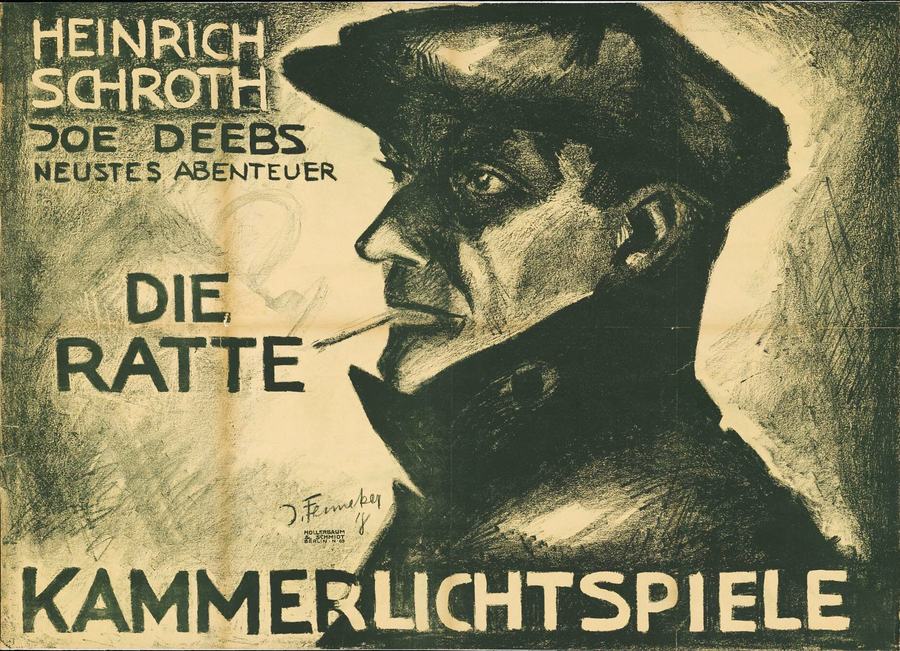
Berlin, 1923. Inflation gallops faster than gossip, and every alley exhales the sour breath of coal smoke. Into this scarred city slinks Die Ratte, a film whose very title feels like a bite. No cozy morality tale here—only the scrape of claws across conscience, the rustle of secrets traded for scraps. Director Harry Piel, better known then for stunt-laden pulp, surprises with something leaner, meaner, nearly feral.
From the first frame—an iris shot that opens like a bloodshot eye—we are shackled to the viewpoint of a child pickpocket, Die Ratte herself, played by Lina Paulsen with the brittle intensity of cracked porcelain. Paulsen, barely sixteen during production, moves with a twitch-shoulder gait, as if her skeleton were trying to shed its skin. She is less character than symptom: the city’s guilt gnawing its own tail.
Stefan Vacano’s camera turns Berlin into a fever diagram: streets narrowed to slits, staircases spiraling like corkscrews, moonlight dripped in mercury beads across puddles. Compare this to the pastoral softness of An Innocent Magdalene or the snow-blanketed fatalism of Forbandelsen; here every shadow seems bitten rather than cast. Intertitles arrive sparingly, often single nouns—“Gift” (poison), “Geld” (money), “Schuld” (guilt)—lettered in jagged Fraktur that resembles snapped ribs.
Leo Burg essays Dr. Holk, chemist and war profiteer, with the clammy elegance of a man who powders the cracks in his own mask. His laboratory is a cathedral of retorts and alembics, but the film never romanticizes intellect; knowledge here is merely another currency, debased like the mark. When Holk poisons his mentor to conceal a faulty batch of battlefield morphine, the act is filmed in a single, merciless tableau: a gloved hand, a gurgle cut short, the delicate clink of glass on parquet. The camera does not cut away; it dollies in until the victim’s iris dilates to black marble. You feel the death as aperture, not event.
Enter Die Ratte, scavenging the doctor’s waste-bin for paper she can resell. She sees the murder, yet instead of running, she inhales the scene, pockets the vial, and thereby becomes both witness and accomplice—a moral ambiguity later echoed in Woman and Wife, though that film dilutes its venom with sentimental redemption.
Screenwriters Richard Hutter and Philipp Silber refuse psychology; they trade in topology. Characters do not develop, they navigate. The plot is a series of locked rooms and liminal zones—pawnshop, dancehall, Salvation Army barracks, opium cellar—each a Petri dish where power mutates. Hermann Picha’s pawnbroker, obese and powdered, sits atop his counter like a toad on a gold throne, pricing human teeth by the gram. Olga Engl’s madame meanwhile stages a marionette show whose puppets wear the faces of underage girls, a grotesque that anticipates the masked decadence of On the Steps of the Throne.
Through this maze scurries Die Ratte, surviving on feral cunning. Paulsen’s performance is astonishingly physical: she communicates hunger by the way her shoulder blades twitch below wool; her smile, when it appears, is sudden as a knife nick. Film historians often liken her to Nosferatu’s Knock, yet she exudes less theatrical menace than animal bewilderment—an empathy magnet even while committing blackmail.
The movie is silent, yet its sound design is implied through synesthetic visuals: each crunch of Die Ratte’s stolen apple is rendered by a jagged splice, a single frame removed so the image seems to hiccup. Poison, repeatedly, is linked to color: chartreuse fog inside the chemist’s lab, bile-yellow streaks across the tenement walls, the sea-blue glass of the fatal vial—an iridescent trifecta that the DVD restoration exaggerates to psychedelic intensity. This chromatic coding prefigures the moral color-play in Hands Up, though that film wields tinting for spectacle rather than nausea.
Women in Die Ratte circulate like dubious banknotes. Mechthildis Thein’s Salvation Army girl tries to purchase Die Ratte’s soul with warm milk and hymns; Engl’s madame buys children wholesale, selling them retail to gentlemen whose top hats never come off, lest their horns show. Masculinity, meanwhile, is diseased: every male character oozes some form of rot—financial, moral, venereal. The film thus inverts the sentimental rescue trope common in Peggy Leads the Way; here salvation is a scam, and the only savior is the rat who refuses the trap.
Visually, the finale is among the most haunting of the decade: an abandoned aquarium, its tanks cracked, water ankle-deep, skeletal fish floating like translucent commas. Holk corners Die Ratte amid the shattered glass; moonlight refracts into spectral beams, turning the scene into an underworld chapel. In this cathedral of decay, Die Ratte finally bites back—literally. She sinks her teeth into Holk’s gloved hand, forcing the poison between his lips. The act is filmed in profile, their silhouettes fused, evoking the predator-prey ouroboros. When the police arrive, the chemist is already foaming, twitching, a marionette with its strings cut. Yet the camera lingers not on him but on Die Ratte’s face, half-illuminated by a policeman’s lantern. Her grin is neither triumph nor remorse; it is the blank aperture through which the next crime will crawl.
Context matters. Shot mere months after the failed Beer Hall Putsch, Die Ratte channels a republic that suspects its own expiration. Inflation had turned grandmothers into currency speculators, and every child knew hunger as a house-guest. Thus the film’s pessimism feels documentary, its expressionism less stylistic choice than civic diagnosis. Compare it to the frontier optimism of The Law of the Great Northwest or the drawing-room redemption of Society for Sale; Die Ratte offers no new world, only the old one stripped to vermin and bone.
Burg’s descent from smug rationalist to poisoned animal is calibrated in micro-gestures: a twitch of the left cheek, a bead of sweat that hesitates at the collar. Picha’s pawnbroker is grotesque yet weirdly pitiable; when he counts coins he licks his thumb as though tasting rusted blood. Thein, with her lantern jaw and contralto voice, turns a hymn into a dirge that seems to slow the film itself. But the film belongs to Paulsen. Watch her in the pawnshop scene: she bargains for a crust of bread using the vial as collateral, her eyes flicking between object and proprietor like a gambler calculating odds. She never begs; she trades terror for nourishment, and the transaction sickens you with its logic.
The montage is propulsive yet sly. Vacano employs match-cuts that swap humans for objects: a child’s hand releases a stolen watch; cut to Holk’s hand releasing a test-tube—time and poison interchangeable commodities. Intertitles intrude irregularly, sometimes upside-down, once backwards-mirrored, forcing the viewer to physically reorient, as if the film itself were a locked room attempting escape. Such editorial audacity outpaces the comparatively linear The Great Mistake and even the fragmented yet moralistic A Woman’s Way.
For decades Die Ratte was presumed lost, another casualty of nitrate bonfires and studio indifference. A 2021 restoration from a Portuguese collector’s partial print—augmented by intertitles reconstructed from censorship cards—reveals a work that anticipates both M and Oliver Twist’s noir progeny. You can trace its DNA in the sewer finale of Carol Reed’s The Third Man, in the child assassins of City of God, even in the poisoned pastels of Suspiria. Yet unlike those descendants, Die Ratte refuses catharsis. The restored blu-ray ends with a 4K gallery of production stills: crew members smoking amid fake fog, Paulsen practicing sleight-of-hand with the vial. The final still is a close-up of the rat-trap mechanism, jaws open, empty. The message: the trap is set; the era, not the individual, is the prey.
Modern viewers may flinch at the child-endangerment spectacle, yet the film indicts us for that very flinch—our sentimental reflex becomes part of its moral circuitry. It is brisk (78 minutes), bruising, and devoid of the redemptive spoonful Hollywood would demand a decade later. In place of salvation it offers fascination: the morbid glow of watching a society chew its own tail while calling it policy. If you seek comfort, look elsewhere—perhaps at The Lion of the Hills with its rugged heroics, or the domestic reconciliations of Old Brandis’ Eyes. But if you crave a film that still scratches the inside of your skull days later, Die Ratte waits in the gutter, grinning, poison vial glinting like a tiny moon.
—reviewed by a fellow rodent in the walls of cinema
IMDb 6.3
1922
Community
Log in to comment.