DbcultAccessing Vault...
6.4/10
Senior Film Conservator
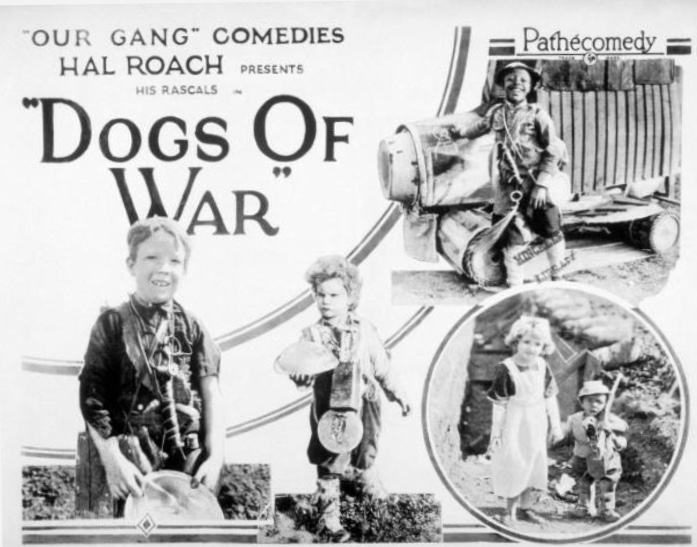
A definitive 6.4/10 rating for a film that redefined the boundaries of cult cinema. Dogs of War! remains a cornerstone of transgressive art.
When the camera rolls on Dogs of War!, the audience is thrust into a pandemonium that feels part slapstick, part avant‑garde protest. The film opens with the gang—an eclectic assembly of juvenile mischief‑makers led by the irrepressible Jack Hill—gathering in a dilapidated barn, their faces smeared with the grime of poverty and ambition. Their weapon of choice? Not guns or explosives, but the very remnants of the earth’s bounty: wilted lettuce, bruised tomatoes, and the occasional over‑ripe pumpkin. These vegetal munitions are catapulted with the fervor of a revolutionary army, each projectile a symbol of resourcefulness turned weaponised satire.
The early sequences are a study in kinetic choreography. James Parrott’s lanky lankiness provides a visual counterpoint to Hal Roach’s Rascals, whose collective energy fuels the film’s relentless pace. The camera, perched low, captures the frenetic energy of the children as they hurl their produce, the orange‑tinged carrots slicing through the air like missiles of absurdity. The cinematography, though constrained by the technology of the 1920s, employs rapid cuts and exaggerated angles that echo the later kinetic style of The Puncher and the Pup, yet retains a distinctly organic feel.
Midway through the narrative, the gang’s mischief escalates from the physical to the metaphysical. They breach the perimeter of a bustling film set, where a melodramatic romance—reminiscent of The Love That Lives—is being shot. In a moment that feels both deliberate and chaotic, they commandeer the camera’s exposure mechanism, deliberately double‑exposing the film stock. The resulting visual is a hallucinatory overlay: the tender gazes of the lead actors are haunted by the ghostly silhouettes of flying vegetables, the soft lighting now interlaced with the stark, jagged shadows of thrown carrots.
This act of sabotage is not merely a gag; it is a meta‑commentary on the fragility of cinematic illusion. The double‑exposure, a technique popularised by pioneers like Georges Méliès, is here wielded as a weapon of subversion. The audience is forced to confront the constructed nature of narrative, as the film’s diegesis collapses under the weight of its own artifice. The chaos on screen mirrors the chaos off screen, where the gang’s anarchic spirit threatens to dismantle the polished veneer of Hollywood’s golden age.
The ensemble cast, a veritable who's who of early twentieth‑century comedy, delivers performances that are both riotously physical and subtly nuanced. Harold Lloyd, appearing in a cameo as a bewildered director, injects a moment of deadpan humour that feels like a nod to his later masterpieces such as True Blue. Jackie Condon’s expressive eyes convey a childlike curiosity that anchors the film’s more surreal moments, while Ernie Morrison Sr., affectionately known as “Sunshine Sammy,” provides a rhythmic cadence to the gang’s antics, his movements echoing the slap‑stick timing of the Puncher and the Pup crew.
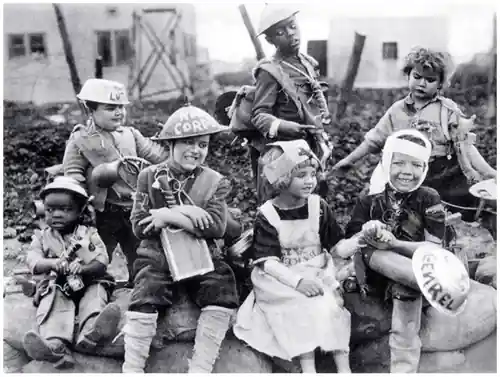
Mary Kornman's delicate poise offers a counterbalance to the surrounding mayhem; her brief interlude—where she attempts to negotiate peace with a carrot‑laden cannon—evokes the bittersweet tenderness found in Over the Garden Wall. Meanwhile, the veteran comedian Jack Davis delivers a series of pratfalls that feel almost choreographed, each tumble a study in physical comedy that predates the later works of Buster Keaton.
Beyond its surface-level antics, Dogs of War! engages with themes of resource scarcity and class struggle. The gang’s reliance on discarded vegetables as weaponry reflects a post‑World War I sensibility, where societies grappled with rationing and the repurposing of everyday objects for survival. This mirrors the narrative of Five Days to Live, where protagonists must improvise under duress.
The film also interrogates the power dynamics between creators and audiences. By double‑exposing the in‑progress movie, the gang forces the director—and by extension, the studio system—to confront the vulnerability of its own product. This act can be read as an early precursor to the post‑modern deconstruction seen in later works such as You're Next, where the audience becomes complicit in the unraveling of narrative cohesion.
Hal Roach’s direction, complemented by H.M. Walker’s intertitles, showcases a daring use of visual metaphor. The double‑exposure sequence, achieved through painstaking in‑camera manipulation, creates a layered tableau that feels both chaotic and meticulously crafted. The use of chiaroscuro—deep shadows juxtaposed with the bright orange of the vegetable artillery—creates a visual rhythm that is both comedic and foreboding.
The editing, though brisk, never sacrifices clarity. Cuts are timed to the cadence of the gang’s chants, each transition punctuated by the thud of a thrown radish. This rhythmic editing foreshadows the syncopated pacing of later sound comedies, illustrating Roach’s forward‑thinking approach.
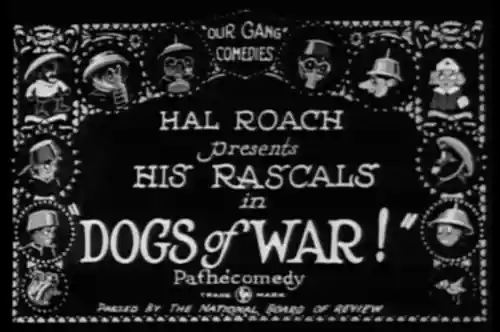
When placed beside contemporaneous works such as The Man Who Beat Dan Dolan, the film’s subversive edge becomes evident. While The Man Who Beat Dan Dolan adheres to a more conventional hero’s journey, Dogs of War! revels in anarchic disruption, turning the hero archetype on its head. Similarly, the emotional gravitas of The Child of Destiny contrasts sharply with the film’s unapologetic absurdity, highlighting Roach’s willingness to experiment beyond melodrama.
Internationally, the film’s chaotic energy finds a kinship with the German expressionist piece Die Faust des Riesen, where visual distortion mirrors psychological turmoil. Though the cultural contexts differ, both films employ visual distortion—whether through double‑exposure or stark set design—to externalise internal conflict.
Though Dogs of War! never achieved the commercial heights of other Roach productions, its daring experimentation left an indelible mark on the evolution of comedy. The film’s willingness to blend slapstick with meta‑cinematic critique paved the way for later genre‑bending works, influencing directors who sought to deconstruct the medium itself. Its visual language can be traced forward to the chaotic montages of the 1930s and even to modern post‑modern cinema.
The film’s cast, many of whom transitioned into sound-era stalwarts, carried forward the kinetic energy cultivated here. Harold Lloyd’s later forays into self‑referential humor, as seen in Broadway Bill, echo the self‑awareness first glimpsed in this silent romp.
In sum, Dogs of War! stands as a testament to the boundless imagination of early cinema. Its blend of vegetable‑laden mayhem, daring double‑exposure, and a cast that radiates kinetic joy creates a viewing experience that is simultaneously uproarious and intellectually stimulating. The film invites repeated viewings, each time revealing new layers of satire, visual wit, and historical resonance. For scholars of silent comedy, it offers a rich case study in how absurdity can be weaponised to critique the very foundations of narrative art.
Whether approached as a riotous comedy or as a subversive manifesto, the film rewards the attentive viewer with a kaleidoscope of color, soundless dialogue, and a lingering sense that, perhaps, the most potent weapons are those forged from the simplest of resources—an insight that remains as relevant today as it was in 1925.
IMDb —
1915
Community
Log in to comment.