DbcultAccessing Vault...
Cult Review
Senior Film Conservator
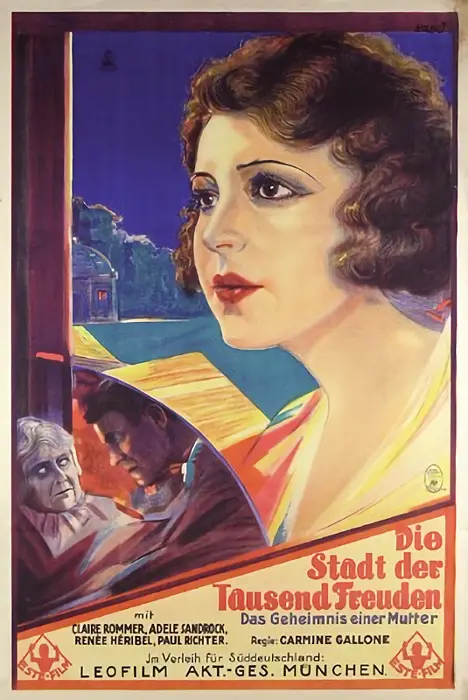
Is Die Stadt der tausend Freuden worth watching today? Short answer: Yes, but strictly as a historical artifact for those obsessed with the technical evolution of European silent cinema.
This film is for the patient cinephile who finds beauty in the architectural scale of the 1920s and for scholars of Arnold Bennett’s cynical literature. It is most certainly NOT for the modern viewer seeking a fast-paced thriller or a cohesive emotional narrative. It is a slow, methodical, and occasionally turgid exploration of ego.
1) This film works because it successfully visualizes the 'City of Pleasure' as a grotesque, living organism that consumes its owners as much as its patrons.
2) This film fails because the second act collapses under the weight of its own melodrama, losing the sharp social critique found in the source material.
3) You should watch it if you want to see the legendary Adele Sandrock command the screen with a presence that rivals the era's most formidable stage actors.
Director Carmine Gallone approaches the 'City of Pleasure' not as a place of fun, but as a monument to hubris. The scale of the sets is staggering. In one particular sequence, the camera pans across the vast amusement park, and you can feel the physical weight of the production. Unlike the more intimate character studies found in films like I de unge Aar, this film demands the viewer look at the macro level. It is about the machinery of entertainment.
The sets are designed with a sharp, almost expressionistic edge that hints at the darker themes beneath the surface. The contrast between the glittering lights of the attractions and the shadowy, cramped offices of the management creates a visual metaphor for the class divide. It is a technique we see utilized differently in Queen of Spades, but here it serves to highlight the artificiality of the 'thousand delights' promised by the title.
Adele Sandrock is, quite frankly, the only reason some of these scenes don't float away into irrelevance. Her performance is grounded. She doesn't just act; she occupies the space with a heaviness that makes the surrounding melodrama feel real. When she enters a room, the frame stabilizes. Compare her work here to the more frantic energy in Mania, and you see a masterclass in silent restraint.
Gaston Modot and Paul Richter provide the necessary conflict, but they often fall into the trap of over-gesticulation common in the late silent period. Richter, in particular, seems to struggle with the nuance of his character's descent into obsession. There are moments where his facial expressions feel disconnected from the gravity of the situation. It works. But it’s flawed. The chemistry between the leads is often overshadowed by the sheer volume of the set design.
If you are looking for a casual evening of entertainment, the answer is a firm no. The pacing is deliberate to the point of being punishing. However, if you are interested in how 1920s European cinema attempted to compete with Hollywood's growing dominance, this film is a fascinating case study. It possesses a grandeur that few modern films can replicate without the use of digital effects.
The film asks a timeless question: Can joy be manufactured? Underneath the layers of 1927 artifice, there is a biting commentary on the commercialization of the human experience. It’s a theme that resonates even today in our era of digital distractions. In that sense, Die Stadt der tausend Freuden is surprisingly prescient.
The cinematography by Massimo Terzano is a highlight. He uses light to carve out the psychological states of the characters. In the scenes where the rivalry reaches its boiling point, the lighting becomes harsh and unforgiving. This is a far cry from the softer, more comedic lighting found in What Happened to Jones. Here, every shadow is a threat.
However, the film suffers from a lack of rhythmic editing. The transitions between the grand spectacle and the intimate drama are often jarring. It lacks the fluid movement found in The Woman Under Cover. You find yourself admiring individual shots rather than being swept away by the narrative flow. It is a collection of beautiful images held together by a fraying plot.
Pros:
Cons:
Adapting Arnold Bennett is always a risk. His prose is sharp, observational, and deeply rooted in the mundane details of life. Translating that to a silent medium often results in the loss of his specific wit. Die Stadt der tausend Freuden tries to compensate for this by amping up the visual drama. While it captures the scale of Bennett's 'City of Pleasure', it loses some of the satirical bite. It is a trade-off that results in a film that is more 'epic' but less 'clever' than its source material.
"The film is a testament to an era that believed cinema could be as grand as the cathedrals of old, even if the stories it told were as transient as a carnival ride."
When compared to other films of the period like Der Galeerensträfling, this movie feels more modern in its cynicism but more antiquated in its execution. It exists in a strange middle ground. It is not quite a masterpiece of expressionism, nor is it a standard commercial drama. It is an experiment in scale.
Die Stadt der tausend Freuden is a fascinating failure. It attempts to build a world of infinite delight and ends up showing us the hollow bones of the industry that creates it. The film is visually arresting and features a powerhouse performance from Sandrock, but it struggles to maintain momentum. It is a monument to the silent era's ambition. It is beautiful. It is exhausting. It is a piece of history that demands to be seen, even if it doesn't necessarily demand to be loved.

IMDb 6.8
1934
Community
Log in to comment.