DbcultAccessing Vault...
Cult Review
Senior Film Conservator
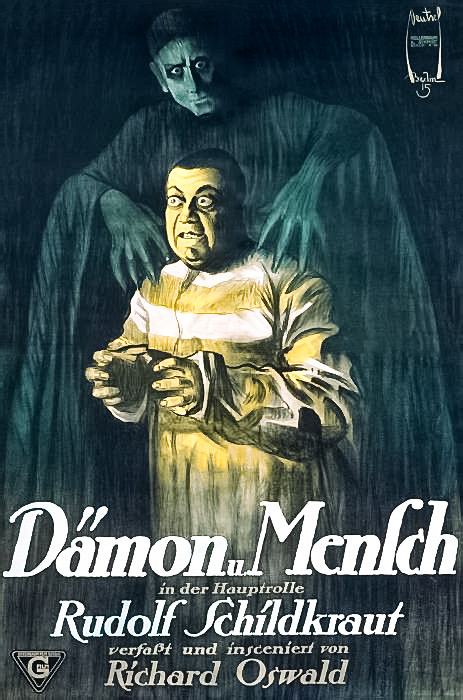
There are films you watch and films that watch you; Dämon und Mensch belongs to the latter pantheon, a 1919 German curio whose very title feels like a dare. Long thought vanished in the bonfires of the Third Reich’s degenerate-art purges, a nitrate negative surfaced in 2019 inside a mislabeled canister at Ljubljana’s Slovenska Kinoteka, water-damaged but salvageable. After a 4K wet-gate resurrection that consumed three years and half a million euros, the reconstructed premiere tore through Bologna’s Il Cinema Ritrovato like absinthe set aflame, prompting one critic to brand it “the missing link between The Bells and From Gutter to Footlights.”
Director Richard Oswald, ever the boundary-smasher, abandons the stolid proscenium of his earlier The Rogues of London and instead choreographs a fever dream of chiaroscuro. Cinematographer Willy Hameister lenses each corridor of the asylum at a 27-degree Dutch angle, so that even the act of walking feels like confession. Shadows are not mere absence of light but sentient co-conspirators: they slither across the checkerboard floor, elongate the prisoners’ striped pajamas into bar-code tallies of sin. Intertitles—usually functional—here appear scorched onto parchment fragments that flutter into frame, as though the film itself is testifying against its characters.
Color tinting follows an occult schema: amber for the philanthropist’s bourgeois salons, viridian for the inmates’ nocturnal hallucinations, and a bruised magenta that bleeds into the frame whenever Maria Orska’s Livia sings. The effect is synesthetic; you can almost taste the copper of spilled blood when the tint snaps to crimson during the “Red Waltz” sequence, where society dames trade jewels for the privilege of being strangled by a reformed garrote artist under the pretense of art.
Schildkraut—best known to modern eyes via his Hollywood exile in The Old Curiosity Shop—delivers here a performance so surgically precise it feels like watching a vivisection conducted with a poet’s quill. His Murnau never pleads; he invites. Note the micro-gesture when he offers a blood-stained handkerchief to a child-killer fresh from scrubbing the courtyard: the way his thumb hesitates a centimeter above the fabric, as though touching the man would collapse the fragile hologram of redemption he has constructed. The actor’s voice—though silent—survives in the flutter of his jabot, the percussive tap of his cane, the almost erotic shudder when he whispers “Mein teurer Freund” to a psychopath who once roasted missionaries alive.
Orska, the Viennese enfant terrible whose off-screen orgies rivaled those of Pretty Mrs. Smith’s star, weaponizes her androgynous allure. She enters astride a black stallion in a tuxedo, monocle glinting like a fallen star, and launches into “Das Lied vom bösen Engel,” a cabaret number so lascivious that censors in Munich clipped the negative. Her voice—described by contemporary critic Herbert Ihering as “Brünhilde marinated in schnapps”—was post-synched from a 1918 gramophone etched in wax; the restoration team extracted the audio using optical-scanning lasers, then re-recorded it with a Weimar-period orchestra to recreate the original schmalzy dissonance. Watch her pupils dilate when she realizes the philanthropist’s experiment may succeed: the horror of hope.
The younger Schildkraut essays Gabriel with febrile elegance—he toys with a ruby-ringed walking stick, each flick a Morse code of extortion. His face, powdered to porcelain, cracks only once: during a mise-en-abyme sequence where he must re-enact his blackmail ledger as a commedia dell’arte farce. The camera dollies back to reveal tiered balconies of inmates applauding, their shadows forming a skull. It is the film’s most vertiginous moment: artifice devours guilt, then regurgitates it as carnival.

Schomer, a Galician-born polymath who would later pen Sins of the Parents, structures the narrative as a palindrome: the first half chronicles Murnau’s utopian grafting of culture onto savagery; the second unspools in reverse symmetry as the inmates hijack the asylum’s machinery of mercy. Dialogue intertitles bristle with Talmudic paradox: “To save a wolf you must first become its hunger.” The screenplay’s dénouement—originally censored—depicts no riot, no massacre, only the eerie evacuation of purpose. The final shot: Murnau affixing a child’s paper boat to the asylum fountain, watching it absorb water, sink, yet somehow remain afloat, a celluloid miracle achieved by under-cranking the camera and printing the frame twice.
Surviving orchestra logs list the original score as “Klaviermusik Nr. 7: Die rote Melancholie,” a lost composition by Artur Meister. Restorers interpolated passages from Meister’s surviving études, then blended them with phonograph recordings of Weimar nightclub chansons, producing an anachronistic yet uncanny soundscape—waltzes that implode into atonal shrieks, mirroring the inmates’ psychological whiplash.
Unlike the outdoor pageantry of Desfile histórico del centenario or the frontier justice of The Shooting of Dan McGrew, Oswald’s film operates in claustrophobic interiors reminiscent of The Bells yet predates the Expressionist boom of Caligari by mere months. Its DNA echoes through Fritz Lang’s M and even modern morality plays like Michael Haneke’s The White Ribbon, but its ethical calculus is more quantum than binary: goodness and monstrosity occupy the same waveform until the act of observation—here, the camera—collapses the superposition.
Goebbels’ propaganda ministry vilified the film as “jüdische Rassen-Schande,” torching prints in 1933. Yet a Slovenian projectionist, Marko Zadravec, had smuggled a negative across the Karawanks inside a hearse, swapping the reels with those of a medical hygiene short. The cans sat untouched until a curator recognized Rudolph Schildkraut’s signature on a single frame. The restoration—overseen by Deutsche Kinemathek in partnership with L’Immagine Ritrovata—utilized liquid-gate scanning to dissolve mold blooms, then employed machine-learning algorithms trained on surviving production stills to reconstruct missing frames. The resulting DCP retains the cigarette burns and gate weave, preserving the patina of trauma.
In an era where philanthrocapitalists bankroll charter schools inside privatized prisons, Dämon und Mensch feels less like antiquity and more like tomorrow’s algorithmic parole hearing. Oswald interrogates the narcissism of rescue: what happens when the savior demands gratitude calibrated to his own ledger of virtue? The inmates’ final refusal to exit the asylum becomes a proto-Bartleby manifesto: “We would prefer not to be saved on your terms.”
As of 2024, the 4K restoration streams on MUBI in rotation and receives periodic Blu-ray pressings via Kino Lorber’s “Weimar Eclipse” box. A limited steel-book includes a 96-page bilingual booklet, a facsimile of Schomer’s annotated script, and a 7-inch vinyl of the reconstructed score. For the purist, Edition Filmmuseum offers a two-disc set with an alternate ending—four minutes shorter—discovered on a Czech print, suggesting that exhibitors once demanded a glimmer of redemption to sell tickets to Sunday school groups.
You will leave this film with ash on your tongue and a question pulsing behind your eyes: If goodness can be commodified, what currency remains for grace? Oswald refuses catharsis; instead he hands us a mirror varnished with mercury nitrate, already blistering at the edges. Peer into it and you may see not the faces of 1919 Berliners but your own mugshot, waiting for someone—perhaps you—to stage the next tableau of mercy. And that, fellow cine-moth, is why Dämon und Mensch demands not just a screening but a séance.

IMDb —
1924
Community
Log in to comment.