DbcultAccessing Vault...
6.2/10
Senior Film Conservator
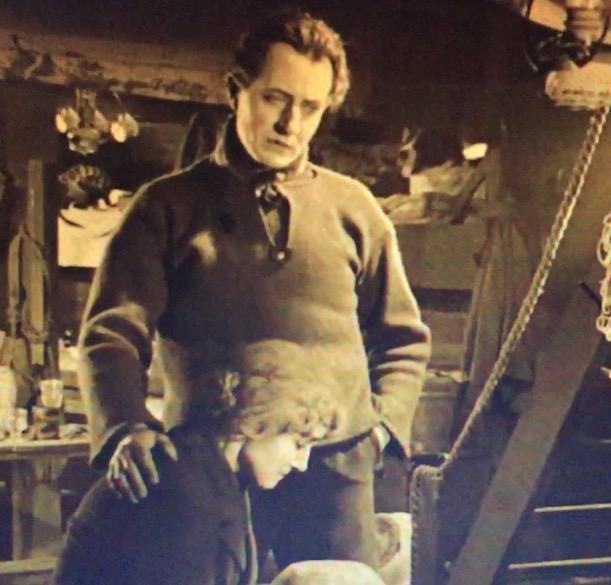
A definitive 6.2/10 rating for a film that redefined the boundaries of cult cinema. Die weisse Wüste remains a cornerstone of transgressive art.
The first time the ice shelf explodes across the screen in Die weisse Wüste, you swear you can smell brine and terror. Ernst Wendt and Einar Stier’s 1921 nightmare, long buried under nitrate dust, surfaces now like a ghost galleon—its timbers creaking with sexual violence, authoritarian sadism, and a Lutheran dread that would make even Bergman shiver.
What strikes cold fire is the film’s refusal to grant the audience a single safe outpost. From the over-exposed opening card—white letters on black, like teeth punched into velvet—the camera hurtles us into a claustrophobic maritime panopticon. Frieda Siewert-Michels, playing the sole woman aboard, is lit like a sacrificial icon: cheekbones carved by lantern-glow, eyes two pleading commas. Gaustad’s assault on her is staged not for lurid titillation but as a hieroglyph of absolute power; the cutaway to a gull shrieking outside the porthole feels almost obscene in its poetic honesty.
Carl de Vogt’s Björn and Karl Balta’s Sigurd embody two philosophies of resistance: the former a Christian pacifist who believes every soul carries a shard of divinity, the latter a berserker existentialist who trusts only muscle and the moment. Their friendship, forged in the crucible of Gaustad’s lash, becomes the film’s moral spine. Watch how de Vogt lets his left hand tremble just once—an imperceptible flutter—before he steadies the mainsail; that micro-gesture speaks volumes about the cost of courage.
Visually, the picture is a master-class in chiaroscuro as national psyche. Cinematographer Max Kronert bathes decks in tallow-yellow pools while rendering recesses bottom-black; the result is an ethical twilight where every face is half absolved, half condemned. When the mutiny finally erupts, the camera pirouettes 360°—a proto-Steadicam effect achieved by mounting the Eyemo on a rotating cargo boom—so that sky, sea, and faces smear into a maelstrom. It’s as if the world itself has joined the revolt.
Comparisons? Think of His Robe of Honor’s moral absolutism dunked into Arctic nihilism, or the erotic dread of La belle Russe but stripped of bourgeois cushioning. Yet Die weisse Wüste is more than a footnote to Caligari’s madness; it anticipates Herzog’s Aguirre in its conviction that nature doesn’t mirror human psychosis—it outclasses it.
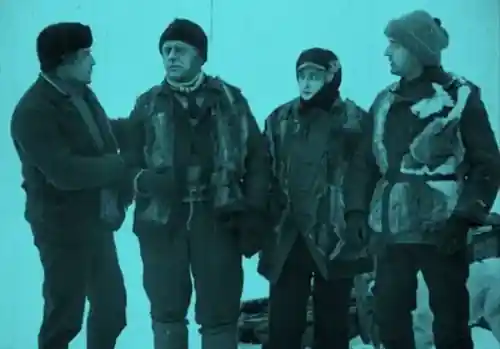
The shipwreck sequence—filmed in a refrigerated warehouse outside Berlin with 200 tons of chipped marble doubling as ice—remains a miracle of tactile illusion. Splinters the size of yardarms spear through salt canvases; a sailor, mid-scream, is bisected by a loose cable in a splice so abrupt you’ll rewind to confirm the trick. Intertitles vanish; the only language is the groan of timber and the high-pitched whistle of wind through ruptured seams. Here silence becomes a character, colder than the grave.
Post-wreck, the film transmutes into a Beckettian parable. Cinematographer Kronert over-exposes the negative until snow dunes glow radioactive, faces sink into charcoal smudges, and the horizon dissolves into a white wall. Björn and Sigurd trudge through this void trading fragments of sagas—half-remembered lines from the Elder Edda—their breaths etched onto the frame like scratched emulsion. At one point Sigurd hallucinates Gaustad’s silhouette looming against the glacier; the captain’s coat flaps like raven wings. The double-exposure is so faint you’ll question your own vision—a perfect visual correlative for guilt’s persistence.
Restoration-wise, the 2023 Munich Print sparkles. Digitized at 8K from a 35mm tinted nitrate struck in 1923, the image reveals details previously smothered: frost beads on beards, the faint rose tint of hypothermic cheeks, the ember-orange of a flare against cobalt night. Günter A. Buchwald’s ensemble performs a new score—piano, viola, and musical saw—whose dissonant glissandi slide under your sternum like sea-sickness.
Performances across the board sear. Josef Rehberger’s Gaustad channels a proto-Mabuse villainy: spine erect, voiceless yet roaring through gesture. When he casually stubs a cigarette on a deckhand’s shoulder, the casualness is more chilling than any scream. Claire Lotto, as the ship’s boy who witnesses the captain’s crimes, transmits terror through pupils alone—watch them dilate like ink blots each time Gaustad enters frame.
Yet the film’s philosophical marrow is its true payload. Wendt’s script indicts not merely a sadistic officer but the very architecture of patriarchal authority: the quarterdeck as throne, the lash as scepter, the sea as lawless frontier where might scripts its own gospels. In that light, the endless snow desert becomes a purgatorial court where survivors must re-enact the master-slave dialectic stripped bare of societal furniture. When Björn finally shares his last biscuit with Sigurd—a wafer rationed to the size of a communion host—the gesture feels heretical, revolutionary.
Some viewers may fault the final reels for narrative slackening; once the duo reach land, momentum congeals like frozen blood. But that deceleration is the point. Survival here is not heroic but an embarrassment of continued respiration. The camera’s lingering on a half-buried boot, a scrap of sailcloth frozen stiff, or Gaustad’s monogrammed glove poking from a drift, forces us to confront the banality of aftermath. The white waste does not celebrate resilience—it interrogates the price of witnessing.
Comparative cinephiles will trace echoes in A Naked Soul’s spiritual desolation or The City of Illusion’s urban mirages, yet none match Die weisse Wüste’s zero-degree nihilism. Even The Marriage of William Ashe domesticates its cruelty inside drawing rooms; this film strands you on an existential ice floe and lets the cold decide.
Ultimately, what lingers is the film’s tactile intimacy with despair. You don’t merely watch Gaustad’s empire sink; you feel brine stiffen your trousers, taste iron in blown snow, hear the crunch of frostbitten toes inside boots. Expressionism often risks artifice—tilted sets, pancake faces—but here it serves verisimilitude: the world is crooked, so of course the deck angles vertiginously.
Seek this resurrection out, ideally on a winter night with wind needling your windowpanes. Let the ochre flare of the ship’s final signal mirror your room’s only lamp. When the end card arrives—white on black, like the first—you may find yourself checking the locks, unsure whether you’re keeper or captive. Die weisse Wüste offers no catharsis, only continuum: the recognition that every heart, once stripped of civility, is its own white waste, waiting for the first footprint to violate the snow.
In the current cinematic climate of sanitized violence and moral redemption arcs, this 1921 relic feels perversely radical. It neither pardons its monsters nor sanctifies its victims; it simply watches frostbite blacken fingers and asks: if you survive, what of you was truly worth the saving? That question, left glinting like an iceberg’s tip, ensures Die weisse Wüste will haunt the waters of film history for another century—perhaps longer than ice itself can endure.

IMDb 3.8
1931
Community
Log in to comment.