DbcultAccessing Vault...
Cult Review
Senior Film Conservator
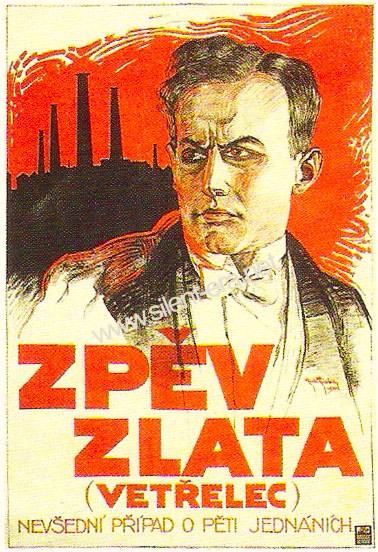
A city humming on the brink of modernity, a melody laced with quicksilver greed, and a camera that refuses to blink—Zpev zlata is less a hunt for bullion than an autopsy on the very notion of worth.
When the lights of a smoky Prague cabaret spill across the screen in the opening reel, Karel Lamač tilts the lens askew, letting chandeliers morph into interrogation lamps. One senses immediately that this 1920 Czech oddity has studied the angular nightmares of Lang’s Destiny yet retained a slavic sense of gallows humor all its own. The intertitles, hand-tinted in bruise-violet and bile-green, arrive with such staccato rhythm that they feel like shrapnel from a futurist manifesto. Viewers coming from the more pastoral The Village Sleuth may find themselves whiplashed by the urban claustrophobia on display here.
Anny Ondra—soon to be Hitchcock’s first blonde prototype—carries the picture in the way a flame carries oxygen: delicately, dangerously. Her Klára is all collarbones and conviction, a girl raised among gold leaf and iconostases who discovers that sanctity can be reverse-engineered into currency. Watch the micro-gesture when she first hears Máša’s mangled rendition of the family lullaby: pupils dilate like a gambler about to plunge into existential debt. In that instant the entire weight of post-imperial disillusion nests behind her eyelids.
Josef Sváb-Malostranský’s Vojta, by contrast, is a walking palimpsest of war trauma. His cough syncopates with streetcar brakes; his shadow arrives a half-second late, as if even darkness needs persuasion. Their chemistry unfolds not in embraces but in overlapping silences—an aesthetic choice that feels shockingly contemporary. One could splice their scenes into any 21st-century slow-burn thriller and lose nothing but the sepia.
Where Outwitting the Hun thrived on patriotic derring-do, Zpev zlata wallows in moral ambiguity. Every character lies, but each fib is rooted in a different dialect of desperation: the Baron wants social resurrection, Máša craves immortality of voice, the inspector covets order, and Klára—poor, luminous Klára—wants a lullaby to mean what it did before the world learned to monetize memory. The screenplay, attributed to Jan S. Kolár, unfolds like a paper chase across language itself: Czech, German, fragments of Italian brokerage slang. Subtitles feel superfluous; the anxiety is polyglot.
Visually, the film weaponizes chiaroscuro the way a pickpocket employs crowding: darkness distracts while light performs the actual theft. Note the sequence inside the defunct alchemist’s shop—shelves of bottled foetuses, astrolabes, dueling pistols coated in verdigris. Lamač backlights the scene so that dust motes swirl like fiduciary constellations, implying that gold is merely meteoric debris we have agreed to worship. The color palette, though bound by monochrome, suggests hues through contrast: the sickly amber of gaslamps, the cerulean chill of cellar bricks, the hemorrhagic red we hallucinate whenever Klára’s hymnal appears. It is a masterclass in synesthetic suggestion.
Comparisons abound yet never quite stick. The film’s obsession with coded music nods toward The Mark of Zorro’s tactical flourish, but whereas Zorro’s sword cuts oppression down, Klára’s song insinuates that liberation may itself be a gilded cage. Likewise, the boarding-house skullduggery of Beware of Boarders feels quaint once you witness Prague’s underbelly here, where every cobblestone is a potential informant.
What lingers longest is the sound design—yes, in a silent film. Lamač orchestrates urban noise by visual proxy: clattering typewriters bleed into montages of stamping coins; the hiss of a film projector dovetails with steam from a street vent. When the gramophone finale threatens to blanket the city in that lethal lullaby, you swear you can hear the celluloid itself vibrate. It is cinema as synaptic weapon, predating Walter Ruttmann’s Berlin: Symphony of a Metropolis by seven years.
Scholars of Czech surrealism will spot pre-echoes of Scandal’s circular guilt, while students of Hollywood melodrama may detect the embryonic DNA of Eyes of the Heart. Yet Zpev zlata refuses lineage; it is a foundling that gnaws at any family tree you attempt to graft it onto.
Flaws? Certainly. The middle act sags under the weight of one too many subterranean set pieces—a concession, perhaps, to the era’s appetite for Les Vampires-style serial thrills. And Anna Lamačová-Karinská’s supporting turn as a semaphore operator teeters on the edge of comic relief without ever quite earning the tonal pivot. Yet these are hairline cracks in an otherwise obsidian surface.
Restoration-wise, the 2018 NFA Prague 4K scan rescues textures you never knew were missing: the glint of imitation gold thread on Vojta’s lapel, the pockmarks on Inspector Kolařík’s cheek that look like exclamation points under magnesium flare. The tinting schema—cobalt for interiors, sulphur-yellow for exteriors—obeys emotional rather than temporal logic, turning each reel into a living cyanotype. Pair it with a live performance of Leoš Janáček’s On an Overgrown Path and the audience will exit the theater speaking in contrapuntal verse.
Interpretively, the film functions as both socialist allegory and capitalist cautionary tale. The gold is never seen because gold, in 1919 Bohemia, is already an abstraction—an IOU from a deposed emperor. Klára’s eventual scream into the broken lens is the moment capital eats its own myth, a gesture echoed a century later by cryptocurrency busts and NFT flameouts. Cine-financiers, take note: the first bubble on record may have been auditory.
Gender politics feel equally unresolved in the most productive way. Ondra’s Klara commands the narrative yet is perpetually framed within thresholds—doorways, casements, sewer grates—suggesting that emancipation and surveillance arrived hand-in-hand. She is both subject and object, minter and minted, a living palindrome of value. Compare that to The Inferior Sex’s more didactic approach and you’ll appreciate how Czech expressionism sneaks feminism in through the servant’s entrance.
Audience strategy: if you program Zpev zlata as a midnight curiosity, expect half the crowd to check their phones for spot-price updates; screen it at sunrise with a hangover-friendly espresso bar and they’ll leave swearing they can hear futures trading in bird chirps. Either way, bring a historian, a crypto bro, and a musicologist, then watch the brawl unfold in the lobby.
In the final calculus, the film’s greatest treasure is its refusal to deliver one. The hollow gramophone is both McGuffin and mirror: we paid admission to see gold but discovered only the echo of our own avarice. That Lamač could smuggle such nihilism past financiers still recovering from Habsburg collapse is itself a heist worthy of song. So go ahead—hum the lullaby. Just don’t be surprised when the next gold rush begins in your own throat.
Verdict: A fractured lullaby for a fractured century, Zpev zlata remains the missing link between Caligari’s asylum and Lang’s metropolis—an alchemical opera whose final aria is the disquieting space between your ears.
IMDb 7.4
1936
Community
Log in to comment.