DbcultAccessing Vault...
Cult Review
Senior Film Conservator
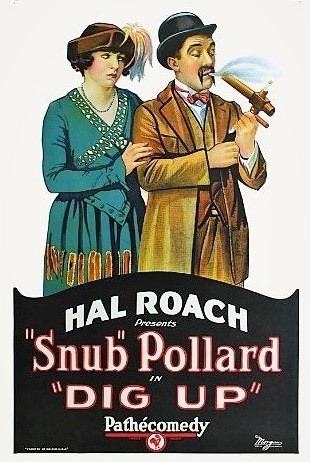
The silent era was not merely a period of technical gestation; it was a sprawling, chaotic laboratory where the visual language of humor was distilled into its most potent forms. In the 1921 short Dig Up, we witness a fascinating intersection of domestic romanticism and the brutalist physical comedy that defined the Hal Roach studios. Snub Pollard, an actor whose facial hair alone carries more comedic weight than many contemporary ensembles, occupies a space of frantic vulnerability. Unlike the stoic resilience of Keaton or the pathos-heavy antics of Chaplin, Pollard’s performance in 'Dig Up' is a frantic dance of nerves, a kinetic response to a world that is fundamentally rigged against his survival.
The premise is deceptively simple, yet it functions as a perfect engine for escalating tension. The landlord, played with a delightful, sneering elitism by Wally Howe, views Snub not as a potential son-in-law but as a parasitic nuisance to be excised. The method of excision is brilliant in its cruelty: promotion. By elevating Snub to the role of rent collector for 'Paradise Flats,' the landlord isn't giving him a career; he’s signing a death warrant. This narrative pivot shifts the film from the soft-focus world of courtship into a gritty, almost proto-noir environment where the stakes are visceral. Paradise Flats is a character in its own right—a crumbling monument to urban decay where every door hides a potential assailant.
In many ways, this setting reminds one of the atmospheric dread found in The Crime of the Camora, though here the menace is played for laughs. The introduction of Butch McKill provides the necessary foil for Snub’s wiry agility. McKill represents the apex predator of the slums, a man whose sole function is to dismantle any representative of authority—or in this case, any representative of the landlord’s ledger. The contrast between Snub’s diminutive, frantic frame and the looming physicality of his antagonists creates a visual tension that sustains the middle act of the film with remarkable consistency.
The gags in 'Dig Up' are not merely isolated incidents of falling or hitting; they are part of a larger, rhythmic tapestry. There is a specific geometry to the way Pollard moves through space. When he enters Paradise Flats, his movements are hesitant, almost staccato, reflecting the psychological burden of his task. This is a far cry from the more polished, almost theatrical performances seen in A Small Town Idol, where the comedy feels more choreographed for the camera. In 'Dig Up,' the camera often feels like an intruder, capturing the raw, unpolished energy of the streets.
One cannot discuss this film without acknowledging the supporting brilliance of Marie Mosquini. While her role as the daughter follows the traditional tropes of the era, her screen presence provides the necessary emotional anchor for Snub’s madness. Without the promise of her affection, his willingness to endure the terrors of McKill would seem nonsensical. Instead, it becomes a quixotic quest, a proletarian struggle against the gatekeepers of both wealth and love. The film’s pacing is relentless, eschewing the slow-burn development found in La dame aux camélias for a more immediate, visceral impact.
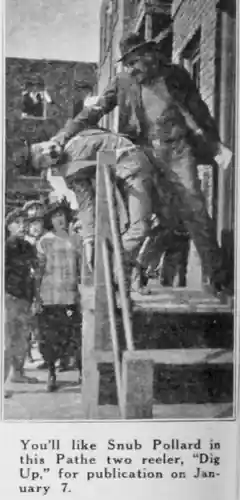
While 'Dig Up' might appear as a straightforward comedy, its underlying structure reveals a sophisticated understanding of audience psychology. The use of the 'Paradise Flats' location allows for a vertical exploration of comedy—gags that travel between floors, through windows, and across rooftops. This utilization of three-dimensional space was a hallmark of the Roach studio’s evolution. It mirrors the adventurous spirit found in The Master Mystery, albeit without the sci-fi trappings. The 'mystery' here is simply how a man as ill-equipped as Snub manages to retain his life while performing a job that has claimed so many predecessors.
The cinematography, though limited by the equipment of the early 20s, manages to capture the claustrophobia of the tenements with surprising efficacy. There is a certain 'documentary' feel to the exterior shots of the flats, a stark realism that heightens the absurdity of the slapstick. This tension between the real and the ridiculous is where Pollard thrives. His reactions are never oversized to the point of breaking the internal logic of the scene; rather, they are the logical responses of a man caught in a waking nightmare. This groundedness makes the eventual triumph of the underdog all the more satisfying for the viewer.
When placing 'Dig Up' alongside its contemporaries, its unique flavor becomes even more apparent. While Kill or Cure explores the absurdity of medical professions, 'Dig Up' tackles the inherent violence of the class divide through the lens of the rent collector. It lacks the surreal, almost haunting quality of Umirayushchiy lebed, but it replaces that poetic melancholy with a robust, quintessentially American optimism. Even in the face of Butch McKill’s murderous intent, there is a sense that ingenuity and a bit of luck can overcome brute force.
Furthermore, the film’s brevity is its strength. It doesn't overstay its welcome or attempt to inject unnecessary melodrama. It is a concentrated burst of energy. In contrast to the more sprawling narratives of films like The Brass Bullet, 'Dig Up' maintains a singular focus on its central conflict. This economy of storytelling is something that modern filmmakers often struggle to replicate. Every frame serves the gag, and every gag serves the character’s desperate motivation.
Snub Pollard’s legacy is often overshadowed by the 'Big Three' of silent comedy, but 'Dig Up' serves as a potent reminder of his specific genius. He was the master of the 'slow burn' within a fast-paced environment. His ability to convey a sense of impending doom while maintaining a comic rhythm is unparalleled. The film also serves as a fascinating historical document of the 'Paradise Flats' trope—the dangerous, unreachable urban zone that would later be explored in much darker tones in films like Mute Witnesses or Blind Man's Eyes.
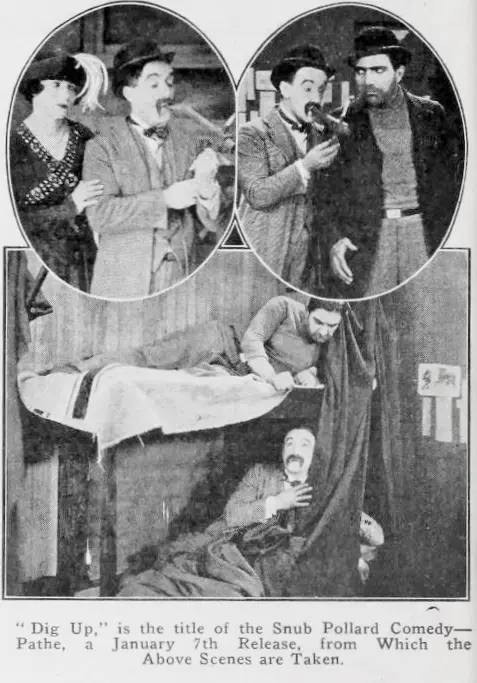
As we deconstruct the final act, where the landlord’s plan inevitably backfires, we see the classic comedic inversion of power. The hunter becomes the hunted, and the lowly rent collector becomes the master of his own destiny. It’s a theme that resonates across cultures, from the Polish sensibilities of Studenci to the Danish intrigue of Den farlige Haand. However, Pollard’s approach is uniquely kinetic. He doesn't just win; he survives a whirlwind of chaos through sheer, frantic persistence.
Ultimately, 'Dig Up' is more than a mere relic of the 1920s; it is a testament to the enduring power of visual storytelling. It manages to convey a complex social hierarchy and a high-stakes survival story without a single word of spoken dialogue. The interplay between the sea-blue depths of the shadows in the flats and the bright, yellow-hued optimism of the romantic scenes creates a visual dichotomy that mirrors the film's tonal shifts. It is a work that demands to be seen not just by film historians, but by anyone who appreciates the pure, unadulterated joy of physical performance.
Whether it’s the subtle interplay of glances between Pollard and Mosquini or the explosive, chaotic energy of the final confrontation with Butch McKill, 'Dig Up' remains a highlight of the silent era. It lacks the pretension of some of the more high-brow 'art' films of the period, such as Les Aventures de Robinson Crusoé, but it possesses a raw, infectious energy that those films often lack. In the world of Snub Pollard, life is a series of traps, and the only way to win is to keep moving, keep dodging, and—most importantly—keep digging.
In the broader context of 1921 cinema, a year that gave us both high drama and low comedy, 'Dig Up' stands as a bridge. It offers the thrills of a serial like The Tarantula with the domestic wit of Don't Tell Everything. It is a perfect microcosm of the era's creative fertility. If one were to watch He Wins immediately after, the evolution of the 'winner' archetype in silent comedy would be strikingly clear. Snub Pollard doesn't win through traditional heroism; he wins through the sheer refusal to be buried by the circumstances of his birth and the cruelty of his betters.
Reviewer's Note: The restoration of these shorts is vital for understanding the DNA of modern comedy. 'Dig Up' is a prime example of why Snub Pollard deserves a permanent place in the pantheon of comedic greats.
IMDb —
1923
Community
Log in to comment.