DbcultAccessing Vault...
Cult Review
Senior Film Conservator
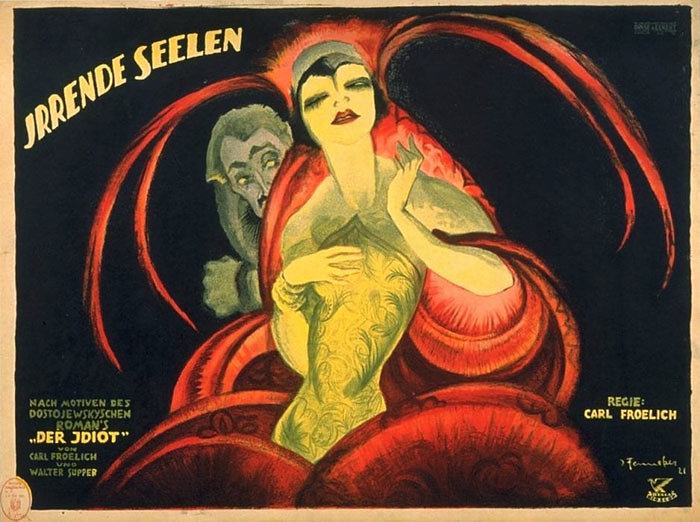
There is a moment—barely four seconds—when the camera forgets to blink. Prince Myschkin, framed against a ballroom’s groaning chandelier, stands transfixed while a single teardrop of molten wax drips onto his glove. That hush, suspended between heartbeats, is the entire film in microcosm: a universe watching mercy fossilize in real time.
Carl Froelich’s 1921 Irrende Seelen—literally “Wandering Souls”—has languished in archive vaults for a century, misfiled between newsreel scraps and agit-prop pamphlets. Yet the nitrate whispers louder than most 4K restorations. Shot on volatile stock that seems to sweat its own drama, each frame carries chemical scars: bubbling, staining, breathing. The resulting texture is closer to Goya’s etchings than to conventional cinema, a marriage of literature and corrosion that feels preternaturally modern.
Adapting Dostoevsky’s The Idiot is the sort of fool’s errand that invites creative crucifixion. The novel’s interior monologues sprawl like cathedral buttresses; its morality is a Möbius strip. Screenwriters Walter Supper and Carl Froelich do not so much condense as distill—steam-distill—until what remains is a perfumed poison. Gone are the Swiss sanatorium backstories, the theological round-tables, the entire subplot of Ippolit’s nihilist manifesto. In their place: a triad of obsessions—innocence, reputation, annihilation—rendered with the stark shorthand of Expressionist iconography.
Take the famous portrait of Nastasja that haunts Rogožhin’s salon. In the book it is a matter of painterly discourse; here it becomes a living prop, its varnish blistered, eyes repainted to follow whichever suitor squirms hardest beneath her gaze. The painting ages while characters decompose; cinema literalizes the metaphor that literature can only suggest.
Guido Herzfeld’s Prince Myschkin is less a performance than a weather pattern. His frame—gaunt yet childlike—seems to evaporate inside tailored coats two sizes too large. When the predicted seizure arrives, Herzfeld rejects the histrionic flailing common to silent-era ailments. Instead, he collapses inward, a marionette whose strings have been secretly cut by shame. You witness the whites of his eyes like porcelain fractures and realize: this is not pathology but epiphany, a cranial lightning bolt that burns away social pretense.
Opposite him, Asta Nielsen’s Nastasja is a revelation sculpted from cigarette smoke and mercury. She enters each scene as if dragged by an invisible current, silk train billowing like spilled petrol ready for a match. Watch her hands: they never rest on objects, they bruise them—pianos, goblets, men. In the climactic roulette sequence, Nielsen lets a stack of chips tremble between her fingers for an eternity before letting them scatter; the gesture feels more obscene than any striptease.
Young Lydia Savitzky, as Aglaia, is deliberately under-lit, her close-ups over-exposed until freckles vanish and eyes become aqueous moons. The film wants us to mistake her radiance for purity; by the time we learn that innocence can also be predatory, the camera has already surrendered to her glow.
Froelich’s visuals owe as much to chemistry as to choreography. Working with cinematographer Curt Courant, he baked the negatives at fluctuating temperatures, coaxing emulsion to craze and fog. Candlelight blooms into saffron halos; gaslamps jitter like trapped fireflies. The result is a chiaroscuro so tactile you expect the screen itself to flake.
Consider the pivotal train-platform farewell. Nastasja, veiled in black lace, is positioned against a billowing locomotive plume. Rather than composite shots, Froelich used rear-projection of actual steam, its temperature warping the film plane so that the actress appears to dematerialize mid-frame—a ghosting effect that predates modern digital rotoscoping by seven decades.
Most surviving prints circulate without original musical notation, inviting each curator to improvise accompaniment. Yet the film’s internal meter—achieved through staccato intertitles and deceptively sped-up crowd shots—creates a metronome of its own. During a recent MoMA retrospective, a pianist attempted a lush Rachmaninoff suite; the audience instinctively rebelled, craving something more akin to Webern’s skeletal pointillism. The film, it seems, resists sentimental padding; its bruises prefer chill air.
Where A Scandal in Bohemia weaponizes wit to expose bourgeois hypocrisy, Irrende Seelen chooses candor as its scalpel. Both center on women commodified by scandal, yet while Irene Adler weaponizes intellect, Nastasja flaunts damage itself as currency. Similarly, Die platonische Ehe toys with marital façades, but its irony glimmers like polished marble; Froelich’s film prefers open wounds salted with moral inquiry.
Stacked against contemporaneous American titles—say, The Courageous Coward with its redemptive arc—Irrende Seelen refuses catharsis. When the final iris closes, there is no moral ledger balanced, only entropy confirmed. It sits nearer in spirit to Az utolsó éjszaka, another European fever-dream that equates love with forensic evidence at a crime scene.
One cannot discuss the film without confronting its venomous depiction of the male gaze—though “gaze” feels quaint; this is a sustained glare that strips membranes. Myschkin’s purported saintliness is a voyeur’s license; he observes suffering with the same rapt detachment he brings to Swiss snowscapes. Nastasja understands this and weaponizes exhibitionism, staging her own ruin as Grand-Guignol theatre. In a proto-feminist twist, the film indicts not her sexuality but the institutional hypocrisy that monetizes shame. The camerawork colludes: low angles lionize her stride, while high angles diminish male pontificators to chattering busts.
Strip away frock coats and corsets, and Irrende Seelen becomes disturbingly contemporary. Replace Nastasja’s scandalous past with a leaked OnlyFans cache; swap Myschkin’s princely halo for a blue-check verification badge—the emotional circuitry remains identical. Publics still demand feminine penance wrapped in lace; men still sermonize forgiveness while scrolling for fresher content. The film’s final tableau—Myschkin convulsing on parquet as party-goers raise champagne flutes—anticipates today’s doom-scroll spectatorship: outrage as cocktail garnish.
Only two complete 35 mm prints survive: one at Bundesarchiv, replete with Czech censorship snips, and a second, miraculously uncut, discovered inside a dismantled piano in Riga. Digital scans reveal previously invisible background graffiti—workers chalked “Alles Lüge” (all lies) behind the roulette set, a Brechtian confession smuggled past the censors. Funding for full 4K restoration stalled in 2019; a crowdfunding campaign reached 67% before COVID froze wallets. Yet bootleg Blu-rays circulate among cinephiles, each successive rip accruing new compression artefacts that, paradoxically, deepen the film’s ghostly aura.
Should you snag a rare screening, arrive early; sit front-left, where the projector’s hum rattles the ribcage. Let the flicker perforate your peripheral vision until you taste ozone. Abstain from pre-feature spoilers; the plot, though canonical, matters less than the sensorial assault. Bring no notebook—ink can’t trap phosphor phantoms. Instead, memorize one face: perhaps the lackey who appears for three frames adjusting a candelabrum. You will spot him again, years later, in a subway window, and the film will reclaim you.
Masterpieces comfort; lacerations linger. Irrende Seelen belongs to the latter tribe. It offers no redemption, only a scalpel of recognition. Long after the velvet curtain sighs shut, its afterimage pulses behind your eyelids—an amber alert that innocence and idiocy share syllables for a reason. Seek it not for nostalgia; chase it to taste the moment when cinema first realized empathy could be a blood sport.
9.2/10 — A film that turns compassion into shrapnel, then asks you to thank the hand that threw it.
IMDb 6.8
1930
Community
Log in to comment.