DbcultAccessing Vault...
Cult Review
Senior Film Conservator
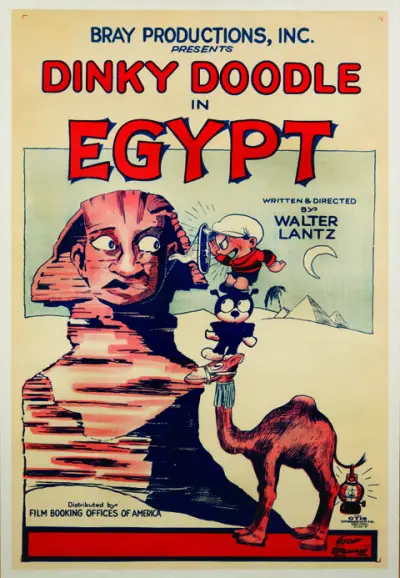
Is Dinky Doodle in Egypt worth watching today? Short answer: yes, but with significant caveats. This early Walter Lantz cartoon is less a narrative triumph and more a fascinating historical artifact, a vibrant snapshot of animation's nascent era. It is essential viewing for animation historians, enthusiasts of silent-era cinema, and anyone curious about the foundational work that paved the way for animated storytelling.
However, it is decidedly not for casual viewers accustomed to modern narrative complexity, sophisticated animation techniques, or fast-paced, polished humor. Its charm lies in its rawness, its simplicity, and its sheer historical significance.
To truly appreciate Dinky Doodle in Egypt, one must approach it not as a contemporary piece of entertainment, but as a window into the past, a testament to the boundless creativity that blossomed even with rudimentary tools.
This film works because... it offers an invaluable glimpse into the meta-narrative possibilities of early animation, blending creator and creation in a surprisingly self-aware manner, and showcases the inventive, if primitive, visual gags that defined the era.
This film fails because... its narrative is incredibly thin, its animation is rudimentary even for its time, and its humor, while charming, lacks the universal resonance required to captivate a broad modern audience.
You should watch it if... you are an animation scholar, a cinephile fascinated by the origins of film, or someone who cherishes the raw, unpolished energy of early 20th-century cartoons.
For those with a keen interest in the evolution of cinema, Dinky Doodle in Egypt is undeniably worth the brief investment of time. It serves as a pedagogical tool, illustrating the foundational principles of cartooning and storytelling when the medium was still finding its voice. Witnessing Walter Lantz himself appear on screen, interacting with his creation, offers a fascinating meta-commentary on authorship that feels remarkably ahead of its time.
However, for the average viewer seeking entertainment, the answer is more nuanced. The film's pacing, while brisk, is driven by a series of disconnected gags rather than a cohesive plot. The animation, while historically significant, lacks the fluidity and detail that modern audiences expect, often appearing crude or even jarring. It demands a particular lens, one of appreciation for historical context, rather than pure enjoyment.
One of the most intriguing aspects of Dinky Doodle in Egypt is its embrace of dream logic. The entire Egyptian adventure unfolds within Dinky’s nap, a narrative device cleverly framed by Lantz’s own presence at a masquerade ball. This layered dream structure allows for a delightful suspension of disbelief, justifying the cartoon's inherent absurdities.
The world Dinky inhabits is one where poker-playing mummies exist, and pharaohs settle disputes with chariot races. This isn't just whimsical; it's a testament to the freedom early animators felt, unburdened by strict realism or established genre conventions. The very act of Dinky falling for a princess and immediately seeking her father's blessing, only to be challenged by an ancient, bandaged rival, is pure, unadulterated dream-state absurdity.
This approach, where the creator (Lantz) influences the reality of his creation (Dinky), and the creation then experiences its own fantastical reality, is surprisingly sophisticated for an early short. It hints at a self-awareness within the burgeoning art form, a playful acknowledgment of the animator's god-like power over their drawn worlds. It's a subtle but powerful observation that elevates the film beyond mere slapstick.
The visual style of Dinky Doodle in Egypt is a masterclass in early 20th-century animation. It’s raw, energetic, and undeniably charming in its imperfections. The hand-drawn lines, the slightly jerky movements, and the often minimalist backgrounds are not flaws, but rather defining characteristics of an era where every frame was a painstaking individual creation.
Compared to the more refined, if still nascent, techniques being developed by studios like Walt Disney around the same period, Lantz’s work here feels more spontaneous, almost improvisational. There's a tangible sense of the artist's hand in every drawing, a direct connection between creator and audience that polished, later animation sometimes loses. The characters are simple, yet expressive, relying on exaggerated actions and clear visual cues to convey emotion and intent.
Modern audiences, desensitized by CGI spectacles, often fail to appreciate the sheer ingenuity and labor involved in these pioneering hand-drawn efforts, dismissing them as mere curiosities rather than foundational art. But to do so is to miss the point entirely. This film, in its very construction, tells a story of artistic struggle and innovation, a vibrant precursor to the animated epics we take for granted today.
Dinky Doodle himself, while not possessing the complex personality of later cartoon icons, embodies the plucky, optimistic hero archetype. He's an innocent adventurer, driven by simple desires: love for the princess and victory in the face of absurd challenges. His dog companion, a loyal if often bewildered sidekick, adds another layer of comedic relief, often reacting to Dinky's predicaments with relatable canine exasperation.
Walter Lantz's decision to include himself in the narrative, both at the masquerade ball and as the waking force that ends Dinky's dream, adds a unique dimension. It's a meta-narrative flourish that acknowledges the artificiality of the cartoon world while simultaneously celebrating its power. Lantz isn't just the animator; he's a character within his own universe, a playful god overseeing his creation's antics.
Dinky's immediate infatuation with the princess and his unwavering determination to win her hand, even against a mummified rival and with a less-than-ideal chariot horse, speaks to a universal, childlike purity of purpose. He is the embodiment of cartoon heroism: simple, direct, and utterly committed to his goal, no matter how outlandish the obstacles.
IMDb —
1918
Community
Log in to comment.