DbcultAccessing Vault...
Cult Review
Senior Film Conservator
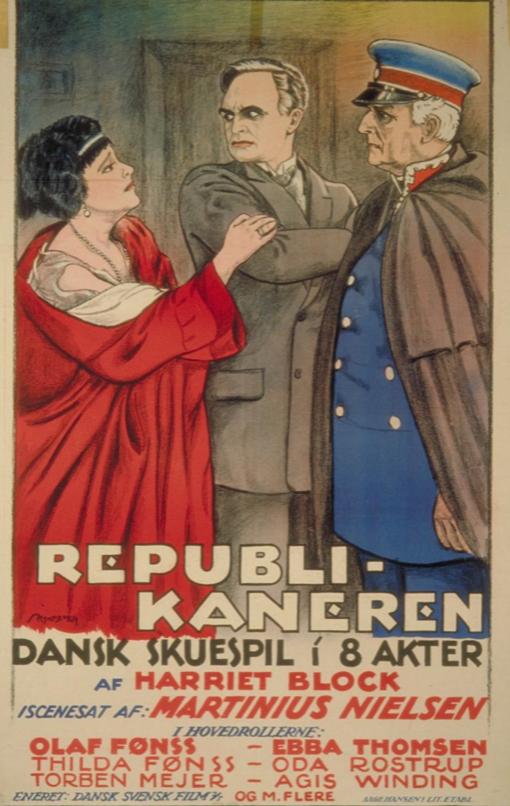
In the annals of silent cinema, few screenwriters possessed the surgical precision of Harriet Bloch. With Republikaneren, she transcends the melodramatic tropes of the era to deliver a narrative that is as much a philosophical treatise as it is a dramatic endeavor. The film functions as a high-stakes interrogation of the social contract, set against the backdrop of a decaying aristocracy. Unlike the more lighthearted social navigation seen in The Ghost of Rosy Taylor, Bloch’s work here is somber, weighted with the gravity of historical inevitability. She doesn't merely present a conflict; she dissects the very atoms of class resentment and the existential dread of a ruling class facing its own obsolescence.
The pacing of the screenplay is deliberate, allowing the audience to marinate in the stifling atmosphere of the estate. Every gesture, every glance between the cast members—Robert Schmidt, Henny Lauritzen, and the formidable Olaf Fønss—is laden with subtext. The film refuses to offer easy catharsis, instead opting for a nuanced exploration of how personal identity is inextricably linked to political conviction. It is a work that demands the viewer's full intellectual engagement, standing in stark contrast to the populist escapism found in Jiggs and the Social Lion.
Olaf Fønss delivers a performance of remarkable restraint. As the titular 'Republican,' he embodies the internal dissonance of a man who has intellectually rejected his birthright but remains physically and emotionally tethered to it. His physical presence on screen is magnetic, yet he avoids the histrionics often associated with silent-era acting. There is a quiet intensity in his portrayal that mirrors the stoic resolve found in The Brute Breaker, though Fønss’s battlefield is one of drawing rooms and parliament floors rather than the rugged wilderness.
The supporting cast provides a rich tapestry of opposition. Torben Meyer and Agis Winding serve as the perfect foils, representing the calcified structures of the past. Their performances are not caricatures; they are portraits of genuine conviction, however misguided it may seem to modern sensibilities. This ensemble creates a sense of lived-in reality that elevates Republikaneren above contemporary dramas like The New Teacher, which, while charming, lacks the sheer gravitas of this political crucible.
Directorially, the film utilizes the architecture of the estate to emphasize the protagonist's isolation. The high ceilings and ornate furnishings are not merely decorative; they are oppressive, a physical manifestation of the tradition he seeks to dismantle. The cinematography employs deep shadows and stark contrasts, a visual echo of the binary struggle between the old world and the new. This use of space is reminiscent of the psychological landscapes in Beyond the Wall, where the environment becomes a character in its own right.
The framing of the characters often isolates them within the frame, highlighting the loneliness inherent in radical thought. Even in scenes of dialogue, there is a sense of vast, unbridgeable distances between the participants. This visual strategy is far more sophisticated than the straightforward storytelling of The Mystery of Dr. Fu Manchu, which relies on pulp thrills rather than the slow-burn tension of ideological warfare.
When comparing Republikaneren to other films of the era, its intellectual rigor becomes even more apparent. While American Methods explores the clash of cultures through an industrial lens, Republikaneren keeps the conflict intimate and familial, which paradoxically makes the stakes feel higher. The betrayal here isn't just professional; it's visceral. It touches upon the same themes of moral purity and social expectation explored in Purity, yet it grounds them in a specific political reality that feels remarkably prescient.
Even when compared to the high-stakes drama of The Challenge, Bloch’s narrative feels more grounded in the complexities of human nature. There are no clear villains, only people caught in the gears of a changing world. This nuance is what allows the film to resonate a century later. It avoids the moralistic simplicity of The Conflict or the sensationalism of The Mad Marriage, choosing instead to dwell in the uncomfortable gray areas of progress.
Republikaneren stands as a pillar of Danish silent cinema, a testament to the sophistication of the industry during this golden age. It shares a certain DNA with the atmospheric tension of The Crimson Skull, but replaces the Gothic horror with the horror of social upheaval. The film’s ability to articulate complex political theories through visual storytelling remains a benchmark for the medium. It is a far cry from the urban satire of The City Chap or the rustic charm of Kärlek och björnjakt; it is a serious, often somber reflection on the cost of change.
Ultimately, the film asks whether one can ever truly shed their skin. Can a count ever truly be a republican? Or are we forever haunted by the ghosts of our ancestors, much like the characters in La lussuria are haunted by their own desires? Republikaneren doesn't provide a definitive answer, but the journey it takes the viewer on is one of the most rewarding experiences in early cinema. It is a masterclass in screenwriting, acting, and the power of the moving image to challenge the status quo.
"The tragedy of the republican count is not that he fails to change the world, but that he succeeds in alienating the only world he ever knew."
In the final analysis, Republikaneren is a vital piece of cinematic history. It captures a moment in time when the world was poised on a knife-edge, and it does so with a grace and intelligence that few modern films can match. The collaboration between Harriet Bloch and this stellar cast produced a work of enduring relevance, proving that the struggle for identity and justice is a timeless narrative. It is a film that deserves to be studied, not just as a relic of the silent era, but as a living, breathing piece of art that continues to speak to our own turbulent times.

IMDb —
1919
Community
Log in to comment.