DbcultAccessing Vault...
Cult Review
Senior Film Conservator
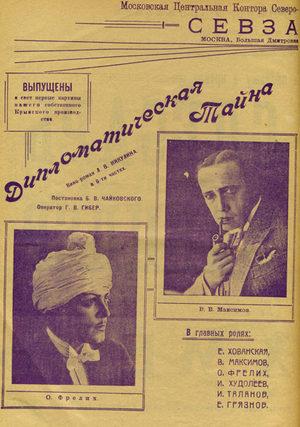
Ah, the allure of the past, particularly when it's filtered through the lens of early cinema, a period rife with experimentation and the audacious spirit of nation-building. Lev Nikulin's Diplomaticheskaya tayna, or 'Diplomatic Secret,' is precisely such a fascinating artifact, a cinematic whisper from a tumultuous era that speaks volumes about the anxieties and aspirations of its time. To approach this film is not merely to watch a story unfold, but to engage in an archaeological dig into the cultural psyche of the early Soviet Union, discerning the delicate interplay between art, propaganda, and human drama. It’s a compelling piece, not just for its narrative intricacies but for its profound reflection on the very nature of statecraft and personal sacrifice.
Nikulin, a writer whose pen often danced on the tightrope between ideological fervor and genuine human insight, crafts a scenario that is both politically charged and deeply personal. The film plunges us into the shadowy world of international espionage, a realm where trust is a currency more volatile than any gold standard, and betrayal lurks in the most unexpected corners. At its pulsating heart is Comrade Ryazanov, brought to life with a nuanced intensity by Ivan Khudoleyev. Khudoleyev, a stalwart of the screen, imbues Ryazanov with a compelling blend of youthful idealism and the nascent weariness of a man thrust into a moral and political maelstrom. His performance is a masterclass in subtlety, conveying the immense pressure of his role through gestures and glances rather than grand pronouncements. We see the weight of his diplomatic mission, the securing of a crucial trade agreement, etched onto his face—a mission that is not just about economic survival but about the very legitimacy of the fledgling Soviet state.
The narrative, as penned by Lev Nikulin, is a tightly wound spring of intrigue. Ryazanov's arrival in a European capital, depicted with an atmospheric sense of foreboding, immediately sets the stage for the machinations that follow. This isn't the glamorous espionage of later decades, but a gritty, often perilous dance of wits and wills. The stakes are acutely felt. It’s here that the film introduces us to the beguiling Elena, portrayed by Yevgeniya Khovanskaya. Khovanskaya’s portrayal is fascinating; she navigates the complexities of her character with a captivating ambiguity, making it genuinely difficult for both Ryazanov and the audience to ascertain her true loyalties. Is she a femme fatale, a pawn, or something far more intricate? Her charisma is undeniable, a dangerous beacon in the murky waters of international politics, and it’s through her interactions with Ryazanov that the 'diplomatic secret' begins to reveal its multifaceted layers.
The true architect of the film's villainy is the enigmatic Baron von Kessel, given a chilling, aristocratic menace by Oleg Frelikh. Frelikh eschews overt theatrics, instead crafting a villain whose power lies in his quiet cunning and pervasive influence. Kessel isn't merely an antagonist; he embodies the entrenched forces of the old order, determined to undermine the new, revolutionary spirit. His network of saboteurs, a shadowy collective working to destabilize the Soviet state, provides the tangible threat that propels much of the plot. The film, in this regard, could draw thematic parallels with other works of political intrigue from the period, such as the German film Das Ende vom Liede, which similarly delved into the moral compromises inherent in political struggles, albeit from a different ideological vantage point. However, 'Diplomaticheskaya tayna' distinguishes itself by its distinctly Soviet lens, presenting the struggle not just as a conflict of nations, but as a clash of worldviews.
The arrival of Evgeniy Gryaznov as Comrade Volkov, a counter-intelligence agent, introduces a compelling dynamic. Volkov is not merely a backup; he is a watchful eye, dispatched to both assist Ryazanov and, subtly, to monitor him. Gryaznov brings a stoic intensity to the role, his character serving as a foil to Ryazanov's more emotionally exposed diplomat. The tension between the two, born of differing approaches and underlying ideological scrutiny, adds a rich psychological layer to the narrative. Volkov represents the unwavering dedication to the state, perhaps even a nascent form of the 'Iron Felix' Dzerzhinsky archetype, contrasting with Ryazanov's more nuanced, humanistic approach to his duties. This internal conflict, the friction between individual conscience and collective directive, is where the film truly shines.
The supporting cast, including Vasili Kozhura, N. Savskaya, Vladimir Maksimov, and Iona Talanov, though perhaps less prominent in the central drama, contribute significantly to the film's rich tapestry. Kozhura might embody a loyal but perhaps naive aide, while Savskaya could play a compromised official, caught between allegiance and survival. Maksimov and Talanov could be the seemingly innocuous figures who are either unwittingly drawn into the conspiracy or are crucial, albeit minor, cogs in Kessel's machinations. Each character, regardless of their screen time, serves to deepen the sense of pervasive danger and the intricate network of relationships that define this world. The film is a careful study in how even peripheral figures can impact the grand narrative, much like the intricate gears of a well-crafted clock.
At its heart, Diplomaticheskaya tayna is a profound exploration of loyalty, betrayal, and the corrosive nature of secrets. The 'diplomatic secret' itself becomes a metaphor for the hidden truths and compromises that underpin state power, particularly in a young nation striving for recognition and stability. The film deftly navigates the moral ambiguities inherent in espionage, where lines between right and wrong blur under the exigencies of national interest. It asks uncomfortable questions about the personal cost of public service, a theme that resonates across various cinematic landscapes, from the more direct nationalistic narratives of films like Soldiers of the Emperor to the more intimate betrayals seen in Wives and Old Sweethearts, though 'Diplomaticheskaya tayna' grounds its exploration firmly in the political sphere.
Cinematically, while details of its precise visual style might be elusive without direct access to the film, one can infer certain characteristics common to Soviet cinema of the period. There would likely be a strong emphasis on expressive montage, a technique pioneered by Soviet filmmakers to create meaning and emotional impact through the juxtaposition of images. The use of light and shadow would undoubtedly be deployed to heighten the sense of suspense and moral ambiguity, particularly in the clandestine meetings and shadowy pursuits that define the spy genre. The pacing, though perhaps slower by modern standards, would build tension meticulously, allowing the psychological weight of the situation to settle upon the viewer. One can imagine stark, angular compositions reflecting the stark political realities, and close-ups that emphasize the internal struggles of the characters, particularly Khudoleyev's Ryazanov as he grapples with his conscience.
The film's exploration of identity is also noteworthy. Ryazanov is not just a diplomat; he is a representative of a new world order, carrying the hopes and burdens of a revolution. His personal integrity is intertwined with the perceived integrity of his nation. The film subtly critiques the hypocrisy and entrenched power structures of the old European order through the character of Kessel and his associates, presenting a stark ideological contrast. This thematic thread echoes in many films of the era that sought to define the 'new Soviet man' against the backdrop of a decadent past, a recurring motif also explored in films that deal with moral rectitude and societal expectation, such as Will It Come to This or The Quitter, albeit 'Diplomaticheskaya tayna' frames it within a grander geopolitical context.
Lev Nikulin's contribution as the writer cannot be overstated. His screenplay is the backbone of this complex narrative, meticulously weaving together political intrigue with personal drama. Nikulin had a knack for crafting characters that felt authentic, even within the confines of an ideological framework. He understood that even the grandest political struggles are ultimately fought by individuals, with their own fears, desires, and moral compasses. The dialogue, one can surmise, would be sharp and purposeful, each line serving to advance the plot or reveal character, devoid of extraneous flourishes. This economy of storytelling, a hallmark of effective early cinema, allows the visual narrative to carry significant weight.
Comparing 'Diplomaticheskaya tayna' to other films of its time, one might find common threads of adventure and moral quandary. For instance, the sense of a grand, dangerous quest and the uncovering of hidden networks might bring to mind the international smuggling operations depicted in Yachts and Hearts, or The Opium Smugglers, though Nikulin’s work here is imbued with a far greater geopolitical significance and ideological underpinning. It's less about individual greed and more about the clash of empires. Similarly, while films like Caught Bluffing or One Eighth Apache might explore themes of deception and hidden identities, 'Diplomaticheskaya tayna' elevates these elements to a national scale, making the stakes infinitely higher.
The performances, particularly from Ivan Khudoleyev, anchor the film’s emotional core. His Ryazanov is not a cardboard cutout hero but a man grappling with immense pressure. The subtle shifts in his demeanor, from confident diplomat to haunted operative, are pivotal in conveying the film's message about the toll of such a life. Yevgeniya Khovanskaya, too, delivers a performance that transcends simple villainy or heroism, making Elena a truly memorable and complex character whose motivations remain tantalizingly ambiguous throughout. This ambiguity is a strength, preventing the film from descending into simplistic good-versus-bad binaries.
In the grand tapestry of early Soviet cinema, 'Diplomaticheskaya tayna' stands as a testament to the era's capacity for complex storytelling. It's a film that demands engagement, inviting viewers to peel back layers of political maneuverings and personal dilemmas. It may not possess the widespread recognition of some of its contemporaries, but its thematic depth and the compelling performances of its cast ensure its place as a significant, albeit perhaps underappreciated, work. Its exploration of diplomatic intrigue, national security, and the human element caught within the gears of geopolitical machinery remains remarkably resonant, offering insights into the enduring challenges of statecraft and the perpetual struggle to define national identity.
What makes Diplomaticheskaya tayna particularly compelling is its ability to transcend its specific historical context and touch upon universal themes. The tension between public duty and private conscience, the seductive power of deception, and the ever-present threat of external forces seeking to undermine a nation’s sovereignty are not confined to the early 20th century. These are dilemmas that continue to plague global politics, making the film's narrative surprisingly timeless. One could even draw parallels to the internal struggles of characters in films like Her Better Self, where personal integrity is tested, but on a much grander, international stage in Nikulin's work.
The film, through its characters like Ivan Khudoleyev's Ryazanov and Evgeniy Gryaznov's Volkov, paints a vivid picture of the individuals tasked with navigating these perilous waters. Their choices, their sacrifices, and their moments of doubt are what elevate the narrative beyond mere political reportage into the realm of compelling human drama. It is a reminder that behind every 'diplomatic secret' and every grand strategy, there are people, with their vulnerabilities and their strengths, bearing the weight of history on their shoulders. The film’s nuanced portrayal of these figures prevents them from becoming mere ideological mouthpieces, instead presenting them as complex individuals grappling with extraordinary circumstances.
Ultimately, Diplomaticheskaya tayna is more than just a spy thriller; it's a cinematic document that captures the spirit of an age. It reflects the hopes, fears, and strategic thinking of a nation finding its footing on the world stage, constantly under threat from perceived and real adversaries. Lev Nikulin's script, combined with the dedicated performances of the cast, particularly Khudoleyev’s central role, creates a work that, even decades later, manages to hold its audience in a state of suspense and thoughtful contemplation. It urges us to consider the hidden costs of international relations and the profound impact of secrets, both big and small, on the lives of individuals and the destiny of nations. It's a film that deserves to be rediscovered, not just for its historical significance but for its enduring power as a piece of dramatic storytelling.
IMDb —
1919
Community
Log in to comment.