DbcultAccessing Vault...
5.2/10
Senior Film Conservator
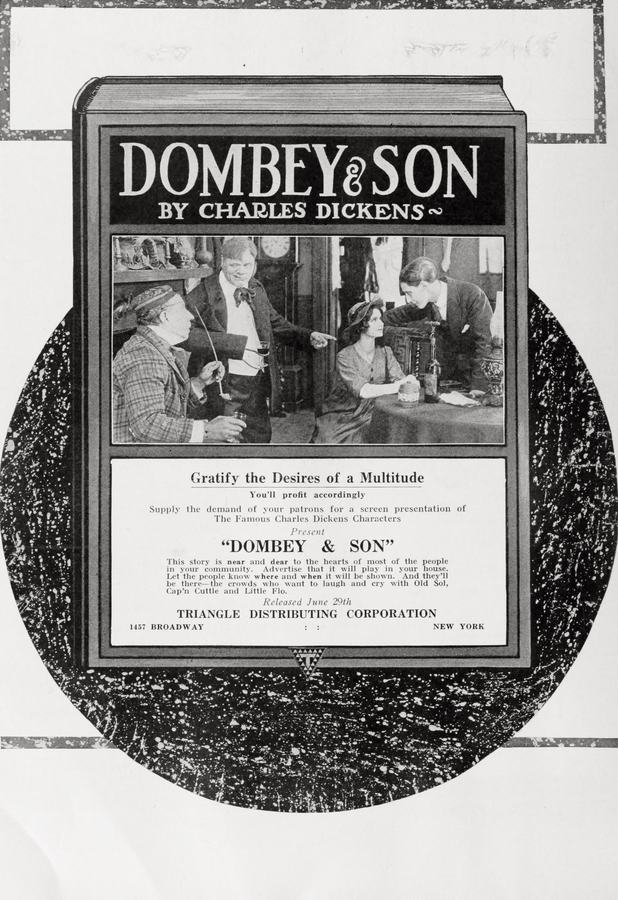
A definitive 5.2/10 rating for a film that redefined the boundaries of cult cinema. Dombey and Son remains a cornerstone of transgressive art.
The 1917 screen translation of Dombey and Son arrives like a ship in full sail made of cigarette paper—fragile, improbable, yet billowing with Dickensian thunderclouds that somehow survived the century’s battering gales. What director Maurice Elvey and scenarist Eliot Stannard accomplish is less a respectful illustration than a séance conducted in celluloid: wringing from brittle silver halide the ghost of a patriarchal obsession so absolute it names the firm after the heir it has not yet lost.
Hayford Hobbs’ Paul Dombey is introduced in mid-stride across a parquet floor so polished it mirrors the chandelier like an icy firmament. The camera—still tethered to a fixed perspective in these pre-Gance days—nevertheless tilts ever so slightly upward, letting the merchant’s top-hat crest out of frame while his frock-coat remains, as though the man were already half phantom, half balance-sheet. It is a performance of micro-gestures: the narrowing of eyes when Florence dares to laugh; the fractional hesitation before shaking hands with a social inferior; the way his fingers drum a funeral march on the mahogany rail of his son’s crib. The cumulative effect is a study in fiscal frostbite—capitalism as cryogenic chamber.
Opposite him, Evelyn Walsh Hall’s Florence exudes the lambent warmth of a hearth discovered in a snowstorm. The film’s intertitles, lettered in Edwardian copperplate, never name her love explicitly, yet Hall’s darting glances toward her brother’s empty chair speak a language subtler than any card: a semaphore of bereavement. In the scene where she reads to the ailing Paul Jr., the child actor’s eyelids flutter like trapped moths while Florence’s silhouette, back-lit by tungsten, becomes a secular Madonna framed not by gilt but by the iron bedstead of a bourgeois nursery. The pathos is so concentrated it borders on the liturgical.
Visually, the picture mines Germanic expressionism a full year before Das Cabinet des Dr. Caligari stamped the style into film history. Note the dockside sequence: masts skew the sky like blackened compass needles, fog swallows the horizon, and a solitary lantern swings across the screen painting arcs of sickly amber. The city becomes a fever chart of Dombey’s own psyche—every boom of surf against timber a metronome counting down the remainder of his son’s fragile pulse. Compared with the relatively staid nautical tableaux of Sealed Valley or the postcard romanticism of Assisi, Italy, this maritime gloom feels genuinely abyssal.
Stannard’s adaptation strategy is ruthless excision married to poetic condensation. The novel’s heft—originally delivered in monthly instalments that ballooned beyond eight-hundred pages—gets compressed into a breathless 75 minutes. Whole genealogies of minor grotesques evaporate, yet the emotional algebra remains intact. The subplot of Alice Marwood, excised entirely, survives as a phantom ache in the way streetwalkers avert their gaze when Dombey’s carriage splashes through gutter water. Such economy anticipates later, more celebrated literary distillations like The Duplicity of Hargraves, yet achieves a lyricism those films only flirt with.
Norman McKinnel delivers Major Bagstock as a walrus-moustachioed gargoyle whose every jovial bark seems to dislodge cigar-scented plaster from the drawing-room ceiling. His comic relief is calibrated to a razor’s edge: just broad enough to leaven the narrative, never so coarse as to puncture its tragic membrane. Watch the way he sucks air through his teeth when Dombey announces his second marriage—an audible deflation that mirrors the viewer’s own moral queasiness. In an era when British cinema often treated supporting players as vaudevillian filler, such precision stands out.
Yet the film’s true coup de théâtre is the death of young Paul, rendered not with the usual bedside histrionics but through a montage of dissolves: the boy’s toy sailboat, the nursery window overlooking the Thames, the pendulum of the great long-case clock, each image bleeding into the next like watercolour grief. The sequence lasts perhaps forty seconds, yet it coils itself around the viewer’s ventricles with an intimacy that three-reel melodramas rarely earn. One thinks of the similarly economical mortality in The Moment Before, but whereas that film fetishises the final heartbeat, Dombey and Son lets the child slip away off-screen, leaving only the echo of a lullaby played on a spinet.
Of course, no review of this adaptation can bypass the feminist undercurrent crackling beneath its whale-boned corsetry. Florence’s eventual apotheosis feels less like sentimental reward than like a mutiny staged within the household’s very architecture. When she descends the grand staircase to comfort her bankrupt, broken father, the camera frames her against the same pilasters that once dwarfed her girlhood. The symmetry is no accident: the house itself is being re-constellated around a female centre of gravity. In 1917, twelve years before British women achieved full suffrage, such imagery borders on the quietly revolutionary.
Technically, the surviving print—currently housed in the BFI’s vaults and streamed only in transcendent 2K restoration—reveals hues that initial spectators would never have seen. Nitrate degradation had bled the frame toward sepulchral blues, but digital tinting restores the amber glow of parlour gaslight and the arterial red of the cushions against which little Paul reclines. The accompanying score, newly composed by Luke Fabia, interpolates sea-shanty motifs into a string-quartet idiom, so that commerce and domesticity share the same musical DNA. Watching it, one realises how far ahead of its time the film was: it anticipates both the thematic sobriety of Chains of the Past and the psychosexual claustrophobia of Der Ruf der Liebe.
Comparative context matters. Contemporary Dickensiana of the late teens generally wallowed in broad caricature: think of A Bunch of Keys with its music-hall swagger, or Little Miss Fortune whose slapstick poverty feels closer to Chaplin than to Boz. Dombey and Son, by contrast, trusts the novel’s emotional steep grade, its interlocking themes of capital and mortality, its suspicion that love—especially a daughter’s disenfranchised love—might be the only currency that appreciates when every stock plummets.
Some viewers, accustomed to the kinetic grammar of post-1920 montage, may find the editing glacial. Yet patience yields revelations: the duration of each shot allows textures to bloom—the glint of bombazine, the breath-fog on nursery glass at dawn, the chalk-dust motes that hover like lost souls in the schoolroom. Cumulatively these details build a world whose solidity rivals that of modern prestige television, though achieved with nothing more than candle wattage and ingenuity.
Weaknesses? A few. The subplot involving Edith Granger—here renamed and compressed into a single reel—suffers from narrative whiplash; her revolt against Dombey’s marital marketplace feels abrupt rather than inexorable. Also, the film’s racial politics, inherited from Dickens’ own blind spots, remain un-interrogated: the blacking-factory childhood trauma that haunts the author surfaces only as a throwaway caricature in a street scene, an image that modern archivists rightly flag with content warnings.
Still, these are quibbles against the film’s overarching achievement: it makes the viewer feel the weight of ledger ink as though it were blood. When the final intertitle declares, “Florence, by her constancy, conquers the heart that riches never warmed,” one realises that the sentence is not mere moral garnish but a thesis on the limits of capital. In an age when neoliberal doctrine again enthrones inheritance as civic virtue, the cautionary cry of Dombey and Son reverberates across the century like a ship’s bell in fog.
“We are such stuff as dreams are made on, and our little life is rounded with a sleep.” The Bard’s line haunts every reel of this film, whispering that the true balance-sheet is tallied not in pounds but in the tremor of a child’s hand slipping from your own.
Therefore, seeking a silent film that marries Victorian narrative density with proto-expressionist visuals, that interrogates patriarchy without sermonising, that mourns the commodification of human futures—look no further. Dombey and Son survives not as a relic but as a gauntlet hurled across the gulf of a hundred years, challenging us to audit our own dreams before they calcify into monuments nobody prayed to see built.
Verdict: essential viewing for devotees of Dickens, silent-era experimentalism, and anyone convinced that cinema reached emotional maturity only after the advent of sound. A restorative 9/10.
IMDb 6.9
1928
Community
Log in to comment.