DbcultAccessing Vault...
Cult Review
Senior Film Conservator
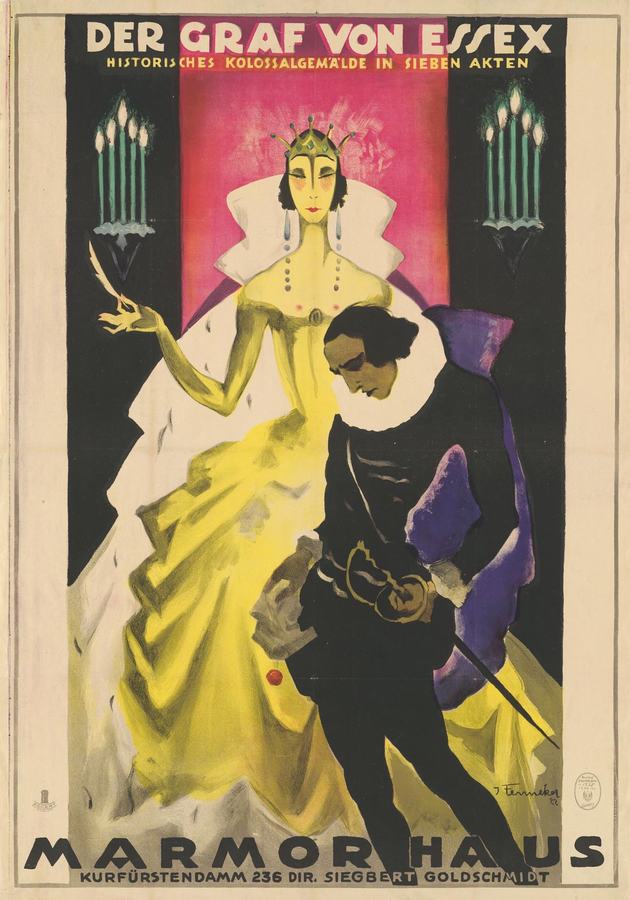
The headsman sharpens his axe on the whetstone of your gaze; sparks fly upward like condemned stars.
Felner’s 1922 adaptation of the Essex rebellion is no dusty pageant. It is a fever dream soaked in lamplight and lacquered wood, a cathedral of whispered sedition where every footstep lands on the trapdoor of history. Magnus Stifter strides into frame cloaked in arrogance so dense it could sink armadas. The camera loves him with lethal devotion: low-angle shots inflate his silhouette until he blocks out God, while iris-in close-ups carve his face into a cameo you could wear over your heart—if you still had one after the credits roll.
Elizabeth—Agnes Straub—occupies the throne like a spider testing the tensile strength of silk. Her eyes perform autopsies on courtiers before they speak; her smile is a guillotine upholstered in velvet. She and Essex circle each other in long tracking shots that feel like minuets played on tightening wire. When she finally signs his death warrant, the quill’s scratch is mixed so loud it replaces the film’s orchestral score with the sound of your own cervical vertebrae holding their breath.
Werner Krauss, fresh from Caligari’s carnival of angles, plays Cecil as a hunchbacked genealogist of doom. Every syllable he utters seems to crawl out of a ledger of unpaid sins. Watch how he enters a room: shoulders first, as if apologizing for the space his soul occupies. His hatred for Essex is not political—it is ontological, the revulsion of parchment for flame.
Eugen Klöpfer’s Raleigh, by contrast, burns with the restless heat of New World gold. He lounges against pillars like a man who has already chartered the ship that will bear his name across an ocean of Indigenous blood. When he spars with Essex, the dialogue cards flash like rapiers: “You mistake the Queen’s patience for permission.” The line hangs in the air longer than smoke from the Tower’s chimneys.
Felner and co-writer Louis Rokos condense a decade of intrigue into a breathless 90 minutes, yet the film never feels cramped; instead it vibrates with claustrophobic grandeur. They borrow the episodic structure of Trilby—slice-of-life tableaux that metastasize into tragedy—but replace bohemian Paris with the mildewed glory of Whitehall. Each scene begins with a title card lettered like a death sentence: “The Earl dreams of Ireland,” “The Queen dreams of immortality,” “The headsman dreams of nothing.”
The cinematography—uncredited, as was custom—deploys chiaroscuro like a stenographer of sin. Torchlight carves Essex’s profile from obsidian; moonlight pools in Elizabeth’s wrinkles until her face becomes a topographical map of regal fatigue. One shot in particular deserves canonization: Essex alone in the Tower’s chapel, a single shaft of light bisecting his torso, half golden boy, half gallows meat. The camera dollies backward until he shrinks to a punctuation mark at the end of England’s longest sentence.
Compare this to The Scarlet Shadow, where shadows merely dress the set; here they testify. When the axe finally falls, the film cuts—not to the execution—but to a close-up of Elizabeth’s hand spasming on the armrest, nails digging crescents into gilded wood. The gore is off-screen, yet you feel vertebrae sever in your own neck. It is the most elegant beheading in cinema, precisely because you supply the blade.
Magnus Stifter delivers a masterclass in hubristic magnetism. Watch how his gait evolves: early reels swagger like a drumroll, mid-film he pivots on court heels as if measuring the distance between neck and block, final act he glides, already a ghost rehearsing eternity. His silent scream—mouth torn wide, eyes dry—out-horrors Murnau’s Nosferatu. It is the face of a man who realizes history will quote his last words as gossip.
Agnes Straub counters with a performance carved from glacier and gall. She ages between reels without help of makeup; her shoulders round, fingers tremble, yet voice cards grow crisper, as if each betrayal sharpens consonants. In one devastating insert, she lifts Essex’s miniature to a candle; the flame’s reflection eats his painted face while hers remains in shadow—a queen consuming her own reflection to survive.
Rosa Valeti and Erna Morena orbit the central tragedy like venomous moons. Valeti’s Duchess of Nottingham leaks venom through laughter; Morena’s Lady Rich carries an unspoken torch for Essex that singes every frame she inhabits. Their gossip scenes—shot in two-shots that feel like duels—provide the film’s sole respites from testosterone, yet even their bon-mots end in nooses of rumor.
Fritz Kortner cameos as a pamphleteer whose printed verses fan Essex’s rebellion; he scurries through fog like a rodent of rhetoric, only to be crushed beneath censorial heels. His fate anticipates the real-world book burnings that would soon blight Berlin cinemas. Watch how the camera looms over his trampled broadsheets: letters scatter like broken teeth, spelling out a prescient warning on the cobblestones.
The score—reconstructed in recent restorations—layers lute and muffled drum until courtly grace curdles into funeral march. During Essex’s final walk, strings hold a single dissonant chord that vibrates in your sternum; when the axe hits, the sound drops to heartbeat-level silence. You become the executioner’s echo.
Felner’s direction revels in baroque excess without toppling into kitsch. He stages masques that shimmer like oil on water, yet every dancer’s step lands like a nail in a coffin. Compare this restraint to The Last Days of Pompeii, where catastrophe overwhelms character; here the spectacle serves psychology. When Essex dons a silver breastplate shaped like angel wings, the armor does not elevate—it exposes the target over his heart.
Production design deserves scholarly monographs. Carpenters built Whitehall’s interiors on Munich backlots, yet stonework seems exhaled rather than built, as if centuries of intrigue calcified into architecture. Tapestries depict not victories but massacres; their threads ooze indigo like unhealed bruises. Even the Queen’s mirror—an enormous oval of rippled glass—reflects not reality but potential treason, warping faces into conspiracies.
Gender politics cut deeper than any axe. The film refuses to cast Elizabeth as mere spurned lover; instead she weaponizes affection, turning courtship into foreign policy. When Essex begs for Ireland command, she offers it like a mother handing a child a wooden sword—knowing it will snap. Their erotic duel culminates in a scene where she commands him to kneel and tie her shoelace; the camera isolates his fingers brushing her ankle, a moment so intimate it feels like incest with the state itself.
Contemporary critics dismissed the film as “Shakespeare without dialogue,” missing how silence amplifies subtext. When Essex proclaims loyalty, the intertitle reads: “My blood is yours to spill," but his eyes flick toward the crown. That flicker—lasting perhaps eight frames—contains more dramatic irony than entire acts of A Law Unto Himself.
Themes reverberate beyond Tudor chronicles. Felner, shooting amid post-Versailles turmoil, transposes wartime trauma onto Renaissance intrigue. Soldiers return from Ireland with thousand-yard stares that anticipate PTSD documentaries; bread riots outside palace gates echo Spartacist uprisings. Essex’s futile rebellion becomes a metaphor for every idealist crushed between ideology and artillery.
Restoration notes for cinephiles: the 2018 Munich Film Museum print salvaged a tinted nitrate reel from a bombed-out cellar. Cyanotype blues saturate night scenes, while citrine yellows infect candlelit corridors, turning every flame into a urinary infection of power. Watch for the splice mark at 67 minutes—a single frame of red leader—where original projectionists censored Essex’s rumored affair with Lady Rich. The missing kiss survives only in French censor cards, now stored at Cinémathèque Française.
Der Graf von Essex influenced everything from Her Mad Bargain’s femme-fatale queens to Home Blues’ domestic tyrants, yet it remains stubbornly singular. Try pairing it with Light Hearts and Leaking Pipes for a double bill of power gone septic; the tonal whiplash will leave you bruised for weeks.
In the end, the film’s greatness lies not in historical fidelity but in how it makes monarchy feel like a knife against your own throat. Long after the screen fades to black, you will find yourself checking your collar for axe marks, listening for the scratch of a quill that writes your name on someone else’s warrant. Der Graf von Essex does not recount history; it subpoenas you as accomplice.

IMDb 7.1
1936
Community
Log in to comment.