DbcultAccessing Vault...
Cult Review
Senior Film Conservator
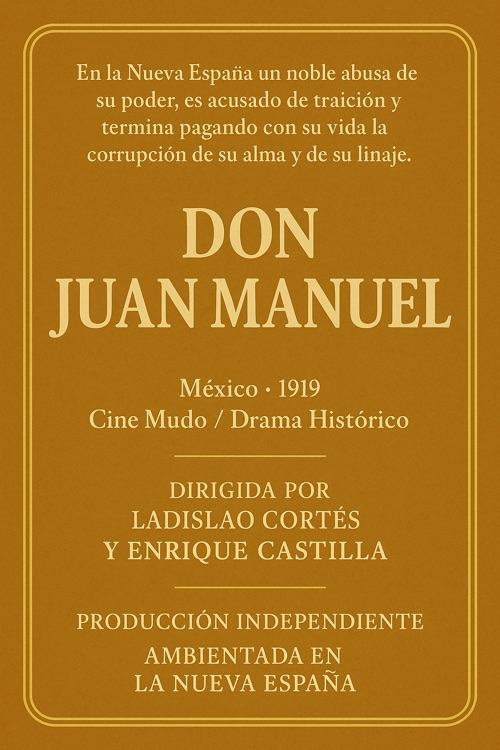
From its opening frames, 'Don Juan Manuel' asserts itself not merely as a narrative, but as a profound cinematic excavation of character, consequence, and the corrosive nature of unbridled desire. This is a film that dares to scrutinize the very foundations of human morality, peeling back layers of societal expectation to expose the raw, often brutal, core of individual choice. It’s a compelling, if at times unsettling, experience that leaves an indelible mark, inviting viewers to ponder the intricate dance between passion and principle. The film, anchored by its titular character, a figure as alluring as he is ultimately destructive, transcends simple storytelling to become a resonant fable for any era. It avoids the overt sermonizing found in works like Ten Nights in a Barroom, instead opting for a more nuanced, psychological approach to its moral quandaries, allowing the audience to witness the slow, agonizing unraveling of a soul rather than simply being told of its demise.
Enrique Cantalaúba's portrayal of Don Juan Manuel is nothing short of a tour de force, a performance that elevates a potentially archetypal character into a figure of tragic grandeur. He imbues Manuel with an almost irresistible magnetism, a charm that radiates from the screen, making his initial conquests entirely believable. Yet, beneath the veneer of effortless sophistication and seductive prowess, Cantalaúba subtly hints at a profound emptiness, a restless spirit perpetually seeking external validation. His Don Juan is not merely a cad, but a man trapped by his own appetites, a prisoner of a reputation he both cultivates and, perhaps, secretly despises. The film allows us to witness the subtle shifts in his demeanor, from the confident swagger of the early scenes to the haunted, contemplative gaze that dominates the latter half. It's a masterclass in character evolution, reminiscent of the complex internal struggles seen in Peer Gynt, though Manuel's journey is arguably more self-inflicted and less fantastical. Cantalaúba manages to elicit a strange blend of fascination and pity, making Manuel's eventual downfall not just a moral lesson, but a deeply personal tragedy.
Opposite Cantalaúba, Josefina Calvo delivers a performance of breathtaking fragility and quiet strength as Elena. Her character serves as the emotional anchor of the film, the innocent caught in the crosscurrents of Manuel's reckless abandon. Calvo's portrayal is nuanced; her initial enchantment with Manuel is palpable, a testament to his allure, but her subsequent heartbreak and disillusionment are rendered with an aching authenticity. She embodies the profound societal pressures placed upon women of her era, her reputation a fragile commodity easily shattered by scandal. Unlike the more defiant heroines of films like The Wild Girl, Elena's journey is one of internal resilience rather than outward rebellion. Her suffering is not melodramatic but deeply internalized, expressed through subtle gestures and haunted eyes, making her plight all the more resonant. The chemistry between Calvo and Cantalaúba is electric, a dangerous spark that ignites the film's central conflict and propels its tragic trajectory. Their scenes together are charged with an undeniable tension, a push and pull between genuine affection and manipulative charm that keeps the audience on edge.
The supporting cast, though perhaps less central, contributes significantly to the film's rich texture. Rutila Urriola, as the spurned former lover, delivers a performance steeped in bitter vengeance, her character a stark reminder of Manuel's past transgressions. Her scenes are charged with a simmering resentment, providing a crucial catalyst for Manuel's eventual exposure. Alfredo Macias and Francisco Pesado, in their roles as pillars of the community, effectively convey the rigid moral framework against which Manuel's actions are judged. Their reactions, ranging from initial tolerance to outright condemnation, paint a vivid picture of a society grappling with changing values and the enduring power of reputation. Even smaller roles, such as those played by Josefina Maldonado and Josefina Segarra, add layers of authenticity to the provincial setting, creating a believable world for the drama to unfold. Enrique Couto, in a pivotal role as Elena’s virtuous suitor, provides a crucial counterpoint to Manuel, embodying the steady, honorable path that Elena ultimately forsakes, highlighting the stark choices presented within the narrative. The ensemble works in concert, much like the intricate social dynamics explored in The Marriage Market, though with a far more dramatic and less comedic outcome.
The film's visual language is as articulate as its dialogue. The cinematography masterfully utilizes shadow and light to reflect the internal states of its characters. Early scenes featuring Manuel are often bathed in a warm, inviting glow, mirroring his charismatic facade. As his world begins to crumble, the visuals grow starker, shadows deepen, and the color palette (if we imagine a restored version) might shift to cooler, more subdued tones, emphasizing his isolation. The production design, though perhaps not overtly opulent, is meticulously crafted, evoking a sense of time and place without becoming distracting. The grand estates, the bustling town squares, and the intimate, often clandestine, meeting places all contribute to a rich, immersive atmosphere. This attention to detail in world-building allows the emotional drama to unfold against a convincing backdrop, grounding the more heightened elements of the narrative. The director's keen eye for composition ensures that every frame is purposeful, contributing to the overall narrative and thematic resonance, a characteristic shared with the deliberate artistry seen in En kunstners kærlighed.
'Don Juan Manuel' delves into a timeless exploration of passion versus morality, a conflict that resonates deeply even today. It asks profound questions about the nature of true love, the weight of societal judgment, and the possibility, or impossibility, of redemption for those who stray from the prescribed path. Manuel's journey is not one of straightforward repentance, but rather a slow, painful awakening to the consequences of his actions. The film refuses to offer easy answers, presenting a complex portrait of a man who, despite his flaws, possesses a flicker of humanity that makes his ultimate isolation all the more poignant. It challenges the audience to consider whether charm and charisma can ever truly compensate for a lack of integrity, and whether a lifetime of heedless indulgence can ever be truly atoned for. The film's ending, rather than providing a neat resolution, opts for a more ambiguous, melancholic tone, leaving the audience to ponder Manuel's fate and the enduring impact of his choices. This thematic depth sets it apart from simpler morality plays like His Wife's Good Name, offering a more introspective and less didactic experience.
The film's pacing is deliberate, allowing the narrative to unfold with a measured intensity. It resists the urge for rapid-fire plot developments, instead building tension through character interaction and the gradual accumulation of Manuel's indiscretions. This measured approach allows for a deeper immersion into the characters' psychological states, making their joys and sorrows all the more impactful. The narrative structure is largely linear, charting Manuel's rise and fall with an almost classical precision. However, there are subtle deviations, perhaps through flashbacks or moments of introspection, that break the linearity and offer glimpses into the characters' inner turmoil. The climax, when Manuel's web of deceit finally unravels, is handled with a powerful, almost operatic intensity, yet it remains grounded in the emotional reality of the characters. The subsequent denouement is a slow, somber meditation on loss and regret, a stark contrast to the initial exuberance of Manuel's life. This careful crafting of narrative ebb and flow ensures that the film's emotional beats land with maximum effect, much like the careful unfolding of a journey in Diligencekusken fra San-Hilo, but with a far more internal destination.
'Don Juan Manuel' stands as a compelling testament to the power of character-driven drama. Its themes of seduction, betrayal, and the search for meaning in a life of excess remain profoundly relevant, ensuring its enduring appeal across generations. While it may not possess the overt spectacle of some contemporary blockbusters, its emotional depth and psychological acuity offer a far richer and more rewarding experience. It's a film that demands reflection, prompting viewers to consider the complexities of human nature and the societal forces that shape our destinies. Its influence can be seen in later character studies exploring moral ambiguity, and its central performance by Cantalaúba continues to be a benchmark for portraying charismatic yet flawed individuals. Unlike lighter fare such as Oh, Baby!, 'Don Juan Manuel' is a film that lingers long after the credits roll, its questions echoing in the mind, its characters etched into memory. It is a work that reminds us of the profound capacity of cinema to not only entertain but also to illuminate the human condition in all its messy, glorious, and sometimes tragic complexity. Comparing it to the intense emotional landscape of Juan sin ropa, one finds a shared commitment to raw, unfiltered human experience, though 'Don Juan Manuel' wraps its intensity in a more classical narrative structure. It is a film that truly earns its place among the classics, not just for its technical merits, but for its courageous and unflinching exploration of what it means to be human, to err, and to confront the often-unforgiving mirror of one's own soul.
IMDb —
1918
Community
Log in to comment.