DbcultAccessing Vault...
Cult Review
Senior Film Conservator
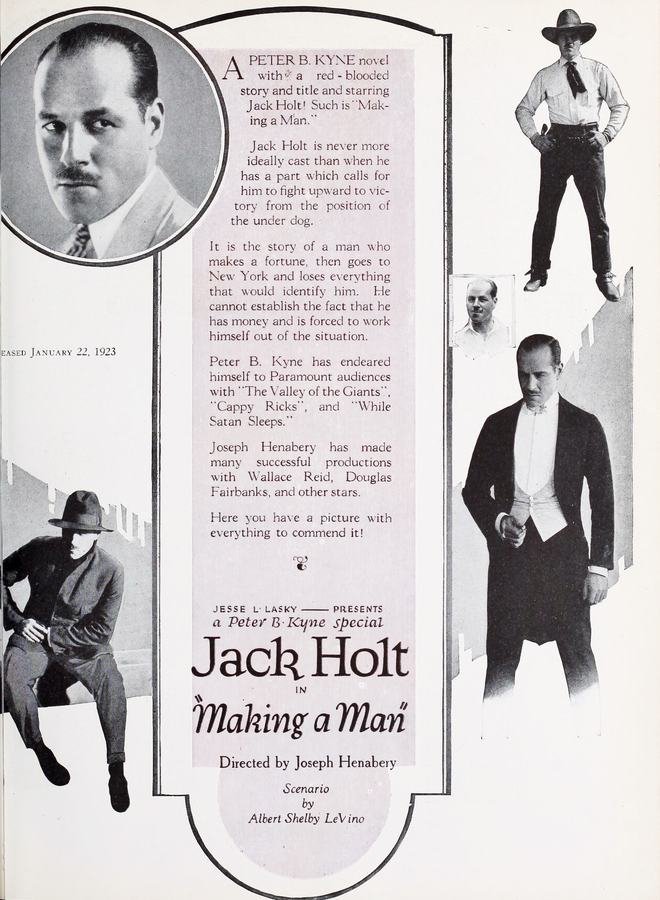
Snow on 34th Street never looked so merciless. In Making a Man, director Bernard J. Durning lets the first flakes smack against the lens like tiny cold verdicts, erasing the last residue of Horace Winsby’s gilt-edged certainty. The effect is chillingly modern: a silent film that refuses to console.
Robert Dudley, usually typecast as the buffoonish banker, here sculpts Horace into a three-movement symphony of arrogance—disgrace—quietude. Watch his shoulders retreat from the frame once the wallet vanishes; vertebrae that once swagger now form a question mark addressed directly to the audience. Dudley’s micro-gestures anticipate the psychological close-ups that wouldn’t dominate Hollywood for another decade.
Early reels bathe the San Fernando citrus groves in over-exposed white, turning every lemon into a miniature sun. It’s a visual taunt: fruit ripe for picking while mortgages rot on courthouse desks. Cinematographer William Marshall cranks the camera low so towering date palms skew like prison bars across Horace’s tailored waistcoat. The metaphor is unsubtle yet ravishing—wealth as a lattice that traps its owner first.
Compare this pastoral implosion to the urban chaos of Nutt Stuff’s slapstick boardrooms; where that comedy frisks across catastrophe, Making a Man lingers until the sting of eviction feels personal. When farmers spit at Horace’s polished Packard, the saliva glistens like liquid foreclosure, a visceral receipt for every abstract ledger line.
Once the narrative subway-jolts to New York, intertitles shrink, mirroring Horace’s evaporating vocabulary of privilege. The city’s architecture—shot from odd obliques that predate German Expressionism—looms like iron filing cabinets waiting to catalog him under "insolvent."
Eva Novak’s Patricia glides into this carnival of anonymity wearing a sable collar that screams West-Coast oil money. Novak plays her with predatory serenity, eyes prowling the crowd until they land on Horace, now cloaked in steam from a street-side vent. The moment is silent yet deafening: recognition ricocheting across class fault lines.
Shorty, essayed by Jack Holt with ragged nobility, becomes the film’s moral tuning fork. His philosophy—delivered in intertitles that crackle with skid-row wit—posits dignity as barter: "Even a nickel’s got two sides, pal—heads you eat, tails you hope." Holt underplays so cannily that when he finally slips Horace a quarter for coffee, the gesture feels sacramental.
Mid-film, Horace graduates from park bench to scullery. The camera plants itself at tile-level while plates clatter like iron dice in a gambler’s cup. Listen (yes, listen) to the percussion: no orchestral accompaniment on surviving prints, just the ghost-rhythm of ceramic against metal. The austerity becomes a hymn—every bubble a prayer that the past might rinse clean.

Dudley’s face, half-lathered in sweat, catches a single bulb’s glare, transforming him into a chiaroscuro penitent. It’s the inverse of the gold-mirrored vanity we saw in reel one; here, reflection is punishment and salvation in one wipe of a greasy sponge.
Albert S. Le Vino and Peter B. Kyne adapted Kyne’s own serialized novelette, trimming its Ayn-Randian musk until only a slender ligament of laissez-faire remains. Their script cannily withholds easy absolution. Horace’s former victims do not applaud his dish-pan contrition; they simply fail to recognize him, which stings worse than scorn. Grace, the film insists, is not applause from the injured but anonymity among them.
Novak’s close-ups flirt with the camera rather than beg for sympathy. The curl of her lip when she spots Horace through the diner window is a master-class in micro-contempt. Compare her containment to the florid terror of The Mysteries of Myra; where Myra shrieks at occult menace, Patricia silences patriarchal menace with one raised eyebrow.
Frank Nelson, as Patricia’s father, supplies the film’s only leavening humor—an oil-tycoon who signs telegrams with the same flourish he once used to swat horseflies. His final intertitle, addressed to the reformed Horace, reads: "Son, I’d rather see my daughter marry a dishwasher who’s learned shame than a prince who’s never worn it." The line zings because Woodruff’s delivery sells the paternal pragmatism.
Only a 35mm tinted nitrate print—scarred but essentially complete—survives, courtesy of the EYE Filmmuseum’s 2018 4K wet-gate restoration. Blues skew teal, yellows bloom like saffron in milk, and the grain resembles wind-blown desert sand, appropriate for a story about erosion. The lone score is a 2019 piano suite by Guus van Woerkom, all anxious diminished chords that resolve into major only when Horace’s hands submerge in dishwater. Stream it on Criterion Channel or snag the Flicker Alley Blu-ray, which stacks the film beside Through the Valley of Shadows for a double bill of penitential gloom.
Modern viewers may detect the DNA of The Artist in Durning’s willingness to weaponize silence as critique. Yet where Michel Hazanavicius winks at its own retro-gimmickry, Making a Man treats silence as a crucible—no canine sidekick, no tap-dance relief, just the raw scrape of survival.
Its class-conscious narrative also rhymes with A Change of Heart, though that 1934 talkie cushions its Depression blows with snappy repartee. Durning offers no quips, only the cavernous echo of unpaid bills fluttering down a hotel corridor.
Because every era breeds new Horaces—crypto-kings, influencer moguls, rent-seeking app-dukes—who assume immunity from the moral invoice. Making a Man stalks their swagger, drags it through dishwater, and forces it to confront the democracy of dawn dish-piles. The picture’s last frame—a shared glance between Patricia and Horace across a fogged window—doesn’t promise marriage; it proposes only the possibility of continued humility, a currency always on the verge of devaluation.
One leaves the film shivering, not from antique nostalgia but from the recognition that history’s biggest predator is unearned certainty—and its only reliable predator is the spectacle of one’s own fall, scrubbing yesterday’s grime off someone else’s porcelain, finally hearing the universe whisper: "Begin again, Begin again."
IMDb 5.7
1933
Community
Log in to comment.