DbcultAccessing Vault...
Cult Review
Senior Film Conservator

The first time we see Joan Doubleday, she is folding a linen napkin as though it were a twelve-year love affair—crease by meticulous crease, each corner tucked with the resigned precision of someone who has mistaken patience for destiny.
Mary Miles Minter, all downcast lakes-for-eyes and half-whispered gestures, plays Joan like a porcelain clock that refuses to strike. She lives in the honey-colored hush of old money and older expectations; the film’s sets drip with lace doilies, ancestral portraits, and the audible hush of corseted possibilities. Enter Monty Wade—Jerome Patrick with a toothpaste-commercial grin—whose proposal has ossified into furniture. He is the human equivalent of a placeholder comma in a run-on sentence.

Then Jerry erupts: Ruth Stonehouse in a flapper halo, bobbed hair like a rebellious exclamation point. She pirouettes into the household, claims the narrative steering wheel, and decides Monty is the prize in her private carnival game. The camera, suddenly liberated from parlors, chases her across sun-dappled docks and moonlit bandstands while intertitles crackle with the adolescent arrogance of someone who has never read a tragedy.
What follows is a screwball waltz rendered in sepia silence. The screenplay, adapted from Catherine Chisholm Cushing’s stage confection, weaponizes coincidence like a card shark. Peter Flagg (Edward Flanagan, equal parts bashful and boulder-shouldered) shadows Joan with the mute devotion of a bookmark longing to be useful. We glimpse his yearning through doorways, reflected in silver trays, sometimes doubled in mirrors—visual rhymes for a man who has loved by subtraction, erasing himself to make room for her silhouette.

Director don’t-call-him-auteur William Desmond Taylor (yes, the same whose unsolved murder later eclipsed his filmography) orchestrates tonal pirouettes: one reel froths with farce, the next pauses for tremulous close-ups where Joan’s eyelashes become weather systems. Notice the wedding montage: cake, veil, and organ chords intercut with Jerry’s impish grin widening like a crack in a dam. On the morning that should seal Joan’s fate, the niece barges into the sacristy and announces the cosmic husband-swap. Close-ups of Monty’s slack jaw and Peter’s deer-lantern disbelief crystallize the moment when narrative plate tectonics lurch.
Chaos spasms through the household: maids drop bouquets, the organist hits a dissonant chord that seems to echo into future Hitchcock, Joan’s mother (Winifred Greenwood) clutches pearls as though they could tether the universe. The film’s comic piston, however, is Jerry’s logic—she insists destiny is a buffet: sample, then switch plates. Her machinations are filmed in brisk medium shots, the camera slightly tilted, as if the world itself were off its axis.
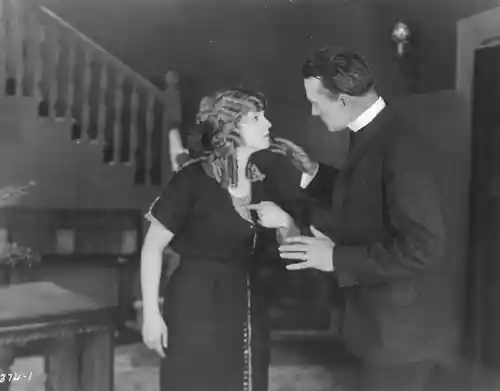
Yet beneath the hijinks lurks a melancholy vein. Joan’s final confrontation with her own reflection—in a mirror framed by cherubs—asks the silent-era audience to read lips and tremors. Minter’s performance modulates from porcelain to phosphorescent; the moment she recognizes Peter’s steadfastness, her shoulders drop two millimeters, a seismic shift in micro-gesture. The film trusts us to intuit epiphanies without spoken syllables.
Compare this to The Floor Below where Minter played a subterranean telegraph girl who literally climbs social ladders; here she excavates interior strata. Or juxtapose Jerry’s anarchic matchmaking with the courtly male bonds in The Chosen Prince—both films toy with desire’s circuitry but reroute voltage toward different catharses.
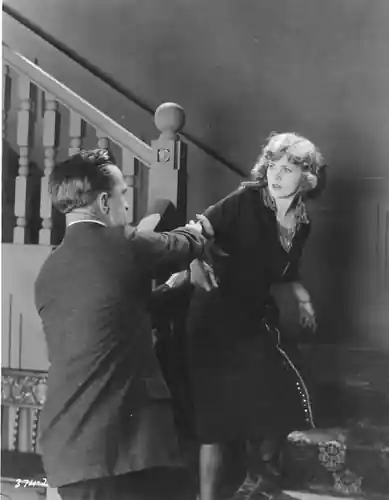
The restoration on Kino’s 2022 Blu-ray reveals textures previously smothered in dupes: the glint of Peter’s pocket watch, the frayed cuff on Monty’s tux, the amber gradient of a sunset that seems to toast the characters. A new score by Aleksandra Vrebalov punctuates scenes with toy-piano plinks and string tremolos, a sonic analogue to Jerry’s mischief.
Is the film proto-feminist? Yes, but with the caveat that liberation arrives via a teenager wielding patriarchal rules like a blunt cudgel. Jerry doesn’t dismantle the marital marketplace; she flips stall assignments. Still, in 1922, showing a woman unpicking a twelve-year engagement felt akin to yanking a boulder from railroad tracks.
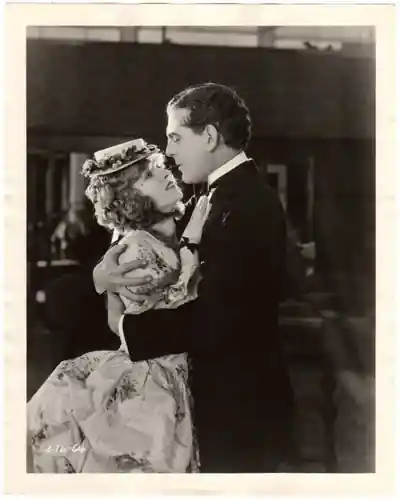
Weaknesses? A slapdash denouement—Peter and Joan reconcile off-screen via Jerry’s hastily inserted intertitle—lands with the thud of a post-climax cigarette. Monty’s exit, relegated to a half-reel comedic sulk, denies the triangle true catharsis. Yet these are the narrative fissures endemic to stage-to-screen transpositions gasping for runtime.
Final verdict: Don’t Call Me Little Girl survives as a champagne-cork of a comedy, effervescent yet laced with the aftertaste of existential dread. It anticipates the screwball ricochets of 1930s Columbia capers while lingering, cat-like, on faces that learn to rename their wants. Watch it for Minter’s chiaroscuro eyes, for Stonehouse’s firecracker legs sprinting across lawns, for the way silence can scream louder than technicolor. Then, perhaps, revisit For a Woman’s Fair Name to observe how reputations—like engagements—can be both armor and cage.
Streaming: Kino Cult, Kanopy, select archival 16 mm events. Runtime: 68 min. 4K restoration available with English intertitles and optional French/Spanish subtitles.

IMDb 7.1
1936
Community
Log in to comment.