DbcultAccessing Vault...
Cult Review
Senior Film Conservator
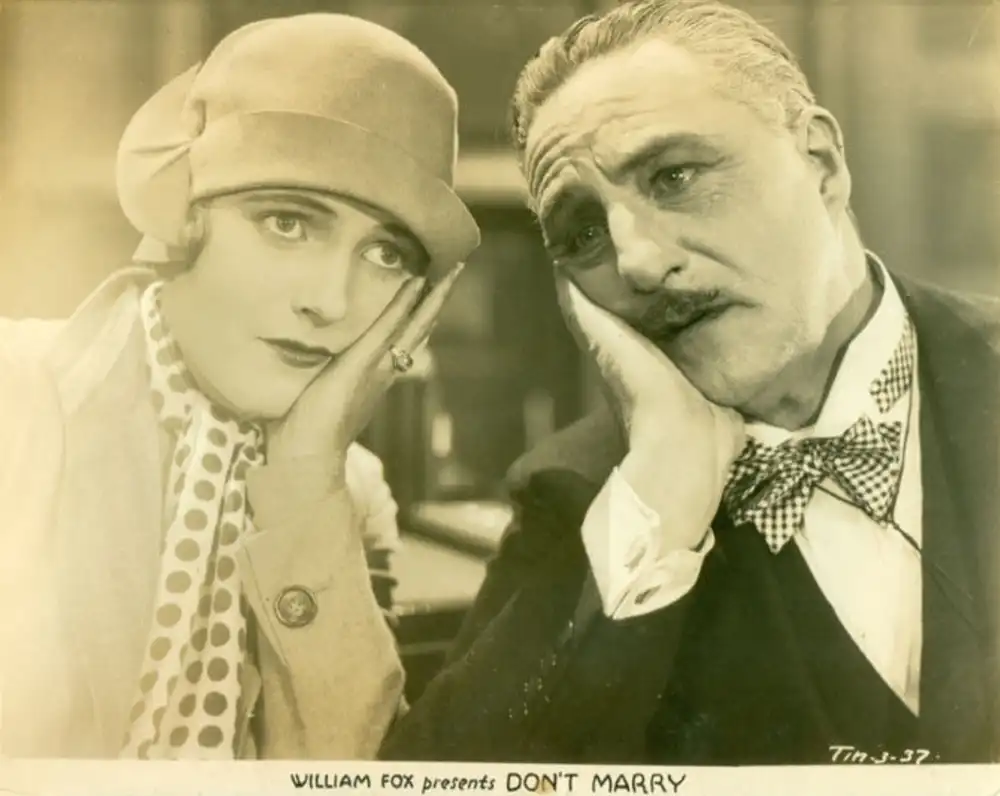
If you’re into the whole 'modern girls are too fast' trope that dominated the late 1920s, you’ll probably have a good time with Don't Marry. It’s worth a watch just to see Lois Moran oscillate between being a high-energy flapper and a human statue from the 1890s. If you hate movies where the entire plot hinges on a very obvious costume change that somehow fools a grown man, you should probably skip it.
Lois Moran plays Priscilla, and she’s genuinely fun to watch. In the beginning, she’s doing the whole 1928 flapper thing—short hair, fringe, a lot of movement. But then she meets Henry (Neil Hamilton). Henry is a lawyer who looks like he’s never had a fun thought in his life. He’s so prim it’s actually kind of irritating. He has this one expression where he looks down his nose at her that makes you want to throw a brick through his office window.
The movie gets interesting when Priscilla decides to teach him a lesson by posing as her own 'cousin' from the Victorian era. She shows up in this massive, ridiculous bustle and a hat that looks like it weighs ten pounds. The costume department went a bit overboard, but it works for the joke. She walks with this stiff, tiny-step gait that is clearly exhausting to maintain. There’s a moment in a garden where she’s trying to sit down in that dress and you can see her struggling with the sheer amount of fabric. It’s not a 'stunt,' but it’s funny in a very physical, awkward way.
Neil Hamilton is... well, he’s stiff. Even for a character who is supposed to be stiff. There are reaction shots of him where he just stares for three seconds too long. You start to wonder if he forgot his next move or if the director just liked the way his jawline looked in that light. It’s not as fluid as something like A Girl in Every Port, which has a much more natural rhythm. Don't Marry feels a bit more like a stage play that someone decided to film outdoors.
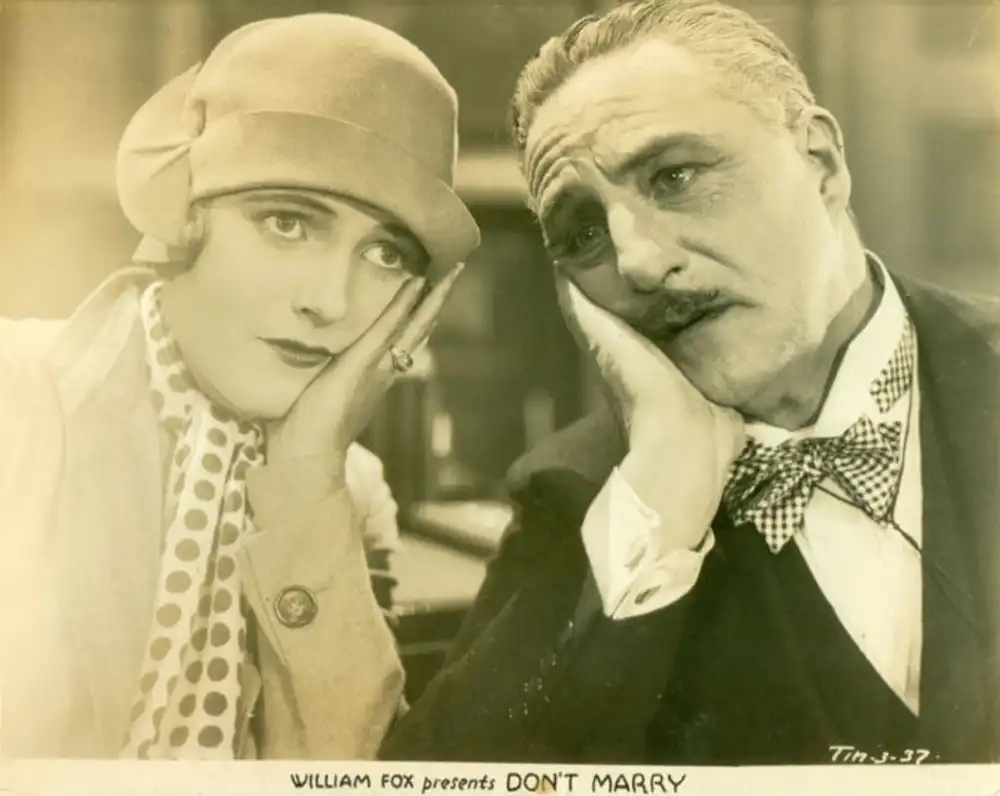
There’s a scene in Henry’s office that drags. They’re talking—or rather, the intertitles are doing the heavy lifting—about legal stuff and 'ideals,' and the camera just sits there. It’s one of those moments where the pacing of a silent film really shows its age. But then Priscilla starts doing this bit with a lace handkerchief, dropping it and making him pick it up over and over, and the movie finds its legs again. It’s the small, annoying behaviors she adopts that make the point better than the dialogue does.
The lighting in the indoor scenes is a bit flat. It’s that very bright, even 1920s studio light that makes everyone look like they’re made of porcelain. It actually helps the 'Victorian' gag because she looks like a doll, but it makes the 'modern' scenes feel a bit less vibrant than they should. I kept noticing the background extras in the street scenes; they look like they were told to walk in a straight line and not look at the camera under any circumstances. It gives the world a slightly hollow feeling.
I don't really buy the chemistry between Moran and Hamilton. She’s so much more alive than he is. When they finally get together, it feels more like she won a bet than like two people falling in love. But maybe that’s the point. The movie is more interested in the satire of 'old-fashioned' values than it is in a sweeping romance.
One weird detail: there’s a shot of a cat near the end that seems to serve no purpose. It just sits there, looks at the camera, and then we cut away. It’s those little unintentional moments that make these old silents feel human. It’s not a masterpiece, but watching Moran weaponize a parasol to make a man realize he’s an idiot is a pretty decent way to spend an hour.
IMDb —
1926
Community
Log in to comment.