DbcultAccessing Vault...
Cult Review
Senior Film Conservator
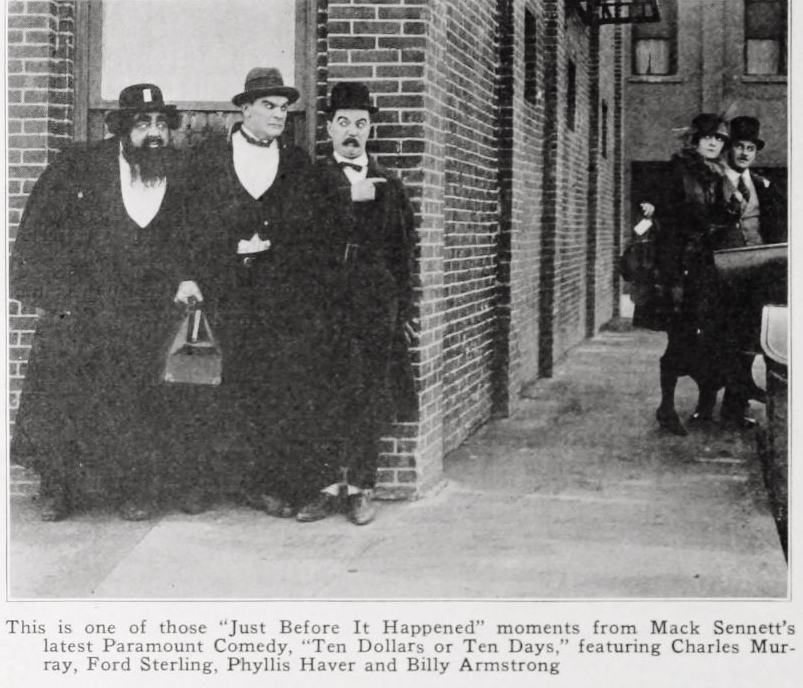
To approach a Mack Sennett production like Ten Dollars or Ten Days is to step into a vortex of cinematic entropy. While the 1920s were elsewhere defined by the burgeoning psychological depth of films like Professor Nissens seltsamer Tod, Sennett remained the unyielding architect of the belly laugh, a purveyor of pure, unadulterated motion. This particular short, though perhaps less cited than the Keystone Cops' seminal runs, represents a refined distillation of the slapstick ethos, where the stakes are as thin as a dime but the consequences are played for operatic intensity.
Ford Sterling, whose face often resembled a topographical map of human anxiety, delivers a performance that defies the stillness of the silent era. Unlike the stoic, almost spectral presence found in Souls Enchained, Sterling’s methodology is one of constant vibration. Every gesture is an exclamation point. In Ten Dollars or Ten Days, his character is caught in the gears of a judicial system that feels less like a pursuit of justice and more like a cruel punchline. The titular choice—pay the fine or serve the time—is the ultimate proletarian nightmare, transformed here into a playground for physical comedy.
The way Sterling interacts with his environment—tripping over the very concept of gravity—mirrors the chaotic energy of The Dippy Dentist, yet there is a desperate humanity beneath his grimaces. He isn't just a clown; he is a man besieged by the inanimate world. Whether he is dodging the hulking Eddie Gribbon or attempting to maintain a shred of dignity in front of Phyllis Haver, Sterling reminds us why he was the king of the lot before the rise of the more subtle comedians.
Phyllis Haver’s role in this short is a fascinating study in the evolution of the Sennett female archetype. Often dismissed as mere decorative elements, the actresses in these shorts were frequently the only ones holding the narrative thread together. In Ten Dollars or Ten Days, Haver displays the burgeoning comedic timing that would eventually lead her to more dramatic heights in films like The She Wolf. She navigates the male-dominated chaos with a poise that highlights the absurdity of Sterling’s flailing.
When we compare the social dynamics here to the high-society posturing of Social Quicksands, we see a stark contrast. Sennett’s world is one of mud, bricks, and cheap suits. Haver’s presence provides a bridge between the grit of the slapstick world and the aspiration of the silent starlet, making her interactions with the bumbling cast members all the more impactful.
The technical execution of the gags in this film is remarkably sophisticated for its time. We see a precursor to the complex mechanical humor that would later be perfected by Keaton. The use of the courtroom as a set-piece allows for a verticality in the humor—judges looming over defendants, the gallery erupting in synchronized shock. This structural rigidity provides the perfect foil for the liquid chaos that Sterling and Gribbon introduce. It’s a thematic resonance we see explored differently in Wanted at Headquarters, where the law is a serious, looming specter; here, the law is merely another prop to be knocked over.
Consider the pacing. Unlike the slow, scenic meditations of Unknown Switzerland, Ten Dollars or Ten Days is edited with a ferocity that feels modern. The cuts are quick, emphasizing the impact of every collision. Kalla Pasha and Leo Sulky serve as the perfect physical obstacles, their bulk creating a gravitational pull that Sterling must constantly fight against. It is a dance of the heavy and the light, the immovable object meeting the manic force.
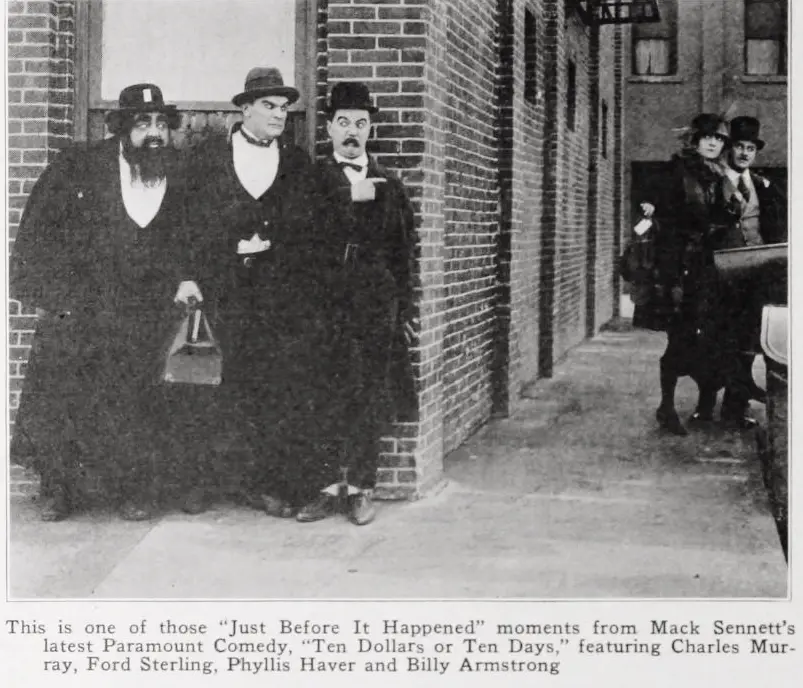
While many films of the era sought to emulate the high tragedy of Romeo and Juliet (1916), Sennett knew that the audience’s truest desires lay in the release of laughter. There is no pretense here. Unlike the mystery-laden atmosphere of The Teeth of the Tiger or the moralistic weight of When Dawn Came, Ten Dollars or Ten Days exists in a perpetual present. Its only goal is the immediate visceral response.
Even when compared to European counterparts like Baron Olson, which brought a different flavor of absurdity to the screen, the American slapstick tradition as seen here is uniquely violent and optimistic. It suggests that no matter how many times you are flattened by the world, you can always pop back up, albeit a bit more disheveled. This resilience is a recurring theme in early American cinema, from the dusty trails of A Daughter of the West to the urban jungles of the Keystone lot.
The central conflict—the inability to pay a small fine—speaks to the precariousness of the working class during the early 20th century. While films like An Honest Man dealt with the internal moral compass, Ten Dollars or Ten Days externalizes that struggle into a series of chases. The 'fine' is a symbol of a system that Sterling’s character simply cannot navigate. In this way, the film is a cousin to The Question (1917), though it answers that question with a pie to the face rather than a philosophical monologue.
The religious undertones seen in Tepeyac are entirely absent here; the only god in the Sennett universe is the God of Chaos. The courtroom is not a place of divine judgment, but a theater of the absurd where the judge is just as likely to be part of the gag as the defendant. This irreverence was revolutionary, paving the way for the subversive comedies of the decades to follow.
In the grand tapestry of silent film, Ten Dollars or Ten Days might seem like a minor thread, but it is one woven with incredible craftsmanship. The collaborative effort of the cast—Charles Murray’s seasoned presence, the bulk of Kalla Pasha, and the frantic lead work of Sterling—creates a symphony of movement. It is a reminder that comedy is a serious business, requiring a precision of timing that rivals any dramatic performance.
As we look back at these shorts, we shouldn't just see them as historical curiosities. They are the DNA of modern entertainment. The DNA of every action sequence, every sitcom misunderstanding, and every physical gag can be traced back to these dusty reels where a man faced with a ten-dollar fine chose instead to give us ten minutes of pure, unbridled joy. It is a legacy of laughter that remains as potent today as it was a century ago, proving that while the currency might change, the value of a good laugh remains constant.
IMDb —
1929
Community
Log in to comment.